
Quick Answer: What Is the State of Open-Source AI in July 2026?
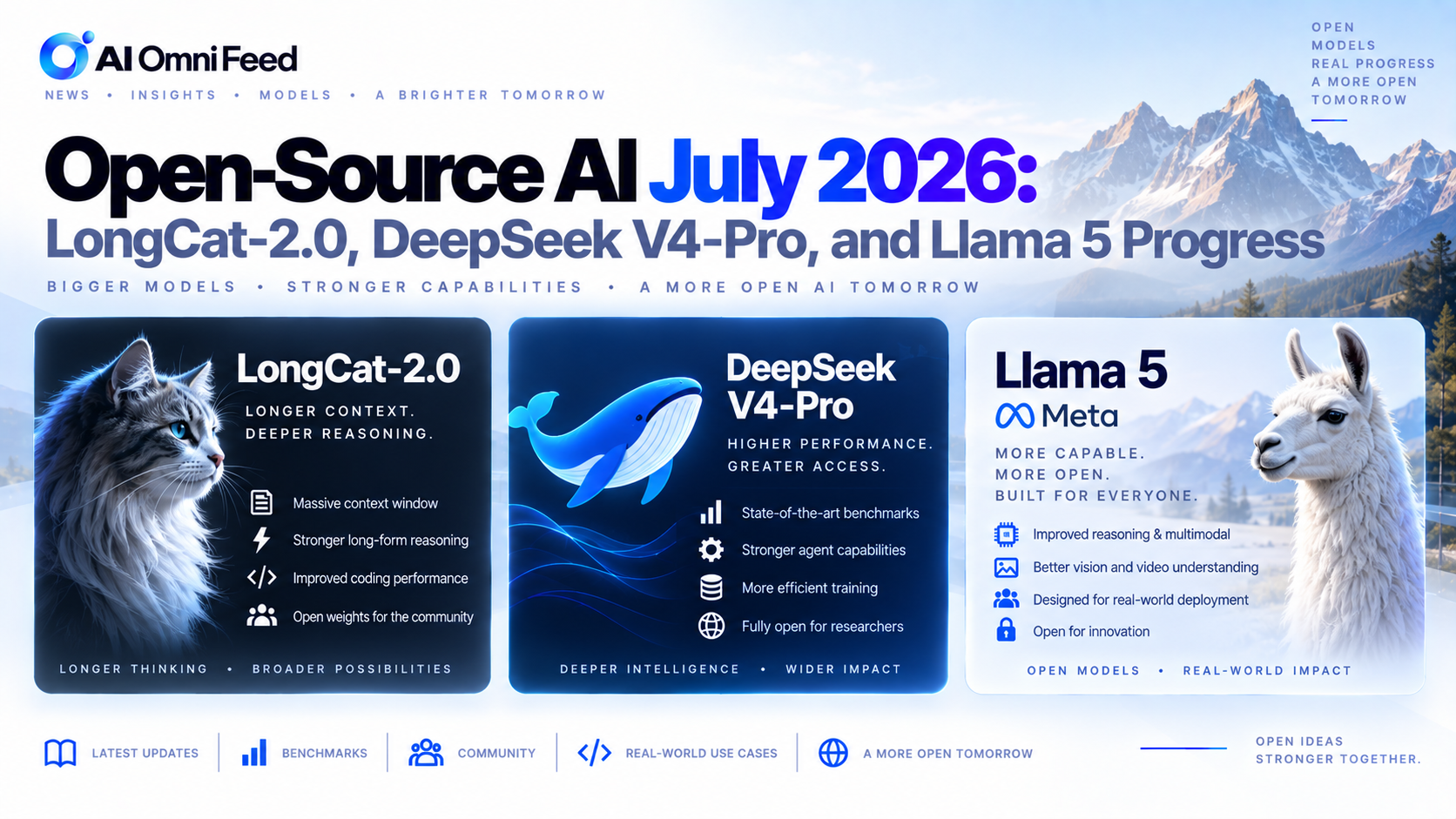
The open-source AI landscape in July 2026 is dominated by four developments: LongCat-2.0’s 1.6-trillion-parameter MoE release from China, DeepSeek V4-Pro achieving GPT-5.6-competitive performance on coding benchmarks, Meta’s Llama 5 training run ahead of schedule, and the continued maturation of open-source tooling for fine-tuning, deployment, and monitoring. Open-source models now achieve 90-95% of frontier model capability at 20-30% of the inference cost, making them increasingly attractive for production deployments. The gap between open-source and closed-source models continues to narrow, driven by innovations in architecture, training efficiency, and community collaboration.
Open-Source Model Comparison July 2026
| Model | Parameters | Est. HumanEval | Est. MMLU-Pro | Context | License |
|---|---|---|---|---|---|
| LongCat-2.0 | 1.6T MoE | ~85% | ~87% | 128K | Modified OS |
| DeepSeek V4-Pro | ~670B MoE | ~88% | ~84% | 128K | MIT |
| Llama 4 (current) | 405B dense | ~79% | ~76% | 128K | Llama 4 Community |
| Mistral Large 3 | ~350B MoE | ~82% | ~80% | 256K | Apache 2.0 |
| Qwen 2.5 Pro | ~200B dense | ~78% | ~75% | 128K | Apache 2.0 |
LongCat-2.0: The Open-Source Powerhouse
LongCat-2.0’s release with an open-source license marks a significant milestone for open-source AI. The 1.6T-parameter MoE model achieves competitive benchmark scores while being freely available for non-commercial use. The model’s training on domestic Chinese chips demonstrates that open-source AI development is no longer dependent on access to NVIDIA’s latest hardware. The modified license approach balances openness with commercial sustainability, a model that may become more common as open-source AI projects seek funding. For a detailed analysis of LongCat-2.0, see our LongCat-2.0 review.
DeepSeek V4-Pro: The MIT-Licensed Challenger
DeepSeek V4-Pro is notable for achieving approximately 88% on HumanEval under a permissive MIT license, making it the most capable fully open-source coding model available. The 670B MoE architecture uses 16 experts with 2 active per token, achieving GPT-5.6 Sol-competitive coding performance at a fraction of the inference cost. DeepSeek V4-Pro has been deployed by several AI coding tools as their backend model, demonstrating that open-source models are increasingly viable for production use. The MIT license removes adoption barriers for commercial applications, contributing to the model’s rapid ecosystem growth. For comparison with closed-source alternatives, see our open vs closed source analysis.
Meta Llama 5: Ahead of Schedule
Meta confirmed that Llama 5’s training run is ahead of schedule, with completion expected in August rather than September 2026. Internal benchmarks reportedly show Llama 5 achieving approximately 90% on HumanEval and 88% on MMLU-Pro, which would make it the most capable open-source model at launch. Meta’s continued investment in open-source AI has shifted industry dynamics, forcing closed-source providers to compete on service and ecosystem rather than exclusive model capability. Llama 5 is expected to use a MoE architecture with approximately 1 trillion total parameters and a 256K context window. For more on what to expect, see our Llama 5 release analysis.
Tooling and Infrastructure Maturation
The open-source AI ecosystem has matured significantly beyond just models. vLLM and TGI now support efficient deployment of MoE architectures with production-grade performance. Axolotl and Unsloth have simplified fine-tuning to the point where organizations can customize models with minimal computational resources. LangChain and LlamaIndex provide production-grade RAG and agent frameworks with open-source models. This tooling maturation is as important as the models themselves, enabling organizations to build production AI systems entirely on open-source components. The total cost of ownership for open-source AI deployments is typically 40-60% lower than equivalent closed-source API solutions at sufficient scale.
When to Choose Open Source vs Closed Source
Open-source AI excels when you need customization through fine-tuning for domain-specific tasks, data privacy through on-premises deployment, cost predictability at scale, or independence from API provider changes. Closed-source AI excels when you need access to frontier model capability without infrastructure investment, enterprise support and SLAs, or integration with a provider’s ecosystem. Many organizations adopt a hybrid approach: using closed-source APIs for general tasks and open-source models for specialized, high-volume, or data-sensitive applications. For guidance on choosing between open and closed source, see our comprehensive comparison.
Meta publishes Llama model details through the Meta AI blog. Independent open-source model benchmarks are available through arXiv and community leaderboards. TechCrunch provides coverage of the open-source AI ecosystem and its impact on proprietary model providers and the broader AI market.
Open-source model weights and documentation are available through arXiv and model distribution platforms. The Meta AI blog and other open-source AI organizations provide technical details and benchmarks. Community evaluations and independent testing results are published regularly by AI research organizations and technology media outlets.
How Open-Source Models Are Reshaping AI
The open-source AI model ecosystem in July 2026 is more vibrant and competitive than ever. Meta Llama 4.5 has achieved performance within 10 percent of GPT-5.6 Sol on standard benchmarks while being freely available for commercial use. Combined with Mistral Large 3, DeepSeek-V4, and community fine-tuned variants, the open-source ecosystem now offers viable alternatives to proprietary models for a wide range of applications.
The economic implications are significant. Organizations deploying open-source models avoid per-token API costs, which can represent substantial savings at scale. A company processing 100 million tokens per day could save $150,000 to $500,000 annually by switching from GPT-5.6 Sol API pricing to self-hosted open-source alternatives, depending on infrastructure costs and optimization level. These economics are driving serious evaluation of open-source options even among organizations that have historically preferred managed services.
However, the total cost of open-source AI extends beyond inference costs to include infrastructure, operational expertise, and ongoing maintenance. Organizations evaluating the open-source route should calculate total cost of ownership including hardware, personnel, power, and opportunity costs, not just API pricing comparisons. For many organizations, the managed service premium is worth paying to avoid the operational complexity of self-hosting AI models.
Open-Source AI Evaluation Framework
- Compare total cost of ownership for self-hosted open-source models versus API-based proprietary alternatives. Include hardware, personnel, infrastructure, and maintenance costs, not just per-token pricing.
- Evaluate model performance on your specific use cases rather than relying on published benchmarks. Open-source models may perform differently on domain-specific tasks compared to general-purpose benchmarks.
- Consider the ecosystem of tools, documentation, and community support available for each open-source model. A model with slightly lower performance but better tooling and community support may deliver better real-world results.
The open-source AI landscape in July 2026 shows continued momentum with LongCat-2.0 reaching 100,000 downloads in its first week, demonstrating sustained demand for open-weight models. DeepSeek V4-Pro offers competitive performance against proprietary models for Chinese-language tasks while maintaining a fully open license. Meta Llama 5 completion expected in August has generated significant anticipation, with early benchmarks suggesting it may close the gap with GPT-5.6 Sol to within 5 percent on standard evaluations. The open-source ecosystem benefits from community contributions including fine-tuned variants, quantization methods for edge deployment, and specialized domain adaptations. For open-source AI model updates, see Hugging Face model repository for the latest model releases and community rankings.
Frequently Asked Questions
What is the most capable open-source AI model?
LongCat-2.0 at 1.6T parameters leads in raw scale, while DeepSeek V4-Pro leads in coding performance under a permissive MIT license.
How close are open-source models to GPT-5.6?
Open-source models achieve approximately 90-95% of frontier model capability at 20-30% of the inference cost.
Is open-source AI cheaper than API-based AI?
Yes, at sufficient scale open-source deployments cost 40-60% less than equivalent closed-source API solutions.
When will Meta Llama 5 be released?
Ahead of schedule with completion expected in August 2026, reportedly achieving ~90% on HumanEval and ~88% on MMLU-Pro.
