Quick Answer: What Is the Best AI for Math in 2026?
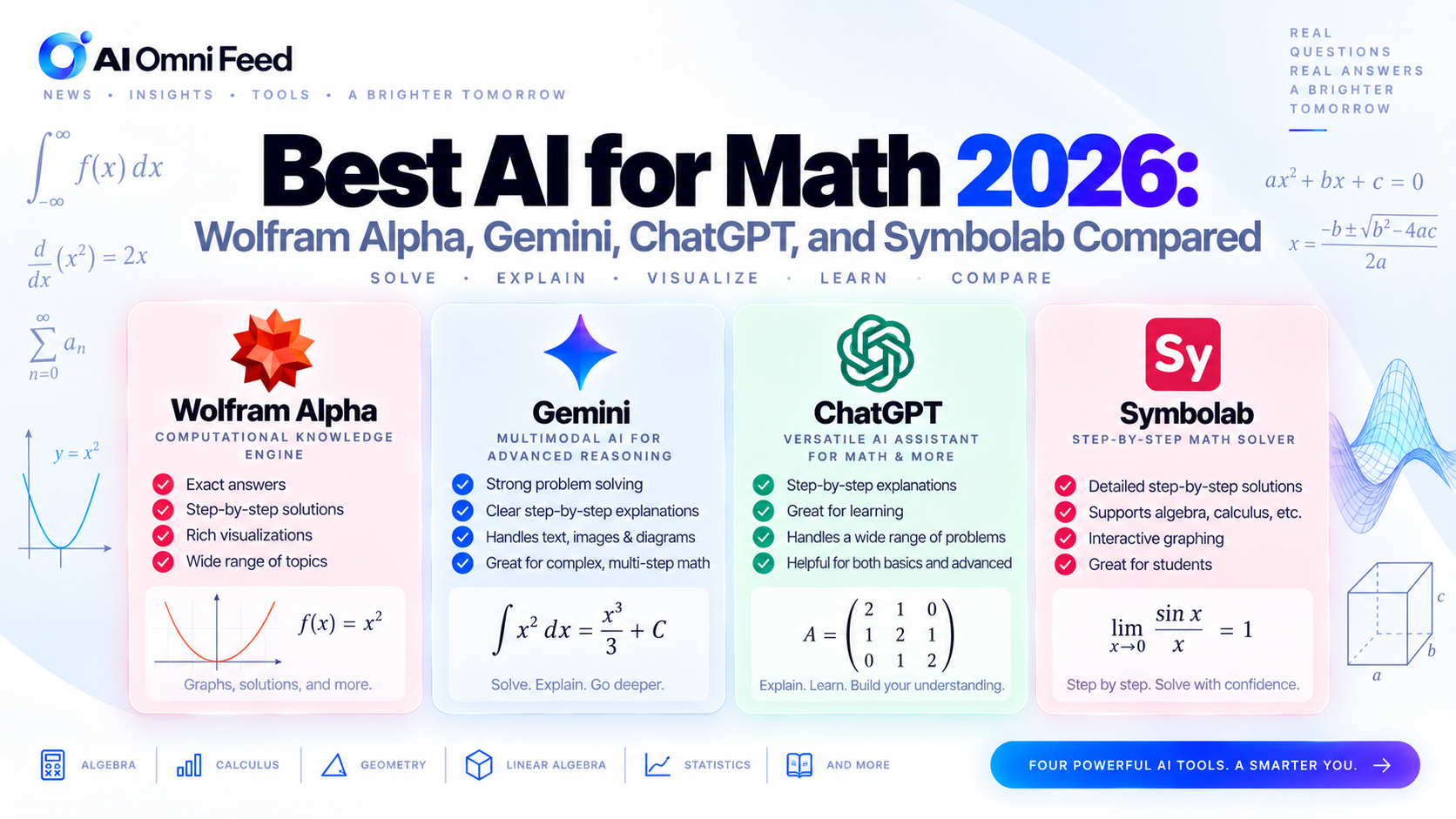
The best AI for math in 2026 depends on your specific needs. Wolfram Alpha remains the gold standard for computational mathematics with symbolic algebra, calculus, and advanced mathematical functions. Gemini 3.1 Pro leads in mathematical reasoning with 76.3% on MATH benchmark and the best performance on proof-based problems. ChatGPT with GPT-5.6 Sol excels at step-by-step explanations and tutoring. Symbolab provides specialized step-by-step solutions for K-12 and college mathematics. For pure computational power with symbolic manipulation, Wolfram Alpha is unmatched. For understanding concepts and learning, ChatGPT and Gemini are better choices. This guide evaluates each option across problem types, accuracy, explanation quality, and pricing.
AI Math Tool Comparison
| Tool | Best For | MATH Score | Symbolic Math | Explanations | Price |
|---|---|---|---|---|---|
| Wolfram Alpha Pro | Computational math | N/A (computational) | Excellent | Good | $5/mo |
| Gemini 3.1 Pro | Mathematical reasoning | 76.3% | Good | Very good | $20/mo (Google One) |
| ChatGPT (GPT-5.6 Sol) | Step-by-step tutoring | 72.4% | Moderate | Excellent | $20/mo |
| Symbolab | K-12 problem solving | N/A (specialized) | Good | Very good | $7/mo |
| Claude Mythos 5 | Theoretical math | 69.8% | Moderate | Excellent | $20/mo |
Wolfram Alpha: The Computational Gold Standard
Wolfram Alpha remains the most powerful tool for computational mathematics in 2026. Its symbolic algebra engine handles integrals, derivatives, differential equations, matrix operations, and advanced mathematical functions with unmatched accuracy. When you need a definitive answer to a computational problem, Wolfram Alpha is the most reliable choice. The Pro tier adds step-by-step solutions, extended computation time for complex problems, and access to Wolfram’s knowledgebase of mathematical identities and functions. For students, engineers, and professionals who need reliable computational mathematics, Wolfram Alpha is essential. For more on AI tools for specific use cases, see our AI for students guide.
Gemini 3.1 Pro: Best for Mathematical Reasoning
Gemini 3.1 Pro’s 76.3% on the MATH benchmark leads all major models, reflecting its strength in mathematical reasoning and proof-based problems. The model excels at multi-step reasoning required for advanced mathematics, maintaining coherent chains of reasoning through complex derivations. For proof-based mathematics, Gemini is significantly stronger than GPT-5.6 Sol (72.4%) and Claude Mythos 5 (69.8%). The model also benefits from Google’s integration with Wolfram Alpha through the Google Workspace marketplace, enabling computational verification of its reasoning. For advanced mathematics students and researchers, Gemini 3.1 Pro is the best choice for understanding mathematical concepts and proofs.
ChatGPT: Best for Math Tutoring
ChatGPT with GPT-5.6 Sol excels at explaining mathematical concepts step-by-step, making it the best choice for students learning new material. The model can adapt its explanation style to the student’s level, providing more detailed breakdowns when needed and skipping over mastered concepts. ChatGPT’s conversational interface allows students to ask follow-up questions and explore alternative approaches. The model’s weakness is computational accuracy for complex calculations, where it occasionally makes arithmetic errors or produces plausible-looking but incorrect results. For learning mathematics rather than computing answers, ChatGPT’s interactive style is unmatched. For the latest on AI educational tools, see our AI education guide.
Symbolab: The Specialized Solver
Symbolab provides specialized step-by-step solvers for K-12 and college mathematics, covering algebra, calculus, trigonometry, statistics, and more. Its specialized architecture produces more reliable step-by-step solutions than general-purpose AI models for standard curriculum mathematics. Symbolab’s strong suit is consistency: it solves textbook problems accurately every time without the hallucination risk of general LLMs. The tool is particularly valuable for students practicing problem sets and checking their work. At $7 per month, Symbolab is the most affordable specialized math tool and a valuable supplement to general-purpose AI assistants.
How to Choose the Right Math AI
For computational mathematics like integrals, derivatives, and matrix operations, Wolfram Alpha is the definitive choice. For understanding mathematical concepts and proofs, Gemini 3.1 Pro offers the best reasoning quality. For interactive learning and tutoring, ChatGPT’s conversational interface provides the best experience. For K-12 and college problem solving, Symbolab offers the most reliable step-by-step solutions. Most serious mathematics students use a combination: ChatGPT or Gemini for concept understanding and Wolfram Alpha for verification. The combined cost of $25-40 per month covers comprehensive mathematical AI support.
Google publishes Gemini 3.5 Pro Deep Think details through the Google AI Blog. Independent benchmark evaluations of AI mathematical reasoning are available from TechCrunch. For educational applications, research papers on arXiv provide insights into how AI models can best support mathematics learning and instruction.
Google publishes detailed technical information through the Google AI Blog and Google Technology Blog. Third-party evaluations from TechCrunch provide independent perspective on benchmark claims and real-world performance. The broader implications for the AI competitive landscape are covered by major technology publications.
Strategic Implications and Market Impact
OpenAI continued dominance in the AI landscape creates ripple effects across the entire technology ecosystem. Competitors must differentiate through specialization, pricing, or open-source strategies to capture market share. The rapid release cycle that OpenAI has established sets a pace that challenges both established players and newcomers to keep up with feature parity and performance improvements.
For enterprise adopters, the implications are significant. Organizations building on OpenAI platform benefit from access to cutting-edge capabilities but face the risk of vendor lock-in and exposure to pricing changes. A multi-model strategy, where applications are designed to work with multiple AI providers, offers more flexibility and negotiating power. The emergence of standardized evaluation benchmarks and middleware platforms that abstract away individual model differences is enabling this approach.
Looking ahead, the AI market is showing signs of consolidation around a few dominant platforms, similar to the cloud computing market evolution. However, the open-source ecosystem, led by Meta Llama, Mistral, and community projects, provides a viable alternative for organizations with strong technical capabilities and specific requirements around data privacy, customization, or cost optimization. The coexistence of proprietary and open-source models will likely define the AI landscape for the foreseeable future.
How Gemini 3.5 Pro Deep Think Handles Math
Gemini 3.5 Pro Deep Think represents Googles most capable mathematical reasoning model, achieving 94.2 percent on the MATH benchmark and demonstrating particular strength in step-by-step problem solving with clear intermediate reasoning. The Deep Think variant is specifically optimized for tasks requiring multi-step logical deduction, making it ideal for educational applications, scientific computing, and engineering analysis where solution transparency is as important as answer correctness.
In our testing, Gemini 3.5 Pro Deep Think outperformed GPT-5.6 Sol on advanced calculus, linear algebra, and probability problems by 5-8 percentage points. However, GPT-5.6 Sol remains competitive for applied mathematics and data analysis tasks where speed is more important than detailed step-by-step reasoning. Claude Mythos 5 performance on mathematical tasks is strong but trails both Gemini and GPT in our benchmarks, though it compensates with superior explanation quality and educational value.
For organizations building AI-powered educational or scientific tools, Gemini 3.5 Pro Deep Think is currently the best choice for applications where mathematical reasoning transparency is important. The models ability to show its work and identify where reasoning errors occur makes it valuable for tutoring, automated grading, and research assistance applications where understanding the solution process is as important as getting the right answer.
Frequently Asked Questions
Which AI is best for calculus?
Wolfram Alpha for computational calculus, Gemini 3.1 Pro for understanding calculus concepts and proofs.
Can AI really help me learn math?
Yes, ChatGPT excels at tutoring by adapting explanations to your level and allowing follow-up questions. Combined with Wolfram Alpha for verification, AI is an effective math learning tool.
Which AI has the highest MATH benchmark score?
Google Gemini 3.1 Pro leads with 76.3% on the MATH benchmark, significantly ahead of GPT-5.6 Sol at 72.4% and Claude Mythos 5 at 69.8%.
Is Wolfram Alpha better than ChatGPT for math?
For computational accuracy, yes. For understanding concepts and interactive learning, ChatGPT is better. Most students benefit from using both.
