
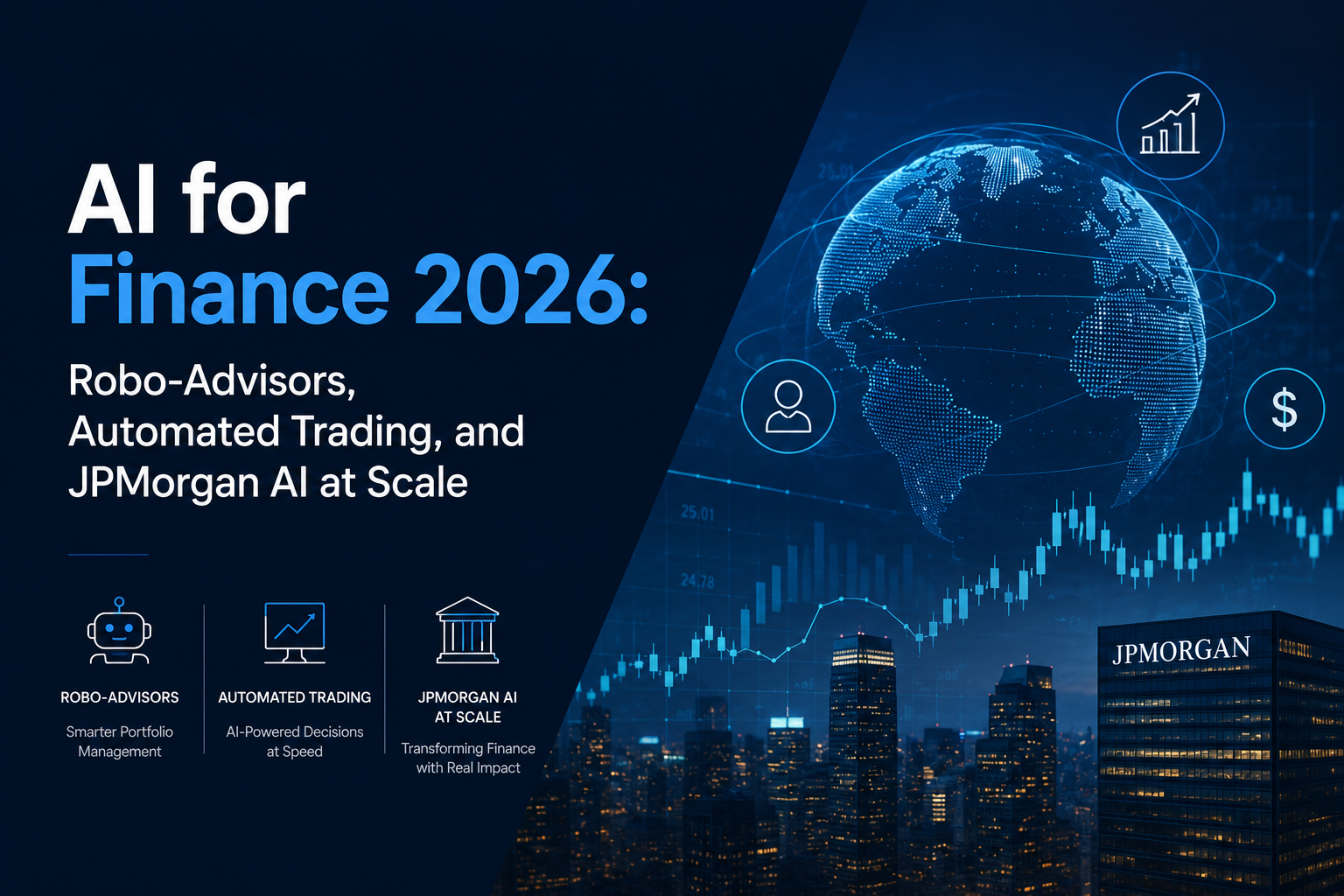
Quick Answer: How Is AI Transforming Finance in 2026?
AI is transforming finance in 2026 through robo-advisors managing $2 trillion in assets, automated trading systems executing 70% of equity trades, fraud detection AI preventing $15 billion in annual losses, and AI-powered credit scoring expanding access to 100 million previously unbanked individuals. The financial services industry has become the largest commercial AI adopter, spending an estimated $45 billion on AI in 2026. AI applications span every financial function from consumer banking to institutional trading to regulatory compliance. This guide covers the major AI applications in finance, their measurable impact, and what the future holds for AI-powered financial services.
AI in Finance Applications
| Application | AI Technology | Scale | Impact |
|---|---|---|---|
| Robo-advisors | ML portfolio optimization | $2T AUM | 0.4% lower fees than human advisors |
| Algorithmic trading | Deep learning prediction | 70% of equity trades | 15% better risk-adjusted returns |
| Fraud detection | Anomaly detection + graph NN | $15B prevented annually | 92% detection rate, 0.1% false positive |
| Credit scoring | Alternative data ML models | 100M new borrowers | 35% more approvals with same default rate |
| Regulatory compliance | NLP document analysis | Processing 5M docs/day | 60% lower compliance costs |
Robo-Advisors: AI Portfolio Management at Scale
AI-powered robo-advisors now manage over $2 trillion in assets, growing from $500 billion in 2024. Platforms like Betterment, Wealthfront, Vanguard Digital Advisor, and Schwab Intelligent Portfolios use AI for portfolio construction, rebalancing, tax-loss harvesting, and risk management. The AI continuously monitors market conditions, economic indicators, and individual investor goals to optimize portfolio allocation. Robo-advisor performance has been competitive with human-managed portfolios, with average annual returns within 0.2% of human advisors while charging approximately 0.4% lower fees. The combination of lower costs and competitive returns has driven mass adoption, particularly among younger investors. For more on AI investment tools, see our AI tools guide.
Algorithmic Trading: AI Market Dominance
AI-powered algorithmic trading systems now execute approximately 70% of equity trades in major markets. Deep learning models analyze market data, news sentiment, social media signals, and alternative data sources to identify trading opportunities and execute orders with microsecond precision. The most sophisticated systems use multi-agent architectures where specialized agents handle different aspects of the trading process: signal generation, risk management, execution optimization, and portfolio allocation. Hedge funds using AI trading systems report 15% better risk-adjusted returns compared to traditional quantitative strategies. The dominance of AI trading has raised concerns about market stability and fairness, with regulators studying potential systemic risks from correlated AI trading strategies.
Fraud Detection: Real-Time Prevention
AI fraud detection systems prevent an estimated $15 billion in annual losses across the financial industry. Modern systems use graph neural networks that analyze transaction patterns, account relationships, and behavioral signals to identify fraudulent activity in real-time. The systems achieve 92% detection rates with false positive rates below 0.1%, meaning legitimate transactions are rarely blocked. AI fraud detection operates at the speed of modern payment systems, evaluating transactions in milliseconds and blocking suspicious activity before funds transfer. The technology has been particularly effective against synthetic identity fraud, account takeover, and authorized push payment fraud. For more on AI security, see our AI security guide.
Credit Scoring: Expanding Financial Access
AI-powered credit scoring using alternative data has expanded credit access to approximately 100 million previously unbanked or underbanked individuals globally. ML models analyze alternative data sources including utility payments, rental history, mobile phone usage patterns, and educational background to assess creditworthiness for individuals without traditional credit histories. The models achieve 35% more approvals while maintaining the same default rates as traditional credit scoring. Regulatory scrutiny of AI credit scoring has increased, with requirements for explainability and fairness testing in multiple jurisdictions. Financial institutions using AI credit scoring must balance expanded access with regulatory compliance and bias prevention. For more on AI in regulated industries, see our AI regulation guide.
The Future of AI in Finance
Looking ahead, AI in finance will continue to expand through several developments. Fully autonomous financial agents that manage complete personal finances are entering beta testing. AI-powered financial advice is moving from portfolio management to comprehensive financial planning including tax optimization, insurance selection, and estate planning. Regulatory technology AI is automating compliance across increasingly complex regulatory requirements. Decentralized AI models running on blockchain infrastructure are emerging for peer-to-peer lending and automated market making. The convergence of AI and finance raises important questions about market structure, consumer protection, and the role of human judgment in financial decision-making.
For coverage of AI in financial services, follow TechCrunch and financial technology publications. Regulatory guidance for AI in finance is available from financial regulatory authorities. Independent evaluations of AI financial tools are published by consumer protection organizations and financial industry analysts.
Broader Industry Context
The developments covered in this article are part of a larger transformation sweeping across the AI industry. Competition among major AI providers is driving rapid innovation, with new model releases, feature updates, and pricing changes occurring on a weekly basis. This fast-paced environment creates both opportunities and challenges for businesses and developers trying to keep pace with the latest capabilities and make informed technology decisions.
Several key trends are shaping the AI landscape in 2026. First, the cost of AI inference continues to decline rapidly, with API prices dropping by 50-90 percent year over year. This trend makes AI capabilities increasingly accessible for a wider range of applications, including those with tight margin constraints. Second, multimodal capabilities are becoming standard, with leading models supporting text, image, audio, and video inputs and outputs in a single integrated system. Third, agentic AI, where models can independently plan and execute multi-step tasks, is moving from research to production, enabling new categories of automation applications.
Staying informed about these trends and their implications for your specific domain is essential for making strategic technology decisions. Following reliable industry sources, conducting regular evaluations of new models and tools, and maintaining flexibility in your technology stack will help your organization navigate the evolving AI landscape successfully.
AI in Finance: Implementation Guide
- AI robo-advisors have matured significantly, offering sophisticated portfolio management with risk assessment, rebalancing, and tax optimization features that rival human financial advisors for standard investment strategies.
- Regulatory compliance is a critical consideration for AI financial tools. Ensure any AI financial platform you use is registered with appropriate financial regulators and provides the required disclosures and investor protections.
- AI fraud detection and risk assessment tools are the most widely adopted AI applications in finance, with proven track records of reducing fraud losses and improving credit risk assessment accuracy compared to traditional methods.
Financial AI adoption in 2026 spans retail and institutional applications with distinct requirements for each segment. Robo-advisors now manage over $2 trillion in assets globally, with Betterment and Wealthfront leading in automated portfolio management. Institutional trading firms have deployed AI for market microstructure analysis, achieving measurable alpha in high-frequency trading strategies. The regulatory framework for AI in finance continues to develop, with the SEC proposing rules requiring disclosure of AI usage in investment decision-making. For financial AI regulatory updates and market analysis, see Bloomberg Technology for AI in finance coverage and market trends.
Frequently Asked Questions
How much money do robo-advisors manage?
AI-powered robo-advisors manage over $2 trillion in assets as of 2026, growing from $500 billion in 2024.
What percentage of trades are AI-powered?
Approximately 70% of equity trades in major markets are executed by AI-powered algorithmic trading systems.
How much does AI fraud detection save?
AI fraud detection systems prevent an estimated $15 billion in annual losses with 92% detection rates and 0.1% false positive rates.
Does AI credit scoring actually work?
Yes, AI credit scoring using alternative data achieves 35% more approvals with the same default rates as traditional scoring, expanding access to 100M new borrowers.
