
Quick Answer: What Is the State of the AI Hardware Race in July 2026?
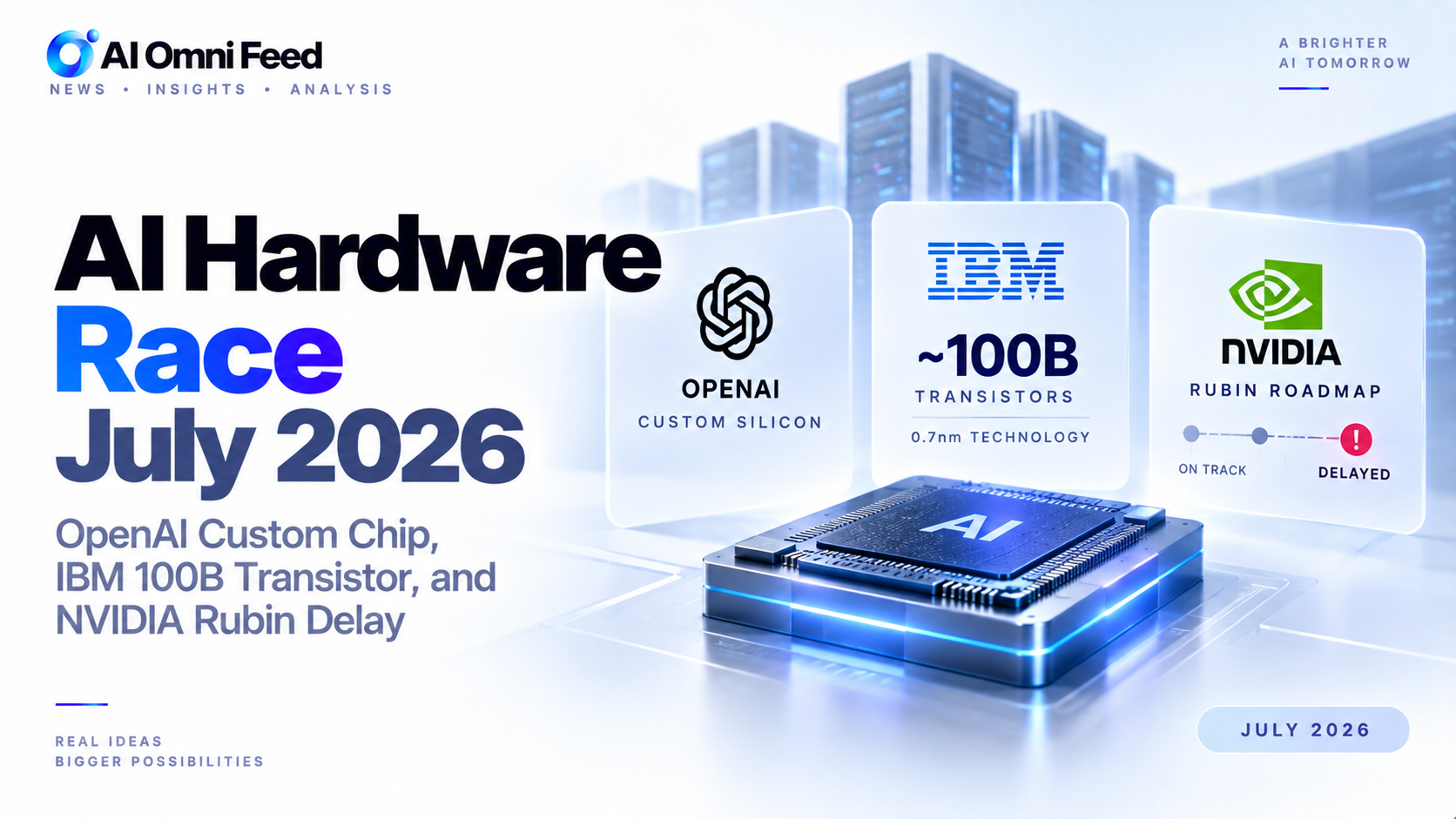
The AI hardware race in July 2026 is defined by three major developments: OpenAI’s custom AI chip (code-named Project Mercury) is tape-out ready with production expected in Q1 2027, IBM announced a 100-billion-transistor AI accelerator built on 2nm process technology, and NVIDIA’s next-generation Rubin architecture delayed to 2027 due to design complexity. These developments signal a fundamental shift from GPU-dominated AI computing toward a more diverse hardware landscape with custom accelerators, wafer-scale processors, and neuromorphic chips competing for AI workloads. The $200 billion AI infrastructure investment cycle continues, but allocation is shifting from general-purpose GPUs toward specialized AI hardware.
OpenAI Project Mercury: Custom Silicon Strategy
| Aspect | Details |
|---|---|
| Codename | Project Mercury |
| Process node | 3nm (TSMC N3P) |
| Status | Tape-out ready, production Q1 2027 |
| Target workload | Inference optimization for transformer models |
| Estimated performance | 2-3x better perf/watt than H100 |
| Investment | $500M+ in design and tape-out |
OpenAI’s custom chip strategy represents a major bet on vertical integration. By designing hardware specifically optimized for transformer inference, OpenAI aims to reduce its dependence on NVIDIA GPUs and capture the margin currently flowing to hardware vendors. The Mercury chip incorporates several novel features including on-chip sparse attention acceleration, variable precision arithmetic optimized for inference, and a custom memory hierarchy designed for transformer model weights. If successful, the chip could reduce OpenAI’s inference costs by 50-60%, potentially enabling lower API prices or higher margins. For analysis of how chip costs affect AI economics, see our AI economics report.
IBM 100B Transistor AI Accelerator
IBM’s announcement of a 100-billion-transistor AI accelerator on 2nm technology represents the most ambitious enterprise AI chip project outside of NVIDIA. The chip uses a novel dataflow architecture that minimizes data movement between memory and compute, the primary bottleneck in AI inference. IBM claims the accelerator achieves 4x better performance per watt than current NVIDIA H100 GPUs for large language model inference. The chip targets enterprise data center deployments with a focus on reliability, security, and IBM’s traditional enterprise customer base. Production is expected in H2 2027, with early access for IBM Cloud customers in Q1 2027.
NVIDIA Rubin Delayed to 2027
NVIDIA confirmed delays in its next-generation Rubin architecture, pushing initial shipments from late 2026 to mid-2027. The delay stems from design complexity in integrating HBM4 memory, a new chiplet interconnect fabric, and power delivery challenges at the 2nm node. The delay creates opportunity for competitors like AMD, Intel, and Cerebras to gain ground in the AI accelerator market. NVIDIA’s current-generation Blackwell Ultra continues to ship in volume, but performance improvements are incremental compared to the generational leap Rubin was expected to provide. The delay also benefits custom chip projects like OpenAI Mercury by giving them more time to reach market before NVIDIA’s next major advance. For more on the chip landscape, see our comprehensive AI chips analysis.
Cerebras and Wafer-Scale Momentum
Cerebras continues to gain momentum with its wafer-scale architecture, recently announcing its partnership with OpenAI to deliver GPT-5.6 Sol inference at 750 tokens per second. The company’s CS-4 system, announced for late 2026, promises another 2x improvement in throughput through architectural refinements and process node advancement. Cerebras’s approach of eliminating GPU interconnect overhead by fitting entire models on single wafer-scale processors is gaining recognition as a viable alternative to GPU clusters for inference workloads. The company is also developing a training-specific variant that could challenge NVIDIA in the training market, though production timelines remain uncertain.
Implications for AI Infrastructure Investment
The $200 billion AI infrastructure investment cycle is shifting in composition. The percentage allocated to custom silicon is growing from 5% in 2025 to an estimated 20% in 2027 as major AI companies pursue vertical integration. GPU spending remains dominant but is growing more slowly than overall AI infrastructure investment. The shift has implications for cloud pricing, model availability, and competitive dynamics across the AI industry. Organizations planning AI infrastructure investments should factor in the increasing diversity of hardware options and avoid locking into single-vendor architectures. For analysis of training costs and infrastructure decisions, see our AI budget management guide.
NVIDIA announces product updates through the NVIDIA blog. Semiconductor industry analysis from TechCrunch and Reuters provides coverage of manufacturing developments, supply chain dynamics, and competitive positioning among chip manufacturers in the AI hardware market.
NVIDIA publishes technical specifications and product updates through the NVIDIA blog. Semiconductor industry analysis from Reuters and TechCrunch provide ongoing coverage of manufacturing developments, supply chain dynamics, and competitive positioning among chip manufacturers.
Strategic Implications and Market Impact
OpenAI continued dominance in the AI landscape creates ripple effects across the entire technology ecosystem. Competitors must differentiate through specialization, pricing, or open-source strategies to capture market share. The rapid release cycle that OpenAI has established sets a pace that challenges both established players and newcomers to keep up with feature parity and performance improvements.
For enterprise adopters, the implications are significant. Organizations building on OpenAI platform benefit from access to cutting-edge capabilities but face the risk of vendor lock-in and exposure to pricing changes. A multi-model strategy, where applications are designed to work with multiple AI providers, offers more flexibility and negotiating power. The emergence of standardized evaluation benchmarks and middleware platforms that abstract away individual model differences is enabling this approach.
Looking ahead, the AI market is showing signs of consolidation around a few dominant platforms, similar to the cloud computing market evolution. However, the open-source ecosystem, led by Meta Llama, Mistral, and community projects, provides a viable alternative for organizations with strong technical capabilities and specific requirements around data privacy, customization, or cost optimization. The coexistence of proprietary and open-source models will likely define the AI landscape for the foreseeable future.
How the AI Hardware Race Is Reshaping the Industry
The AI hardware race in 2026 is characterized by unprecedented investment, intensifying competition, and significant geopolitical implications. NVIDIA continues to dominate the AI accelerator market with data center GPU revenue exceeding $80 billion, but competitors are making meaningful progress. AMD MI400 series has achieved competitive training performance for specific model architectures, and Intel Gaudi 3 is gaining traction in inference workloads where its price-performance ratio is compelling.
The emergence of custom silicon from cloud providers represents the most significant long-term threat to NVIDIA dominance. Google TPU v6, AWS Trainium 3, and Microsoft Maia 2 are now in production deployment for their respective cloud platforms, reducing dependence on external GPU suppliers and enabling tighter integration between hardware and software stacks. These custom chips are optimized for the specific workload patterns of their cloud platforms, delivering efficiency advantages that general-purpose GPUs cannot match.
Geopolitical factors continue to shape the hardware market significantly. US export controls on advanced semiconductors to China have accelerated Chinese domestic chip development, with companies like Huawei and Bitmain producing competitive AI accelerators for the Chinese market. The CHIPS Act funding in the US is supporting domestic fabrication facility construction, but these investments will take years to impact supply. Organizations planning AI infrastructure should maintain flexibility to adapt to a rapidly evolving hardware landscape.
Frequently Asked Questions
Is OpenAI building its own AI chip?
Yes, Project Mercury is OpenAI’s custom inference chip, tape-out ready with production expected in Q1 2027, promising 2-3x better performance per watt than H100.
Why is NVIDIA Rubin delayed?
Design complexity at 2nm node, HBM4 memory integration, and power delivery challenges pushed Rubin’s launch from late 2026 to mid-2027.
What is IBM’s AI chip strategy?
IBM announced a 100-billion-transistor AI accelerator on 2nm technology with a dataflow architecture achieving 4x better perf/watt than H100 for LLM inference.
How will custom chips affect AI pricing?
Custom chips like OpenAI Mercury could reduce inference costs by 50-60%, potentially enabling lower API prices for consumers.
