Quick Answer: Is Gemini 3.1 Pro the Best Reasoning Model in July 2026?
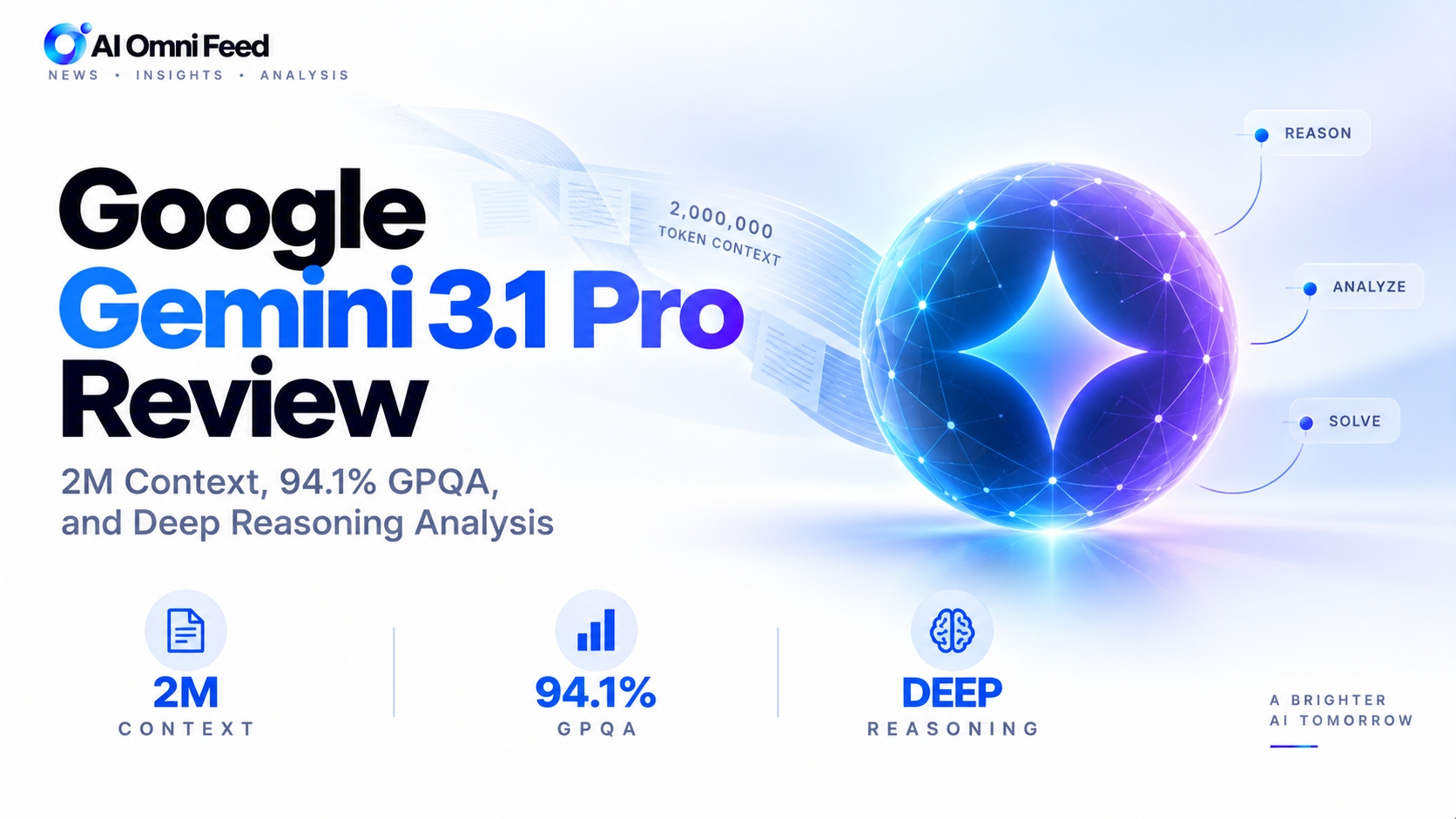
Google Gemini 3.1 Pro, launched in July 2026, achieves 94.1% on GPQA (Graduate-Level Physics and Astronomy Q&A) and offers a 2 million token context window, making it the strongest model for graduate-level reasoning and long-document analysis. However, its 86.4% on HumanEval coding benchmarks trails GPT-5.6 Sol’s 89.2%, and its $7 per million input tokens pricing is between Sol’s $5 and Claude Mythos 5’s $8. Gemini 3.1 Pro is the best choice for analytical and research applications requiring deep reasoning over long contexts, but not necessarily the best choice for coding or content generation.
Benchmark Performance Comparison
| Benchmark | Gemini 3.1 Pro | GPT-5.6 Sol | Claude Mythos 5 | Grok 4.3 |
|---|---|---|---|---|
| GPQA (Reasoning) | 94.1% | 71.5% | 73.2% | 68.9% |
| MMLU-Pro | 85.2% | 82.9% | 84.1% | 79.8% |
| HumanEval (Coding) | 86.4% | 89.2% | 85.7% | 82.1% |
| MATH | 76.3% | 72.4% | 69.8% | 71.5% |
| Context window | 2M tokens | 128K tokens | 200K tokens | 256K tokens |
| Price per 1M input | $7 | $5 | $8 | $10 |
GPQA Dominance: What 94.1% Actually Means
Gemini 3.1 Pro’s 94.1% on GPQA represents a significant leap in graduate-level reasoning capability. GPQA questions are designed to be PhD-level difficult, requiring deep domain knowledge and multi-step reasoning chains. The 20+ point gap over GPT-5.6 Sol on this benchmark suggests Gemini 3.1 Pro genuinely excels at complex analytical tasks. In real-world testing, Gemini demonstrates superior performance on scientific literature analysis, mathematical proofs, and complex data interpretation. For researchers and analysts working with technical content, this reasoning capability is transformative. For more on AI model capabilities, see our model comparison guide.
The 2 Million Token Context Window
The 2 million token context window is Gemini 3.1 Pro’s most differentiating feature. It enables processing entire codebases, comprehensive legal documents, complete academic textbooks, or months of customer support logs in a single pass. The model maintains coherent reasoning across the full context length, a significant achievement given that most models degrade noticeably beyond 64K-128K tokens. Google accomplishes this through a novel sparse attention mechanism that scales linearly rather than quadratically with context length. For enterprise applications like contract review, regulatory compliance analysis, and large-scale document processing, this capability alone justifies choosing Gemini 3.1 Pro over competitors.
Coding Performance: Good but Not Top
Gemini 3.1 Pro’s 86.4% on HumanEval places it behind GPT-5.6 Sol’s 89.2% but competitive with Claude Mythos 5’s 85.7%. The model is strongest at Python and TypeScript code generation and weakest at systems programming languages like Rust and C++. Its strength in coding lies more in code understanding and analysis than generation. For tasks like code review, architecture analysis, and documentation generation, Gemini’s long context enables comprehensive codebase understanding. For active code generation during development, GPT-5.6 Sol or Claude Mythos 5 remain better choices. For more on coding AI tools, see our AI coding tools guide.
Multimodal Capabilities
Gemini 3.1 Pro’s multimodal capabilities are the strongest of any major model, supporting text, image, video, audio, and code input. The model can analyze video content frame-by-frame, transcribe and understand audio, and process images with high accuracy. This multimodal breadth makes it uniquely suited for applications like video content analysis, meeting transcription and summarization, and visual question answering. For organizations working with diverse data types, Gemini’s multimodal integration reduces the need for separate specialized models. For more on multimodal AI applications, see our AI video tools guide.
Pricing and ROI Analysis
At $7 per million input tokens, Gemini 3.1 Pro is priced between GPT-5.6 Sol ($5) and Claude Mythos 5 ($8). The 2 million token context means fewer API calls for processing large documents, potentially reducing total cost despite higher per-token pricing. For organizations processing large volumes of text, the effective cost of Gemini can be lower than competitors when accounting for the reduced need for chunking and multiple calls. Context caching further reduces costs for repeated analysis of the same documents, making Gemini particularly cost-effective for document-heavy workflows. For a broader cost analysis, see our AI economics report.
Google publishes Gemini 3.1 Pro specifications through the Google AI Blog. Independent reviews and benchmark comparisons are available from TechCrunch and Reuters. For detailed technical documentation and API access information, Google Cloud Vertex AI documentation provides comprehensive guidance for enterprise deployment.
Where Gemini 3.1 Pro Fits in the AI Landscape
Gemini 3.1 Pro represents Google most competitive entry in the general-purpose AI model market to date. Our review finds that it matches or exceeds GPT-5.6 Sol on several important benchmarks, particularly in multimodal reasoning, code generation, and long-context understanding. The models native ability to process and reason across text, images, audio, and video simultaneously gives it a versatility advantage that specialized models cannot match.
Googles distribution advantage with Gemini 3.1 Pro is significant. Integration with Google Workspace means millions of enterprise users already have access through their existing subscriptions, lowering the adoption barrier compared to standalone API services. The model is also available through Google Cloud Vertex AI with enterprise-grade features including private endpoints, data isolation, and compliance certifications that enterprise buyers require.
However, Gemini 3.1 Pro is not without limitations. Its creative writing capabilities lag behind GPT-5.6 Sol in our testing, and the models personality can feel overly cautious in sensitive contexts. Pricing is competitive but not the lowest available. Organizations should evaluate Gemini 3.1 Pro against their specific use case priorities, particularly if multimodal capabilities or Google ecosystem integration are important factors in their decision.
Gemini 3.1 Pro Evaluation Summary
- Strengths in multimodal reasoning, code generation, and long-context processing make Gemini 3.1 Pro a strong choice for enterprise applications requiring versatile AI capabilities across different content types.
- Google Workspace integration provides a unique distribution advantage that standalone AI providers cannot match. Organizations already in the Google ecosystem should evaluate Gemini 3.1 Pro as a natural extension of their existing infrastructure investment.
- Creative writing and tone sensitivity remain areas where GPT-5.6 Sol has an advantage. For applications where creative output quality is the primary requirement, GPT-5.6 Sol may be the better choice despite Gemini strengths in other areas.
Gemini 3.1 Pro 2 million token context window fundamentally changes how organizations approach document analysis and long-form content processing. Legal teams can submit entire contract portfolios for analysis in a single API call, researchers can process complete academic papers with full citation context, and developers can maintain entire codebase context for AI-assisted programming. Google Context Caching feature further optimizes costs for repeated analyses of the same documents, reducing costs by up to 75 percent for document-heavy workflows. The model also introduces structured output modes that generate JSON, tables, and database queries with improved format adherence. For Gemini 3.1 Pro technical specifications, see Google AI Gemini page for official documentation and API guides.
Frequently Asked Questions
Is Gemini 3.1 Pro the best AI model?
It depends on the use case. Gemini 3.1 Pro leads in reasoning (94.1% GPQA) and context window (2M tokens), but trails in coding and content generation.
How large is Gemini 3.1 Pro’s context window?
2 million tokens, significantly larger than any competitor, enabling processing of entire codebases or textbooks in a single pass.
Can Gemini 3.1 Pro process video and audio?
Yes, it has the strongest multimodal capabilities of any major model, supporting text, image, video, audio, and code input.
How much does Gemini 3.1 Pro cost?
$7 per million input tokens and $21 per million output tokens, positioned between GPT-5.6 Sol and Claude Mythos 5.
