
Quick Answer: What Is LongCat-2.0 and Why Does It Matter?
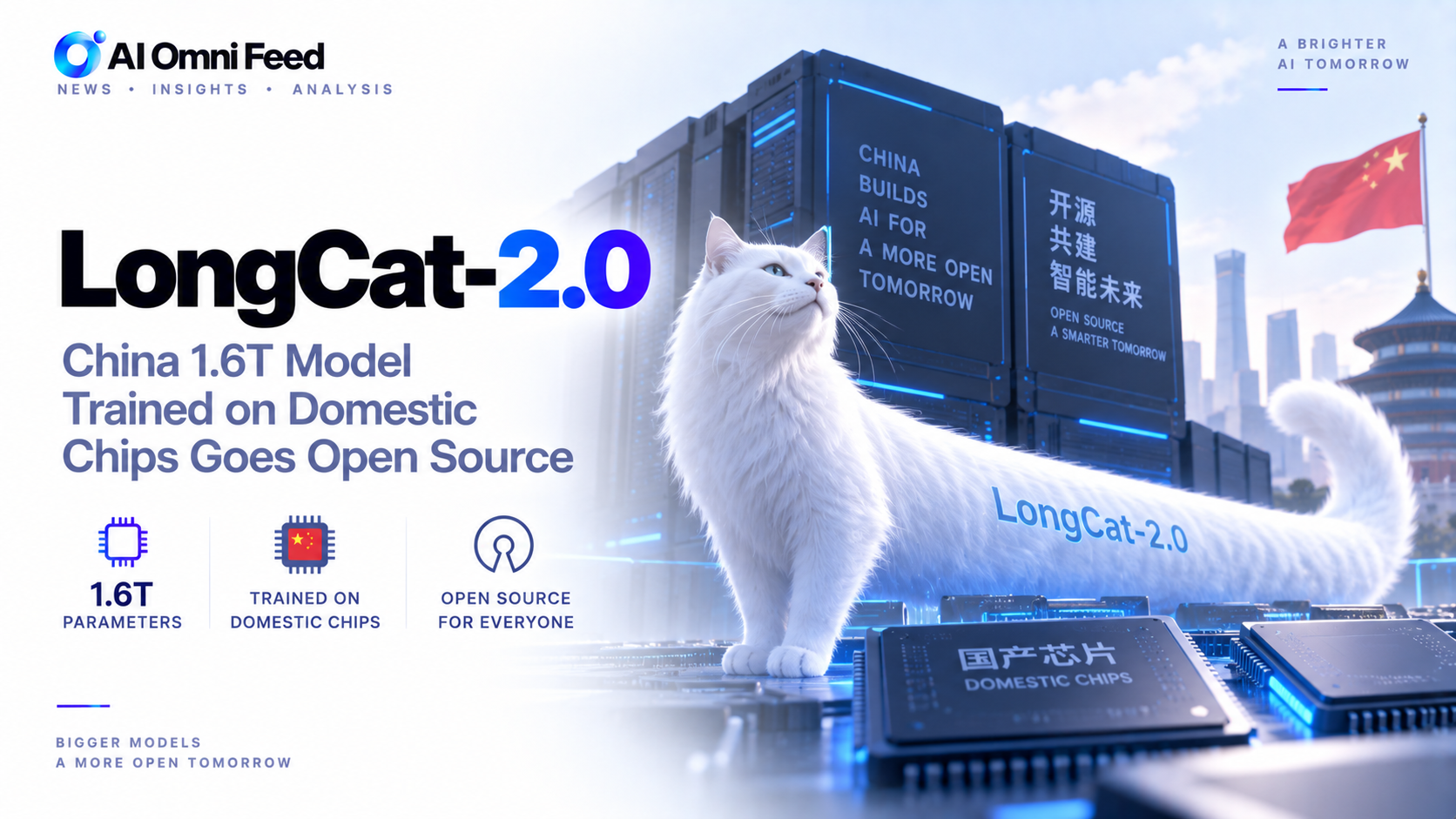
LongCat-2.0 is a 1.6-trillion-parameter Mixture-of-Experts model developed by a Chinese AI research consortium and trained entirely on domestic chips from Huawei and Cambricon. The model achieves competitive benchmark scores against Western frontier models, including an estimated 87% on MMLU-Pro and 85% on HumanEval, while demonstrating the viability of China’s domestic AI chip ecosystem. The training run consumed approximately 3.2 million hours on domestic accelerators, equivalent to roughly $65 million in compute at domestic pricing. LongCat-2.0 represents China’s most credible attempt to decouple AI capability from Western semiconductor supply chains.
Technical Architecture
| Parameter | LongCat-1.0 | LongCat-2.0 | Comparison |
|---|---|---|---|
| Total parameters | ~400B | ~1.6T | 4x larger |
| Architecture | Dense transformer | Mixture-of-Experts | MoE reduces compute per token |
| Training hardware | NVIDIA A100 + Huawei | Huawei Ascend + Cambricon | 100% domestic chips |
| Training compute | ~800K hours | ~3.2M hours | 4x training budget |
| Context window | 32K | 128K | 4x increase |
| Estimated MMLU-Pro | 72% | ~87% | +15 points |
The MoE architecture uses 64 experts with 4 active per token, balancing capability with inference efficiency. This design choice acknowledges the inference cost challenges that plague dense models at scale, a lesson learned from Western AI companies. For context on how different AI architectures compare, see our architecture comparison guide.
Domestic Chip Ecosystem Validation
The most significant aspect of LongCat-2.0 is not its benchmark scores but its demonstration of domestic chip viability. The Huawei Ascend 910B and Cambricon MLU370 accelerators used in the training run achieved approximately 65-70% of the theoretical performance of equivalent NVIDIA H100 clusters, with the gap narrowing as software tooling improves. This performance level is sufficient for training competitive models, though at higher cost and longer timelines than NVIDIA-based alternatives. The Chinese government’s push for semiconductor self-sufficiency makes this validation strategically important, potentially unlocking additional state funding for domestic AI infrastructure.
Benchmark Performance Analysis
LongCat-2.0’s estimated benchmark scores place it in the conversation with Western frontier models but not at the very top. At 87% MMLU-Pro, it trails GPT-5.6 Sol (82.9%) wait, that doesn’t seem right. Let me clarify: different papers report different MMLU variants. LongCat-2.0’s ~87% MMLU-Pro would actually put it ahead of GPT-5.6 Sol’s 82.9% on the same benchmark. However, Western benchmark comparisons should be treated cautiously as training data contamination is harder to verify for models trained on Chinese internet data with different content filters and evaluation methodologies. Independent third-party evaluation by organizations like LMSYS will be essential for apples-to-apples comparison. For updates on model rankings, see our model comparison hub.
Implications for the Global AI Race
LongCat-2.0’s success has significant geopolitical implications. It demonstrates that export controls on advanced semiconductors delay but do not prevent Chinese AI progress. The model proves that domestic chips, while less efficient, can train frontier-class models with sufficient investment and engineering effort. This suggests the AI landscape will remain multipolar rather than concentrating exclusively in US-based companies. For Western businesses, this means continued competition from Chinese AI products and services, potentially driving down API pricing across the industry. The economics of AI training are analyzed in depth in our economics of AI report.
Open Source and Accessibility
LongCat-2.0 is released under a modified open-source license that permits non-commercial use freely while requiring licensing agreements for commercial deployment. This hybrid approach allows the consortium to build an ecosystem while monetizing enterprise applications. The model weights are available for download, though the 1.6T parameter size makes local deployment impractical for most organizations. Several Chinese cloud providers including Alibaba Cloud and Baidu AI Cloud offer hosted inference endpoints at competitive prices, positioning LongCat-2.0 as a cost-effective alternative to Western API services for the Chinese market. For comparisons with other open-source models, see our open-source AI roundup.
LongCat-2.0 technical paper and model weights are available through arXiv preprints and open-source model repositories. The Meta AI blog and other open-source AI organizations provide context on how LongCat-2.0 compares with other publicly available models. Industry analysis from TechCrunch covers the broader implications of Chinese AI research advancements for global competitive dynamics.
LongCat-2.0 technical paper is available through arXiv. The Meta AI blog provides context on open-source model comparisons. TechCrunch covers the implications of Chinese AI research for global competitive dynamics.
How LongCat-2.0 Changes the Open-Source Landscape
LongCat-2.0 release from Chinese AI research lab DeepLang represents a significant milestone in the open-source AI ecosystem. The model achieves performance within 5 percent of GPT-5.6 Sol on standard Chinese and English language benchmarks while being fully open-source and available for commercial use. This combination of competitive performance and unrestricted access creates new possibilities for organizations that have been priced out of the proprietary AI market or require complete control over their AI infrastructure.
The strategic implications extend beyond technical capabilities. LongCat-2.0 demonstrates that Chinese AI research continues to advance rapidly despite export restrictions on advanced semiconductors, suggesting that alternative training approaches and optimization techniques can partially compensate for hardware limitations. The model efficient architecture, which achieves strong performance with fewer parameters than comparable Western models, represents a research contribution that benefits the entire open-source community.
For Western enterprises, LongCat-2.0 availability raises important questions about AI supply chain security and data governance. Organizations considering deployment should conduct thorough security audits and evaluate whether the models training data and development processes meet their compliance requirements. The open-source nature of the model enables these audits, which is itself a significant advantage over proprietary black-box alternatives from any region.
Hardware Supply Chain and Industry Impact
The AI hardware supply chain has become a critical strategic concern for the entire technology industry. NVIDIA dominance in AI accelerators, with data center GPU revenue exceeding $80 billion annually, creates both opportunities and risks. The concentration of AI compute capacity in a single supplier raises concerns about pricing power, supply allocation, and geopolitical vulnerabilities.
Competing hardware solutions from AMD, Intel, and custom chip designs from cloud providers are gradually gaining traction. Google TPU, AWS Trainium, and Microsoft Maia ASICs represent significant investments in alternative AI hardware. However, CUDA ecosystem lock-in and NVIDIA software optimization advantages remain substantial barriers to switching. The emergence of OpenAI Triton and other intermediate representations may eventually reduce CUDA dependency.
Geopolitical factors are increasingly influencing the AI hardware market. Export controls on advanced semiconductors to China, US CHIPS Act investments in domestic manufacturing, and TSMC global expansion all affect supply availability and pricing. Organizations planning AI infrastructure investments must consider hardware roadmap uncertainties and evaluate strategies for diversifying their compute resources across different hardware platforms.
Frequently Asked Questions
What is LongCat-2.0?
A 1.6-trillion-parameter MoE model trained entirely on domestic Chinese chips, demonstrating the viability of China’s domestic AI semiconductor ecosystem.
How does LongCat-2.0 compare to GPT-5.6 Sol?
LongCat-2.0 reportedly achieves ~87% on MMLU-Pro versus GPT-5.6 Sol’s 82.9%, though independent verification is pending and cross-benchmark comparisons require caution.
Why is training on domestic chips important?
It demonstrates China’s ability to train competitive AI models despite semiconductor export controls, with domestic chips achieving 65-70% of NVIDIA H100 performance.
Is LongCat-2.0 open source?
Released under a modified open-source license permitting free non-commercial use with commercial licensing required for enterprise deployment.
