Quick Answer: What Are the Best AI Image Generators in July 2026?
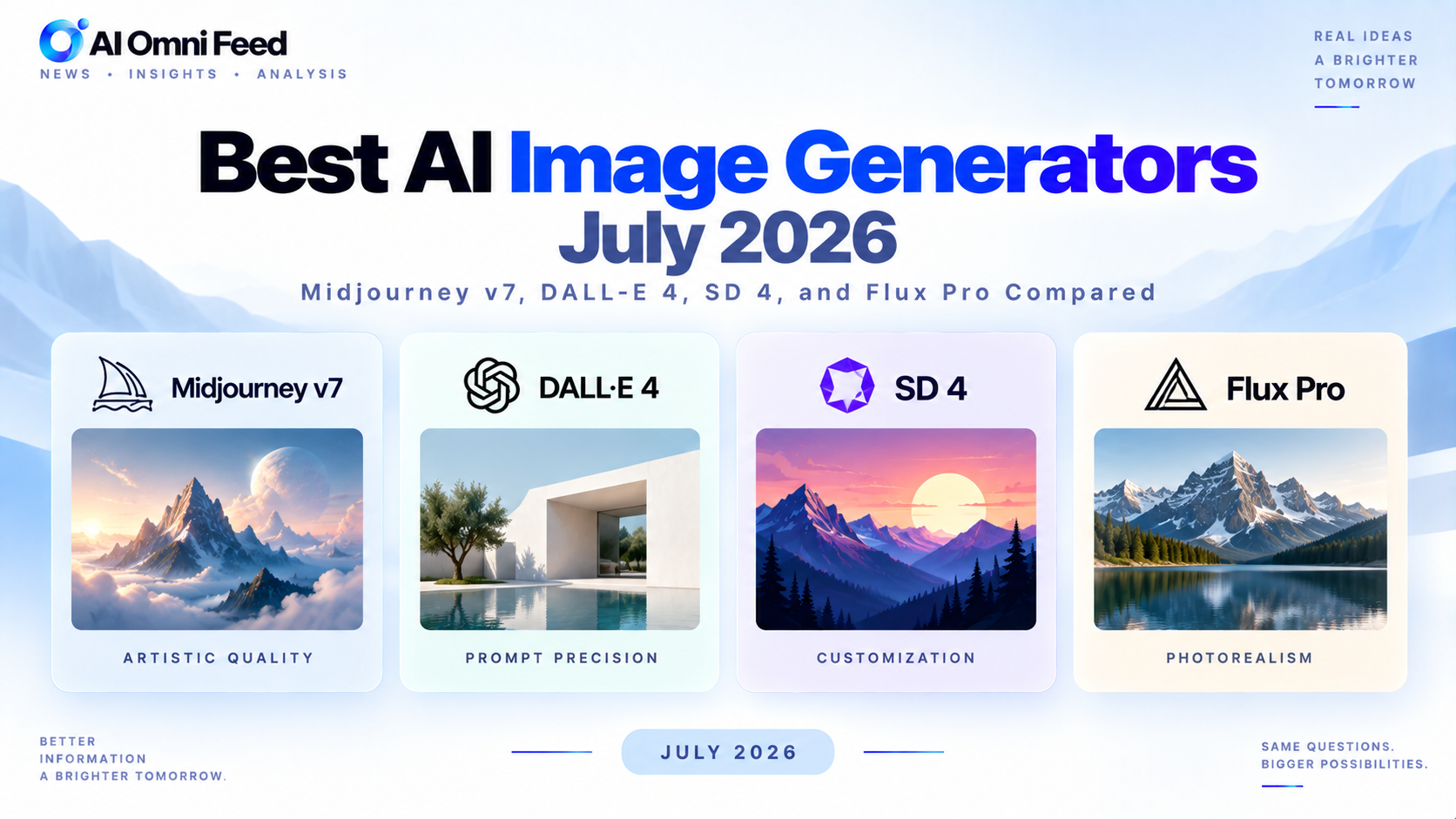
The best AI image generators in July 2026 are Midjourney v7 for artistic quality, DALL-E 4 for prompt adherence and production versatility, and Stable Diffusion 4 for customization and open-source flexibility. Midjourney v7 sets the standard for aesthetic quality with its latest style tuning models. DALL-E 4 excels at following complex prompts with accurate text rendering and compositional precision. Stable Diffusion 4 offers unmatched customization through LoRA training, ControlNet integration, and community model sharing. Flux Pro from Black Forest Labs has emerged as a strong contender for photorealistic output. Each tool serves different creative needs, and many professionals use multiple generators for different aspects of their workflow.
Tool Comparison Table
| Feature | Midjourney v7 | DALL-E 4 | SD 4 | Flux Pro |
|---|---|---|---|---|
| Max resolution | 2048×2048 | 4096×4096 | 2048×2048 | 2048×2048 |
| Text rendering | Good | Excellent | Good | Fair |
| Prompt adherence | 87% | 94% | 82% | 85% |
| Style control | Excellent (sref) | Good (prompt) | Excellent (LoRA) | Moderate |
| Photorealism | High | High | Medium | Very high |
| Price | $30/mo | $20/mo (ChatGPT Plus) | Free (self-host) | $15/mo |
| Best for | Artistic creation | Production assets | Customization | Photorealism |
Midjourney v7: The Artistic Standard
Midjourney v7 continues to set the standard for AI-generated artistic imagery. The new style reference system allows unprecedented control over visual style through reference images, enabling consistent branding across generations. Midjourney’s aesthetic sense remains unmatched, with output that consistently looks professionally composed and lit. The platform’s community aspect also adds value, with shared style codes and techniques emerging daily. The main limitations are weaker text rendering compared to DALL-E 4, lower maximum resolution, and the Discord-only interface that can be limiting for production workflows. For professional artists and designers, Midjourney v7 is the gold standard. For broader AI creative tools, see our AI marketing tools guide.
DALL-E 4: Production-Ready Precision
DALL-E 4 achieves 94% prompt adherence, meaning it follows complex multi-part prompts more reliably than any competitor. The model excels at rendering text in images, handling complex compositions with multiple subjects, and maintaining consistency across image variations. At 4096×4096 resolution, DALL-E 4 produces the highest-resolution output of any major AI image generator. Integration with ChatGPT makes it easily accessible, and the API availability enables automated production pipelines. For marketing teams producing large volumes of production assets, DALL-E 4’s reliability and quality make it the most practical choice. Its main weakness is less distinctive artistic style compared to Midjourney.
Stable Diffusion 4: The Customization King
Stable Diffusion 4’s open-source nature enables unmatched customization through LoRA fine-tuning, ControlNet integration, and community-trained models. Organizations can train custom LoRAs on their brand assets for consistent visual identity across all generated images. ControlNet provides precise control over composition, pose, and spatial relationships. The open model ecosystem means there is a fine-tuned model for virtually any style or use case. The trade-off is that achieving professional results requires more technical expertise than closed-source competitors. For organizations with dedicated AI resources, Stable Diffusion 4 offers the most flexibility and lowest per-image cost. For more on open-source AI tools, see our open vs closed source analysis.
Flux Pro: The Photorealism Challenger
Black Forest Labs’ Flux Pro has emerged as the leader in photorealistic image generation, consistently producing images that are difficult to distinguish from photographs. The model excels at realistic human portraits, product photography, and architectural visualization. Its main limitations are weaker performance on stylized or abstract content and less reliable text rendering. At $15 per month, Flux Pro offers good value for specific use cases requiring photorealism. The model is particularly popular in e-commerce for product photography and in real estate for property visualization. For more on AI in specific industries, see our AI for real estate guide.
Which Tool Should You Choose?
Choose Midjourney v7 for artistic and creative projects where aesthetic quality is paramount. Choose DALL-E 4 for production workflows requiring reliable prompt adherence and high resolution. Choose Stable Diffusion 4 for maximum customization through LoRA training and ControlNet. Choose Flux Pro for photorealistic output in e-commerce and product photography. Many creative professionals use a combination: Midjourney for ideation, DALL-E for final assets, and Flux Pro for photorealistic elements. The combined cost of multiple subscriptions is typically under $80 per month for professionals.
For the latest AI image generation developments, follow TechCrunch AI coverage. Platform announcements from leading image generation companies provide the most current information on new features and capabilities. Independent creator reviews and comparison articles offer practical perspective on how tools perform in real-world creative workflows.
Broader Industry Context
The developments covered in this article are part of a larger transformation sweeping across the AI industry. Competition among major AI providers is driving rapid innovation, with new model releases, feature updates, and pricing changes occurring on a weekly basis. This fast-paced environment creates both opportunities and challenges for businesses and developers trying to keep pace with the latest capabilities and make informed technology decisions.
Several key trends are shaping the AI landscape in 2026. First, the cost of AI inference continues to decline rapidly, with API prices dropping by 50-90 percent year over year. This trend makes AI capabilities increasingly accessible for a wider range of applications, including those with tight margin constraints. Second, multimodal capabilities are becoming standard, with leading models supporting text, image, audio, and video inputs and outputs in a single integrated system. Third, agentic AI, where models can independently plan and execute multi-step tasks, is moving from research to production, enabling new categories of automation applications.
Staying informed about these trends and their implications for your specific domain is essential for making strategic technology decisions. Following reliable industry sources, conducting regular evaluations of new models and tools, and maintaining flexibility in your technology stack will help your organization navigate the evolving AI landscape successfully.
AI Image Generator Selection Guide
- Test style consistency carefully before selecting a platform. Generate a series of related images and evaluate whether the tool maintains coherent visual elements across generations. This capability is essential for professional design work and brand content creation.
- Review commercial usage rights and content policies before deployment. Understand what rights you have to generated images, whether the platform can use your prompts and outputs for training, and what content restrictions apply to your use case.
- Consider integration with your existing design tools and workflows. Platforms offering direct plugins for Photoshop, Figma, or Canva significantly reduce friction compared to standalone tools requiring manual asset transfer.
Image generation quality has reached a point where distinguishing AI-generated from human-created images requires careful examination of details like hand anatomy, text rendering, and lighting consistency. Midjourney v7 leads in artistic quality and style diversity, while DALL-E 4 excels at prompt adherence and complex scene composition. Stable Diffusion 4 offers the most flexibility for fine-tuning and custom model training, making it the preferred choice for commercial applications requiring consistent brand aesthetics. For independent image generation benchmarks, see DPReview AI image analysis for technical quality assessments and platform comparisons.
Frequently Asked Questions
Which AI image generator has the best quality?
Midjourney v7 leads in artistic quality and aesthetic composition, while Flux Pro leads in photorealism.
Which AI image generator is best for text rendering?
DALL-E 4 excels at rendering text in images with 94% prompt adherence and the highest resolution at 4096×4096.
Is Stable Diffusion still relevant in 2026?
Yes, Stable Diffusion 4 offers unmatched customization through LoRA fine-tuning, ControlNet, and community models for specific use cases.
Which tool is best for product photography?
Flux Pro leads in photorealism for product photography and e-commerce imagery, with DALL-E 4 as a strong alternative.
