
Key Takeaways
- AI is accelerating drug discovery from years to months, with several AI-discovered drugs now in clinical trials.
- Medical imaging AI matches or exceeds radiologist accuracy for many conditions. FDA has approved 900+ AI-enabled devices.
- AI-powered hospital robots handle logistics, cleaning, and patient monitoring, freeing healthcare workers for direct care.
How AI Is Transforming Healthcare in 2026
Healthcare is one of the most consequential applications of AI. In 2026, AI is moving rapidly from experimental research to real clinical deployment across drug discovery, medical imaging, hospital operations, and personalized medicine.
AI in Drug Discovery
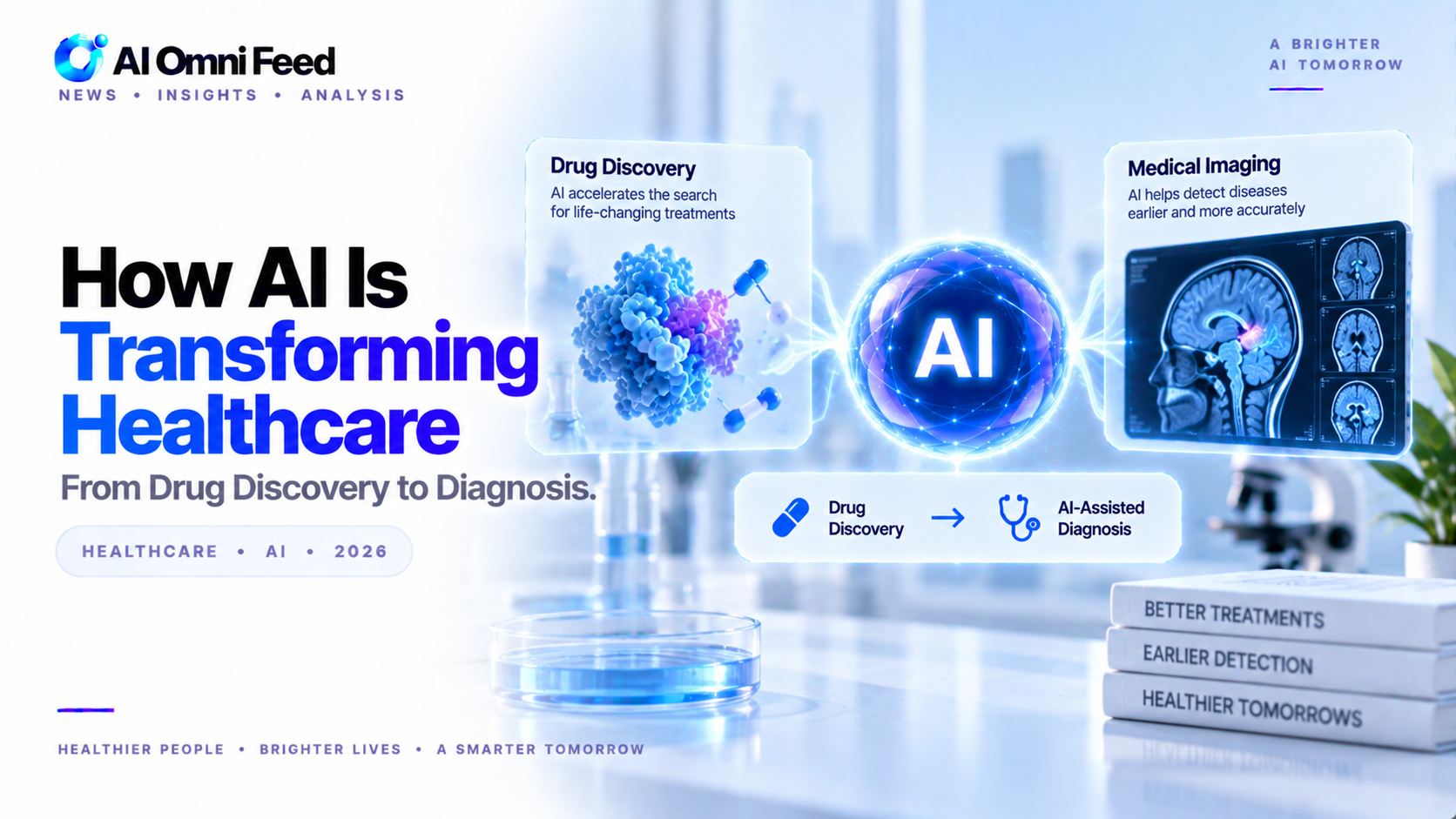
Drug discovery traditionally takes 10-15 years and costs over $2 billion per approved drug. AI compresses this timeline dramatically. Models screen millions of molecular compounds in days, predict interactions with biological targets, and optimize chemical properties before any lab work begins.
Several AI-discovered drugs are now in clinical trials. Isomorphic Labs (DeepMind spinout) has cancer candidates in Phase II. Insilico Medicine has an AI-discovered drug for idiopathic pulmonary fibrosis in Phase II. Recursion Pharmaceuticals uses AI to analyze cellular images and identify candidates human researchers would miss. AI can explore chemical space far more broadly than traditional methods, identifying treatments for diseases previously considered undruggable.
AI in Medical Imaging
Radiology AI has reached clinical parity. Deep learning models detect tumors, fractures, and abnormalities in X-rays, MRIs, and CT scans with accuracy matching or exceeding human radiologists. The FDA has approved over 900 AI-enabled medical devices as of 2026, covering radiology, cardiology, pathology, and dermatology.
AI excels at pattern recognition with large training datasets. It flags urgent findings for immediate review, measures structures with sub-millimeter precision, and tracks lesion changes over time. It serves as a tireless second reader, reducing radiologist cognitive load and catching missed findings.
AI in Hospital Operations
AI-powered robots handle logistics, cleaning, supply delivery, and medication transport. Foxconn and Compal deploy Nurabot and PolyMedX robots across hospitals in Asia for patient care assistance and operating room support. AI scheduling systems optimize operating room utilization and predict admission rates. AI clinical documentation saves physicians an average of 90 minutes per day at one major hospital system.
AI in Personalized Medicine
AI analyzes genetic profiles, medical history, and lifestyle factors to recommend personalized treatments. This is most advanced in oncology, where AI matches patients to therapies based on tumor genetics. The approach is expanding to cardiology, neurology, and autoimmune diseases. AI can also predict disease risk before symptoms appear, enabling preventive interventions.
Challenges and Limitations
Data privacy, regulatory approval, and EHR integration remain significant barriers. Healthcare data is highly sensitive under HIPAA and GDPR. Training AI requires large datasets, creating tension with privacy requirements. AI remains a tool for healthcare professionals, not a replacement for clinical judgment. The best outcomes come from human-AI collaboration.
AI in Robotic Surgery
AI-assisted robotic surgery is expanding beyond the da Vinci systems of the past decade. Modern surgical AI platforms analyze real-time video from endoscopic cameras, identify anatomical structures, highlight危险 areas, and suggest optimal incision paths. NVIDIAs Isaac for Healthcare platform is being adopted by Foxconn and Compal to accelerate hospital robotics development. The Scrub Nurse Collaborative Robot from Foxconn helps optimize operating room workflows by anticipating surgeon needs and delivering instruments autonomously.
AI in Mental Health
AI-powered chatbots and virtual therapists are providing mental health support at scale. Woebot and similar platforms use cognitive behavioral therapy techniques delivered through natural language conversations. While not a replacement for human therapists, these tools provide 24/7 accessible support and have shown clinical efficacy for mild to moderate anxiety and depression. The FDA is developing a regulatory framework for AI mental health tools as the evidence base grows.
AI in Drug Manufacturing
Beyond discovery, AI is optimizing how drugs are manufactured. AI models predict the most efficient synthesis pathways, optimize reaction conditions, and monitor production quality in real time. This reduces manufacturing costs and speeds the transition from laboratory discovery to commercial production. Companies like Pfizer and Novartis are deploying AI across their manufacturing pipelines.
The Regulatory Landscape
The FDA has approved over 900 AI-enabled medical devices as of 2026, but the regulatory framework continues to evolve. The EU AI Act classifies many healthcare AI applications as high-risk, subjecting them to conformity assessments and transparency requirements. The challenge for regulators is balancing innovation with patient safety. AI models that learn and update post-deployment raise particular regulatory questions about when a device is substantially modified and requires new approval.
What the Future Holds
AI will not replace doctors, but doctors who use AI will replace those who do not. The most impactful applications in the next 3-5 years will be clinical decision support, workflow automation, and personalized treatment planning. The combination of AI pattern recognition with human clinical judgment consistently produces better outcomes than either alone.
AI in Clinical Decision Support
Clinical decision support systems powered by AI are becoming standard in leading hospitals. These systems analyze patient data in real time, flag potential drug interactions, suggest diagnostic possibilities based on symptom patterns, and alert physicians to deviations from evidence-based treatment protocols. A study published in JAMA Internal Medicine in 2025 found that AI-assisted diagnosis improved accuracy by 22% in primary care settings and reduced diagnostic errors by 30% in emergency departments.
The most advanced systems integrate with electronic health records, lab results, and medical imaging to provide a comprehensive view of each patient. They learn from outcomes, continuously improving their recommendations. But they remain decision support tools, not decision makers. The physician retains ultimate authority and responsibility for patient care.
AI in Remote Patient Monitoring
The proliferation of wearable devices and home health sensors has created an explosion of patient-generated health data. AI processes this data continuously, detecting early warning signs of deterioration before they become emergencies. Patients with chronic conditions like diabetes, heart failure, and COPD benefit most from AI-powered remote monitoring. Algorithms detect subtle changes in vital signs, activity levels, and medication adherence, triggering alerts when intervention is needed.
AI in Health Insurance and Administration
Behind the scenes, AI is transforming health insurance operations. Claims processing, prior authorization, fraud detection, and risk adjustment are all being automated with AI. The result is lower administrative costs and faster processing times. Critics raise concerns about algorithmic bias in claims decisions and the transparency of AI-driven coverage determinations. Regulation is evolving to require human review of AI decisions that affect patient access to care.
AI in Public Health and Epidemiology
Public health agencies use AI to track disease outbreaks, model transmission patterns, and allocate resources. During the COVID-19 pandemic, AI models predicted hospital utilization and guided resource allocation. In 2026, AI-powered epidemiological surveillance systems monitor wastewater, social media, and emergency room data for early signs of emerging outbreaks. These systems were instrumental in containing the 2025 avian influenza outbreak and are being deployed globally for pandemic preparedness.
Ethical Considerations and AI Safety in Healthcare
Healthcare AI raises profound ethical questions. If an AI system recommends a treatment that harms a patient, who is responsible? How do we ensure AI systems are trained on diverse populations and do not perpetuate health disparities? How do we protect patient privacy while enabling AI to learn from clinical data? These questions do not have easy answers, but they are essential to the responsible deployment of AI in healthcare. Professional medical societies, regulators, and technology companies are developing frameworks for AI governance that prioritize patient safety and equity.
Frequently Asked Questions
How is AI used in healthcare?
AI in healthcare spans drug discovery, medical imaging diagnosis, personalized treatment planning, electronic health record analysis, robotic surgery assistance, and hospital operations optimization.
Is AI replacing doctors?
No. AI augments healthcare professionals by improving accuracy and efficiency. Doctors remain essential for clinical judgment, patient communication, and complex decision-making.
What is the biggest AI healthcare breakthrough?
AI-accelerated drug discovery is the most impactful application, reducing drug development timelines from years to months and enabling personalized medicine approaches.
