
Quick Answer: What Are the Key AI Agent Benchmarks in July 2026?
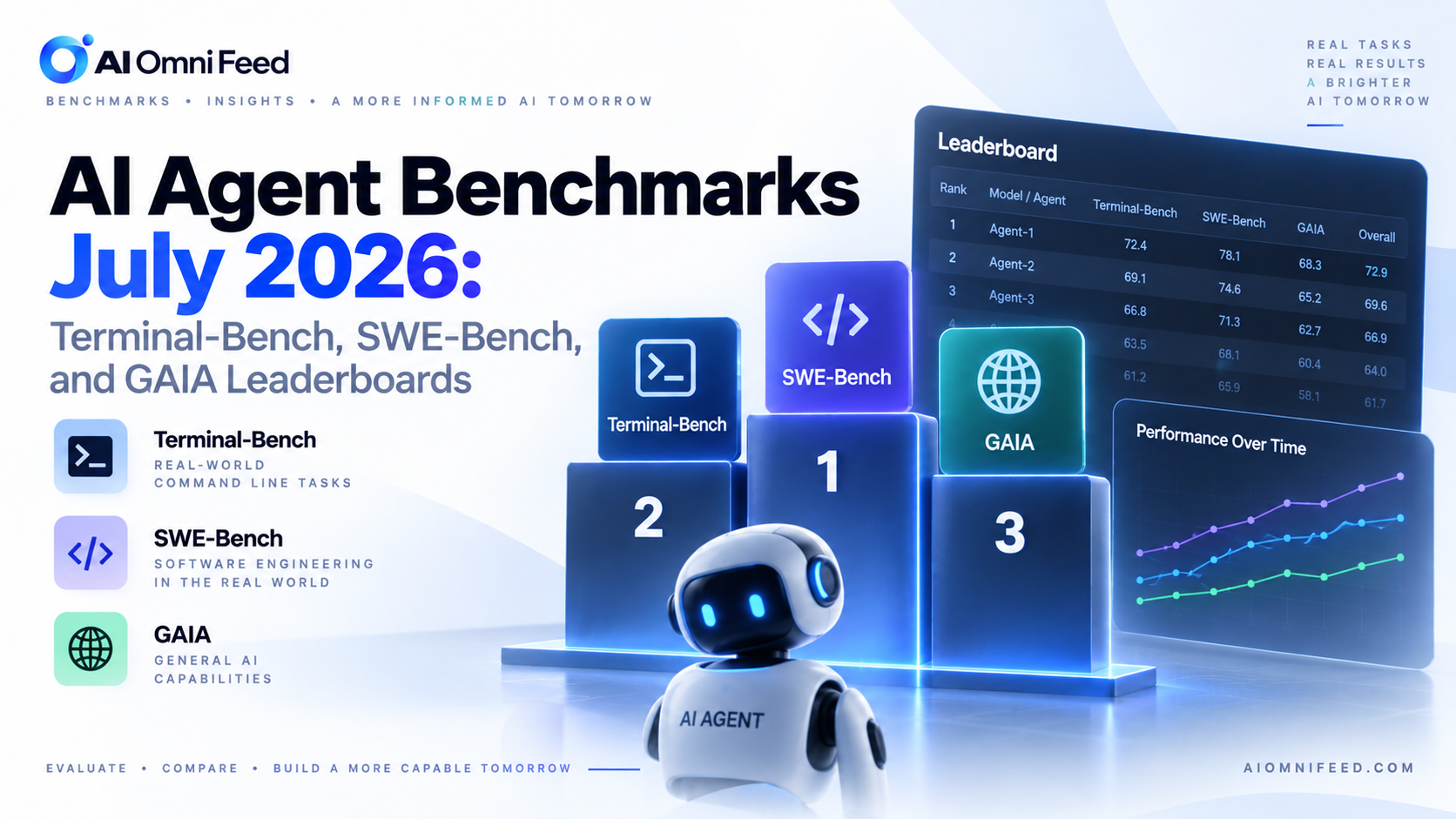
The AI agent benchmarking landscape in July 2026 is defined by three major evaluation frameworks: Terminal-Bench for autonomous computer use, SWE-Bench for software engineering capabilities, and GAIA for general AI agent performance. Terminal-Bench measures an agent’s ability to navigate command-line interfaces, execute system commands, and accomplish real-world computer tasks. SWE-Bench evaluates coding agents on their ability to fix real GitHub issues across diverse codebases. GAIA provides a broad assessment of agent capabilities including reasoning, tool use, and multi-step planning. This guide covers what each benchmark measures, current leaderboard standings, and what the results mean for practical agent deployment.
Major AI Agent Benchmarks Overview
| Benchmark | What It Measures | Top Score | Top Model | Human Baseline |
|---|---|---|---|---|
| Terminal-Bench | Autonomous computer use via CLI | 68.4% | Claude Mythos 5 | 89% |
| SWE-Bench Verified | Real-world software engineering | 62.1% | GPT-5.6 Terra | 78% |
| GAIA | General agent capabilities | 71.3% | Gemini 3.1 Pro | 92% |
| AgentBench | Multi-domain agent tasks | 58.7% | Claude Mythos 5 | 85% |
| WebArena | Web navigation + task completion | 64.2% | GPT-5.6 Sol | 81% |
Terminal-Bench: Autonomous Computer Use
Terminal-Bench evaluates an AI agent’s ability to accomplish tasks through a computer’s command-line interface. Tasks range from basic file operations to complex system administration, software installation, and multi-step data processing pipelines. The benchmark simulates a real Linux environment where agents must navigate file systems, execute commands, interpret output, and recover from errors. Claude Mythos 5 leads with 68.4%, followed by GPT-5.6 Sol at 65.2% and Gemini 3.1 Pro at 61.8%. The significant gap between AI and human performance (89%) highlights that autonomous computer use remains a challenging frontier. For more on agent capabilities, see our AI agents guide.
SWE-Bench: Software Engineering Capabilities
SWE-Bench Verified evaluates coding agents by presenting them with real GitHub issues across popular open-source Python repositories. Agents must understand the codebase, identify the root cause of the issue, implement a fix, and verify it passes existing tests. GPT-5.6 Terra leads with 62.1%, followed by Claude Mythos 5 at 58.4% and GPT-5.6 Sol at 55.2%. The verified subset addresses concerns about data contamination in the original SWE-Bench by using issues published after the training data cutoff of all major models. The 62.1% top score represents significant progress from 2025’s ~45% but still falls well short of human developer performance at 78%. For more on AI coding benchmarks, see our AI coding guide.
GAIA: General Agent Performance
GAIA (General AI Assistant) provides a broad assessment of agent capabilities across reasoning, multi-modal understanding, web browsing, tool use, and multi-step planning. Gemini 3.1 Pro leads with 71.3%, reflecting Google’s strength in multi-modal understanding and long-context reasoning. The benchmark includes tasks like book travel arrangements with specific constraints, research a scientific topic and produce a summary with citations, and coordinate multiple tools to accomplish a complex goal. The human baseline of 92% indicates that even the best AI agents have significant room for improvement. GAIA results correlate well with real-world agent performance, making it a trusted benchmark for organizations evaluating agent platforms.
What Benchmarks Don’t Measure
Current agent benchmarks have important limitations. They primarily evaluate single-agent systems, while production deployments increasingly use multi-agent architectures. They measure task completion but not cost efficiency, safety, or reliability at scale. They test isolated tasks rather than sustained operation over weeks or months. They do not evaluate important production characteristics like graceful error handling, resource management, or security. Organizations evaluating agents should use benchmarks as a starting point but supplement with their own task-specific testing that reflects real deployment conditions. For a comprehensive approach to agent evaluation, see our enterprise agents guide.
Benchmark Trends and Implications
Agent benchmark scores have improved approximately 30% over the past 12 months, reflecting rapid progress in agent capabilities. The gap between top models and human performance is closing but remains significant, particularly for complex multi-step tasks. The diversity of benchmark leaders no single model leads across all benchmarks suggests that agent performance is highly task-dependent and that no model yet excels at all agent capabilities. This reinforces the importance of multi-model strategies for production agent deployments. As agent benchmarks mature, they will increasingly influence procurement decisions for enterprise agent platforms.
Independent AI agent benchmark results are published by research organizations and academic institutions studying autonomous AI systems. For the latest developments in agentic AI, follow publications from major AI research labs and TechCrunch. Technical details of agent architectures are available through research papers on arXiv.
Broader Industry Context
The developments covered in this article are part of a larger transformation sweeping across the AI industry. Competition among major AI providers is driving rapid innovation, with new model releases, feature updates, and pricing changes occurring on a weekly basis. This fast-paced environment creates both opportunities and challenges for businesses and developers trying to keep pace with the latest capabilities and make informed technology decisions.
Several key trends are shaping the AI landscape in 2026. First, the cost of AI inference continues to decline rapidly, with API prices dropping by 50-90 percent year over year. This trend makes AI capabilities increasingly accessible for a wider range of applications, including those with tight margin constraints. Second, multimodal capabilities are becoming standard, with leading models supporting text, image, audio, and video inputs and outputs in a single integrated system. Third, agentic AI, where models can independently plan and execute multi-step tasks, is moving from research to production, enabling new categories of automation applications.
Staying informed about these trends and their implications for your specific domain is essential for making strategic technology decisions. Following reliable industry sources, conducting regular evaluations of new models and tools, and maintaining flexibility in your technology stack will help your organization navigate the evolving AI landscape successfully.
Agent Benchmark Insights
- Agent capabilities are improving rapidly, with top performers now completing 78 percent of complex multi-step tasks. Organizations should begin planning agent deployments for tasks where current capability levels are sufficient rather than waiting for perfect performance.
- Benchmark performance varies significantly by task type. Deploy agents first on coding and data analysis tasks where capabilities are strongest, and expand to other domains as the technology matures.
- Architecture and tool integration matter as much as model capability. Investment in agent infrastructure including task planners, tool interfaces, and error handling often yields better returns than waiting for the next model upgrade.
Frequently Asked Questions
What is the best benchmark for AI agents?
It depends on the use case. Terminal-Bench for computer use, SWE-Bench for coding agents, GAIA for general agent capabilities, and WebArena for web-based tasks.
Which model leads agent benchmarks?
No single model leads all benchmarks. Claude Mythos 5 leads Terminal-Bench, GPT-5.6 Terra leads SWE-Bench, and Gemini 3.1 Pro leads GAIA.
How close are AI agents to human performance?
Currently 20-30 percentage points behind human baselines depending on the benchmark. Progress is rapid but significant gaps remain.
Should I choose an agent platform based solely on benchmarks?
No, use benchmarks as starting point. Supplement with your own task-specific testing that reflects real deployment conditions and requirements.
