Quick Answer: What Are the Best AI Marketing Tools in 2026?
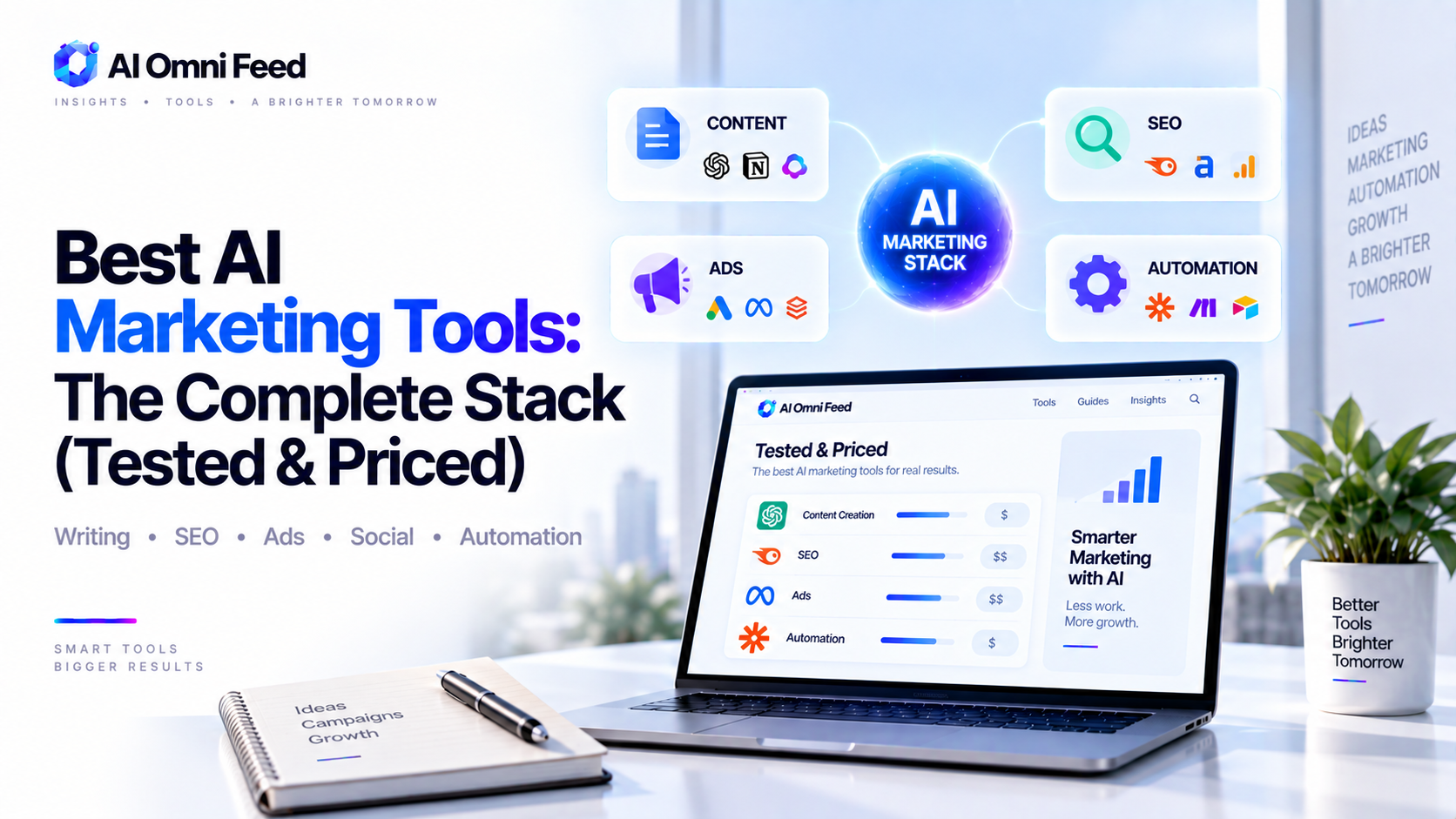
The best AI marketing tools in 2026 combine generation (content, images, video, email) with automation (campaigns, personalization, reporting) and insight (search data, competitor monitoring, attribution). The standouts are ChatGPT (GPT-5.6) and Claude (Fable 5 / Sonnet 5) for writing and strategy, Perplexity for cited research, specialist platforms for SEO, social, and email, plus AI agents that run whole campaigns on their own. In this guide we break the 2026 stack into five categories, list the best tool in each with pricing, and give you a sample stack you can copy.
The Five Marketing AI Categories
- Content & Copywriting – blog posts, landing pages, ads, emails, and repurposing one asset into many formats.
- SEO & Research – keyword intelligence, entity optimization, and cited web research that keeps facts straight.
- Social & Community – posting calendars, image and short-video generation, reply drafting, and engagement analytics.
- Email & Campaign Automation – segmentation, subject-line testing, send-time optimization, and agentic drip flows.
- Analytics & Agents – attribution, funnel analysis, and autonomous agents that launch, monitor, and optimize campaigns.
Best Tools by Category (2026)
Content & Copywriting
| Tool | Model / Tier | Pricing (2026) | Best For |
|---|---|---|---|
| ChatGPT | GPT-5.6 / Free, Plus, Pro | Free / $20 / $100-200/mo | Fast, versatile copy, briefs, outlines, and brainstorming at scale. |
| Claude | Fable 5 / Sonnet 5 | Free / $10-100/mo | Long-form and on-brand writing; dependable tone across a full funnel. |
| Jasper | GPT-5.6 / Starting tier | From $49/mo | Teams that want brand voice memory, templates, and workflows. |
SEO & Research
| Tool | Model / Tier | Pricing (2026) | Best For |
|---|---|---|---|
| Perplexity | Pro / Enterprise | Free (limited) / $20-200/mo | Cited research and quick competitive snapshots with sources. |
| Ahrefs | AI site audit | From $99/mo | Keyword intelligence, content gaps, and technical SEO at depth. |
| SEMrush | AI writing assistant | From $119/mo | Full-stack SEO plus AI briefs built on real ranking data. |
Social & Community
| Tool | Model / Tier | Pricing (2026) | Best For |
|---|---|---|---|
| Buffer | AI assistant built-in | Free (3 channels) / from $6/channel | Scheduling, publishing, and light AI caption help. |
| Hootsuite | AI content studio | From $99/mo | Multi-channel teams needing reply drafting and reporting. |
| Canva | AI image + video (Magic Studio) | Free / Pro $15-25/mo | On-brand graphics, resizing, and short video clips fast. |
Email & Campaign Automation
| Tool | Model / Tier | Pricing (2026) | Best For |
|---|---|---|---|
| Klaviyo | AI flows + subject-line scoring | From $20/mo | E-commerce segmented flows with smart send-time. |
| ActiveCampaign | AI automations | From $29/mo | B2B lifecycle automation and CRM-integrated campaigns. |
| Mailchimp | AI creative assistant | Free / from $13/mo | Easiest on-ramp for small lists and newsletters. |
Analytics & Autonomous Agents
| Tool | Model / Tier | Pricing (2026) | Best For |
|---|---|---|---|
| ChatGPT agents | GPT-5.6 agents | Plus $20 / Pro $100-200/mo | Custom agents that gather data, draft, and report on a schedule. |
| Google Analytics 4 | AI insights | Free | Standard funnel and engagement insight without extra cost. |
| Triple Whale | AI attribution | From $119/mo | DTC attribution and live-store dashboards. |
Sample Stack You Can Copy Today
For a marketing team of one to three people, start with:
- Writing: Claude (Fable 5) at $10-20/mo for long-form and on-brand copy, plus ChatGPT Free for quick drafts.
- Research: Perplexity Pro at $20/mo for cited competitive research.
- Design: Canva Pro at $15-25/mo for social graphics and video.
- Scheduling: Buffer free tier to start, upgrade as you add channels.
- Email: Mailchimp free or Klaviyo from $20/mo for segmentation and flows.
- Reporting: GA4 free plus a weekly ChatGPT agent summary.
That is roughly $65-110/mo for a serious solo-marketer setup – far less than a single human hire, and it covers 80% of the daily work.
How to Pick the Right AI Marketing Stack
- Start with your biggest time sink. If writing eats your week, buy that first; if it’s replying on social, start there.
- Prefer tools with APIs or native integrations so your stack can trigger itself (research -> draft -> schedule -> report) instead of paste-and-copy.
- Keep a human gate on facts and brand voice. The best 2026 setup uses AI for volume and a quick human review before anything goes live.
- Audit once a quarter. Prices and model quality shift fast; the tool that wins in January may not win in June.
Common Mistakes When Adopting AI Marketing Tools
Most teams waste money on AI marketing software by repeating a few familiar errors:
- Buying five overlapping tools. One strong writing assistant, one scheduler, and one analytics product cover most needs – everything else is duplicated spend.
- Letting AI post without review. Regulatory, brand, and factual errors are expensive once live. Keep a human gate on anything public, at least at the start.
- Ignoring integrations. A tool that can’t talk to your CRM or email platform creates manual work that erases its time savings.
- Giving up after two weeks. Effective AI workflows take time to tune – prompts, brand voice, and data wiring all improve with iteration.
The teams that succeed treat AI tools as a system to refine, not a subscription to collect.
How to Measure ROI on AI Marketing
If you can’t measure the stack, you can’t justify it. The 2026 approach:
- Track hours saved per week on drafting, scheduling, and reporting before you add tools, then re-measure monthly.
- Watch cost per acquired lead, especially for email and social, where AI often lifts volume without raising spend.
- Compare response and time-to-publish vs the pre-AI baseline – the two metrics that move fastest.
- Review quarterly. Model quality and prices shift quickly; a tool that was right in January may not be in June.
Simple, regular measurement converts “we bought AI tools” from a cost line into a demonstrable driver.
Frequently Asked Questions
What is the best AI tool for marketing in 2026?
For most teams, ChatGPT (GPT-5.6) or Claude (Fable 5 / Sonnet 5) for writing plus Perplexity for research is the best starting combo. They cover the widest range of marketing tasks at $0-20/mo combined, and both plug into the specialized tools above as you scale.
Can AI run marketing campaigns fully on its own?
Largely yes in 2026 for always-on tactics like social posting, email drips, and paid bid optimization. Modern AI agents can research, draft, schedule, and report. You still want a human review for anything legally sensitive (claims, medical, financial) and for major brand moments.
Is there a free AI marketing tool that’s actually good?
Yes. ChatGPT Free, Claude Free, Canva Free, Buffer Free, GA4, and Mailchimp Free cover research, writing, design, scheduling, analytics, and email at zero cost. A competent marketer can run a solo business on free tiers alone, then layer one or two paid tools where volume hurts.
How much should a small business spend on AI marketing tools in 2026?
A solo operator gets a full stack for $65-110/mo. A 3-5 person team typically spends $200-500/mo on AI marketing software. Compare that to agency retainers (usually $1,000+/mo) and the ROI is easy to justify.
Which AI model is best for marketing copy?
For long, on-brand, trustworthy copy, Claude (Fable 5 / Sonnet 5) tends to lead. For fast, varied, high-volume copy and brainstorming, GPT-5.6 is excellent. Most 2026 teams use both – Claude for the pieces that need voice control, ChatGPT for speed and breadth.
