Quick Answer: What Are the Key AI Predictions for August 2026?
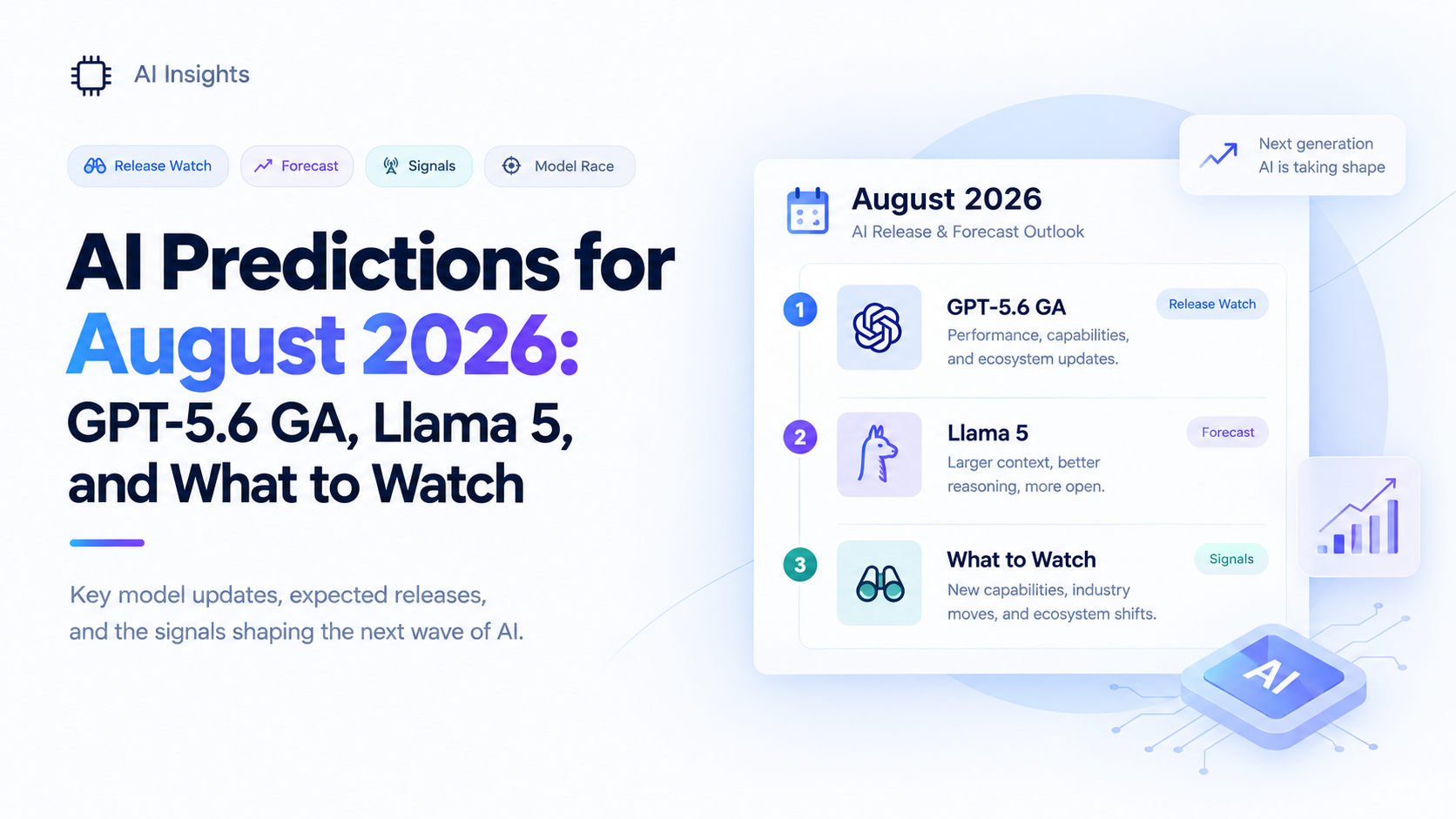
August 2026 is shaping up to be a pivotal month for AI with several anticipated developments: GPT-5.6 Sol expected to reach general availability, Meta Llama 5 completion ahead of schedule, Gemini 3.5 Pro Deep Think entering wider preview, Grok 4.5 private beta expanding, and EU AI Act compliance requirements continuing to take shape. Market analysts predict continued AI investment growth of 40-50% year-over-year. The most significant anticipated event is Meta Llama 5’s release, which could reshape the open-source AI landscape. This guide covers the key events expected in August and their potential impact on the AI industry.
Expected August 2026 AI Developments
| Event | Timeline | Impact Level | Key Implications |
|---|---|---|---|
| GPT-5.6 Sol GA | Mid-August | High | Stable pricing, SLAs, enterprise procurement readiness |
| Meta Llama 5 release | Late August | Very high | Most capable open-source model, reshapes competition |
| Gemini 3.5 Deep Think preview expansion | August | Medium | Broader access to iterative reasoning capability |
| Grok 4.5 beta expansion | August | Medium | More tester feedback, competitive pressure on OpenAI |
| EU AI Act compliance deadlines | Ongoing | High | Continued guidance and enforcement development |
| AI chip supply updates | August | Medium | TSMC N2 production ramp, NVIDIA Rubin status |
Meta Llama 5: The Month’s Biggest Event
Meta Llama 5’s anticipated release in late August is the most significant AI event of the month. Early benchmarks suggesting ~90% HumanEval and ~88% MMLU-Pro would make Llama 5 the most capable open-source model ever released, competitive with GPT-5.6 Sol on several dimensions. The release is expected to accelerate open-source AI adoption and put pressure on proprietary API pricing. For organizations currently evaluating AI models, waiting for Llama 5 benchmarks before making procurement decisions is advisable. For more on what to expect, see our Llama 5 analysis.
GPT-5.6 Sol GA Impact
GPT-5.6 Sol’s expected GA in mid-August brings several changes. Pricing stabilizes without early-access discounts, SLA guarantees become available for enterprise customers, API reliability meets production-grade standards, and procurement teams can complete security reviews and compliance documentation. For organizations that have been testing Sol during early access, GA triggers the transition to production deployment. OpenAI is also expected to announce volume pricing tiers and enterprise agreements alongside the GA announcement. For pricing analysis, see our GPT-5.6 pricing guide.
AI Investment and Market Trends
AI investment continues to grow at 40-50% year-over-year, driven by infrastructure spending, model training costs, and enterprise AI adoption. August is expected to bring several funding announcements as AI startups close summer rounds. The public market AI sector has shown volatility, with AI company valuations fluctuating based on model release news and competitive dynamics. The long-term trend remains strongly positive, with AI spending projected to reach $500 billion annually by 2028. For more on AI market dynamics, see our AI funding analysis.
Regulatory Developments
August brings continued development of AI regulatory frameworks globally. The EU AI Act’s sector-specific guidance continues to roll out, with additional industries receiving compliance clarity. The US AI Accountability Act faces key committee votes that will determine its legislative prospects. China’s updated generative AI rules take full effect, creating compliance requirements for foreign AI companies operating in the Chinese market. Organizations operating across multiple jurisdictions should track these developments closely and adjust compliance programs accordingly. For more on AI regulation, see our global AI regulation guide.
Strategic Recommendations
For organizations planning AI strategy for August and beyond, several recommendations emerge. Evaluate Llama 5 as a potential alternative to proprietary API services for appropriate use cases. Prepare for GPT-5.6 Sol GA by completing testing during early access. Monitor Grok 4.5 developments for potential impact on model pricing and capability landscape. Continue EU AI Act compliance preparation regardless of August deadlines. Invest in multi-model routing infrastructure to take advantage of the increasingly competitive model landscape. The AI market is entering a period of intense competition that benefits buyers through lower prices, better capability, and more choice.
For ongoing AI industry developments, follow TechCrunch and Reuters for breaking news. Official announcements from OpenAI, Anthropic, Google AI, and other major providers provide the most current information on product roadmaps and strategic direction. Industry analysis from AI research organizations offers informed perspective on future trends and their implications.
Meta publishes Llama model details through the Meta AI blog. The open-source AI community provides independent benchmarks on arXiv and through community leaderboards. TechCrunch and other technology publications provide ongoing coverage of the open-source AI ecosystem and its impact on proprietary model providers.
Strategic Implications and Market Impact
OpenAI continued dominance in the AI landscape creates ripple effects across the entire technology ecosystem. Competitors must differentiate through specialization, pricing, or open-source strategies to capture market share. The rapid release cycle that OpenAI has established sets a pace that challenges both established players and newcomers to keep up with feature parity and performance improvements.
For enterprise adopters, the implications are significant. Organizations building on OpenAI platform benefit from access to cutting-edge capabilities but face the risk of vendor lock-in and exposure to pricing changes. A multi-model strategy, where applications are designed to work with multiple AI providers, offers more flexibility and negotiating power. The emergence of standardized evaluation benchmarks and middleware platforms that abstract away individual model differences is enabling this approach.
Looking ahead, the AI market is showing signs of consolidation around a few dominant platforms, similar to the cloud computing market evolution. However, the open-source ecosystem, led by Meta Llama, Mistral, and community projects, provides a viable alternative for organizations with strong technical capabilities and specific requirements around data privacy, customization, or cost optimization. The coexistence of proprietary and open-source models will likely define the AI landscape for the foreseeable future.
Impact on the AI Ecosystem
Open-source AI models are fundamentally reshaping the competitive landscape by democratizing access to advanced AI capabilities. Meta Llama series, along with Mistral, DeepSeek, and community projects, have demonstrated that open-source models can achieve performance competitive with proprietary systems while offering advantages in customization, data privacy, and cost control. The rapid pace of improvement in open-source models is challenging the assumption that proprietary systems will maintain a permanent capability advantage.
For enterprises, the availability of capable open-source models creates strategic options that did not exist previously. Organizations can deploy models on their own infrastructure, fine-tune them on proprietary data, and avoid per-token API costs. This flexibility is particularly valuable for applications with high volume, sensitive data requirements, or specialized domain needs. The growing ecosystem of tools for model deployment, optimization, and monitoring is reducing the technical barriers to adopting open-source AI.
The tension between open-source and proprietary AI development models will likely intensify. While proprietary providers emphasize safety, reliability, and managed infrastructure advantages, the open-source community argues that transparency and distributed development lead to better security and faster innovation. Organizations developing AI strategies should evaluate both approaches based on their specific requirements, technical capabilities, and risk tolerance.
Frequently Asked Questions
What is the biggest AI event in August 2026?
Meta Llama 5’s anticipated release is the most significant event, potentially reshaping the open-source AI landscape with GPT-5.6-competitive performance.
When does GPT-5.6 Sol reach GA?
Expected in mid-August 2026, bringing stable pricing, SLAs, and production-grade reliability for enterprise deployment.
How much is AI investment growing?
AI investment continues at 40-50% year-over-year growth, with total AI spending projected to reach $500 billion annually by 2028.
What AI regulatory developments are expected in August?
Continued EU AI Act sector guidance, US AI Accountability Act committee votes, and China’s updated generative AI rules taking full effect.
