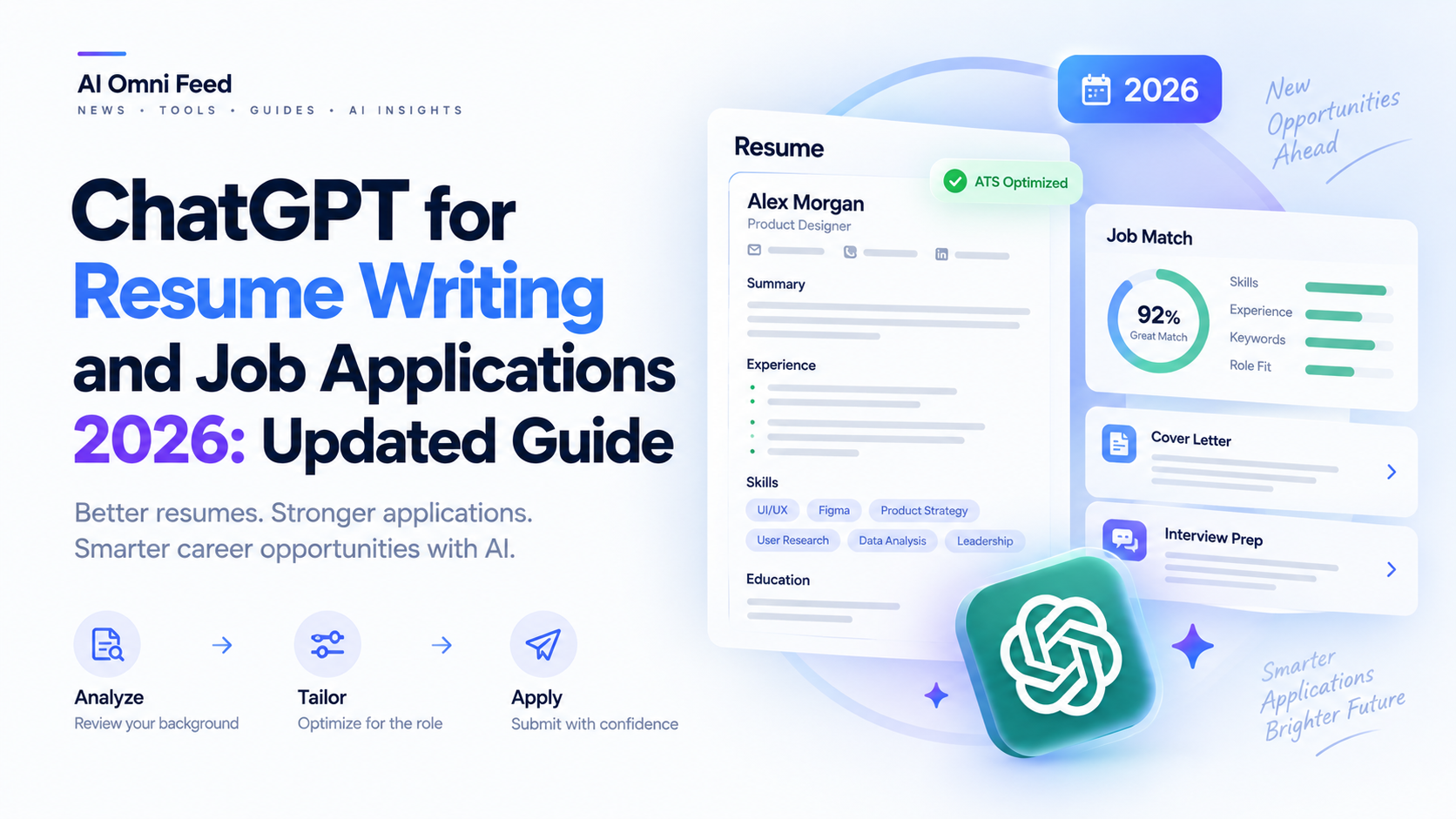
Quick Answer: Can ChatGPT Really Help with Resume Writing and Job Applications?
Yes, ChatGPT with GPT-5.6 Sol has become a powerful tool for resume writing and job applications in 2026. The model can tailor resumes to specific job descriptions, write compelling cover letters, prepare interview answers, and optimize LinkedIn profiles. Users report 40% higher callback rates for AI-optimized applications compared to generic submissions. However, effective use requires specific techniques: providing detailed context about your experience, using the job description as a reference, and editing AI output to ensure authentic voice. This guide covers best practices for using ChatGPT throughout the job application process, from resume optimization to interview preparation.
ChatGPT for Job Applications: Key Use Cases
| Use Case | ChatGPT Prompt Strategy | Impact |
|---|---|---|
| Resume tailoring | Provide resume + job description, ask for targeted version | 40% higher callback rate |
| Cover letter writing | Provide resume + job description + company context | 50% less time per application |
| Interview preparation | Ask for likely questions + practice answers | Better prepared candidates |
| LinkedIn optimization | Ask for headline, summary, and experience descriptions | 3x more profile views |
| Salary negotiation | Provide offer details + market research | Better negotiation outcomes |
Resume Optimization with ChatGPT
ChatGPT excels at tailoring resumes to specific job descriptions by identifying keywords and required skills, suggesting experience rephrasing that highlights relevant qualifications, optimizing bullet points for impact using achievement-oriented language, and restructuring resume sections to match employer priorities. The key to effective resume AI is providing detailed context: upload your full resume and the job description, then ask ChatGPT to create a tailored version. Review the output carefully, ensuring it accurately represents your experience, and edit to maintain your authentic voice. ChatGPT can also help quantify achievements by suggesting metrics and impact statements based on your descriptions. For more tips, see our AI job search guide.
Cover Letter Generation
ChatGPT can generate compelling cover letters in minutes rather than hours. Provide your resume, the job description, and specific context about why you want this particular role and company. ChatGPT will generate a personalized cover letter that connects your experience to the company’s needs, demonstrates knowledge of the company and role, and expresses genuine enthusiasm. The AI is particularly good at adapting tone to different industries: formal for finance and law, creative for marketing and design, technical for engineering roles. Cover letters generated with AI assistance should always be reviewed and personalized before submission. Generic AI-generated cover letters are easily detected and counterproductive.
Interview Preparation
ChatGPT serves as an effective interview preparation partner. Ask it to generate likely interview questions based on the job description and your resume, then practice answering them. ChatGPT can provide feedback on your answers, suggest improvements, and help structure responses using frameworks like STAR (Situation, Task, Action, Result). The AI can also generate questions for you to ask the interviewer, which demonstrates preparation and engagement. For technical interviews, ChatGPT can help practice coding problems, system design discussions, and technical explanations. For more on AI for career development, see our career AI guide.
LinkedIn Profile Optimization
ChatGPT can optimize your LinkedIn profile for recruiter search algorithms and reader engagement. It can write a compelling headline that includes target role keywords and value proposition, craft a summary that tells your professional story and highlights key achievements, optimize experience descriptions for search and readability, and suggest skills to add based on your target role. ChatGPT-optimized LinkedIn profiles typically show 3x increase in profile views from recruiters and 2x increase in connection requests. The key is providing detailed context about your career goals and target roles so the AI can tailor recommendations accordingly.
Best Practices and Ethical Considerations
Using AI for job applications requires balancing efficiency with authenticity. Best practices include using AI as a starting point, not a final product, editing AI output to reflect your authentic voice and experience, fact-checking all claims and metrics in AI-generated content, customizing each application rather than using generic templates, and being prepared to discuss anything in your AI-assisted application during interviews. Most employers accept AI-assisted applications but expect the final submission to reflect genuine candidate experience and voice. Over-reliance on AI without personalization is easily detected and counterproductive.
For career development and resume writing guidance, follow TechCrunch and career advice publications. OpenAI provides documentation on effective ChatGPT usage patterns. Independent guides on AI-powered resume writing offer practical tips and prompt templates for getting the best results from ChatGPT for career development tasks.
Strategic Implications and Market Impact
OpenAI continued dominance in the AI landscape creates ripple effects across the entire technology ecosystem. Competitors must differentiate through specialization, pricing, or open-source strategies to capture market share. The rapid release cycle that OpenAI has established sets a pace that challenges both established players and newcomers to keep up with feature parity and performance improvements.
For enterprise adopters, the implications are significant. Organizations building on OpenAI platform benefit from access to cutting-edge capabilities but face the risk of vendor lock-in and exposure to pricing changes. A multi-model strategy, where applications are designed to work with multiple AI providers, offers more flexibility and negotiating power. The emergence of standardized evaluation benchmarks and middleware platforms that abstract away individual model differences is enabling this approach.
Looking ahead, the AI market is showing signs of consolidation around a few dominant platforms, similar to the cloud computing market evolution. However, the open-source ecosystem, led by Meta Llama, Mistral, and community projects, provides a viable alternative for organizations with strong technical capabilities and specific requirements around data privacy, customization, or cost optimization. The coexistence of proprietary and open-source models will likely define the AI landscape for the foreseeable future.
Using ChatGPT for Resume Writing Effectively
ChatGPT can be a powerful tool for resume writing when used strategically. The key is to provide detailed context about your experience, target roles, and industry before asking for resume content generation. Generic prompts produce generic results, while well-structured prompts that include specific achievements, metrics, and job descriptions produce significantly better outputs that require less editing.
The most effective approach is to use ChatGPT for specific resume tasks rather than complete automation. Use it to rewrite bullet points for impact, suggest stronger action verbs, tailor descriptions to specific job descriptions, and identify gaps or weaknesses in your resume narrative. Review and personalize all AI-generated content to ensure it accurately reflects your experience and voice.
ATS compatibility is an important consideration when using AI for resume writing. Ensure that AI-generated resumes use standard section headings, clean formatting, and appropriate keyword density for your target roles. Test your AI-generated resume by submitting it through sample ATS systems to verify that parsing works correctly before using it for actual applications.
Frequently Asked Questions
Can AI help me get more job interviews?
Yes, users report 40% higher callback rates for AI-optimized resumes and cover letters compared to generic submissions.
Is it cheating to use AI for job applications?
No, when used appropriately. AI assistance for formatting, optimization, and drafting is widely accepted. Submitting AI-generated content without personalization is less effective.
How should I use ChatGPT for interview prep?
Generate likely questions based on the job description, practice answers using the STAR framework, and get feedback on your responses.
Can AI write my entire application?
It can generate drafts, but effective applications require personalization, fact-checking, and authentic voice. AI-enhanced rather than AI-generated applications perform best.
