
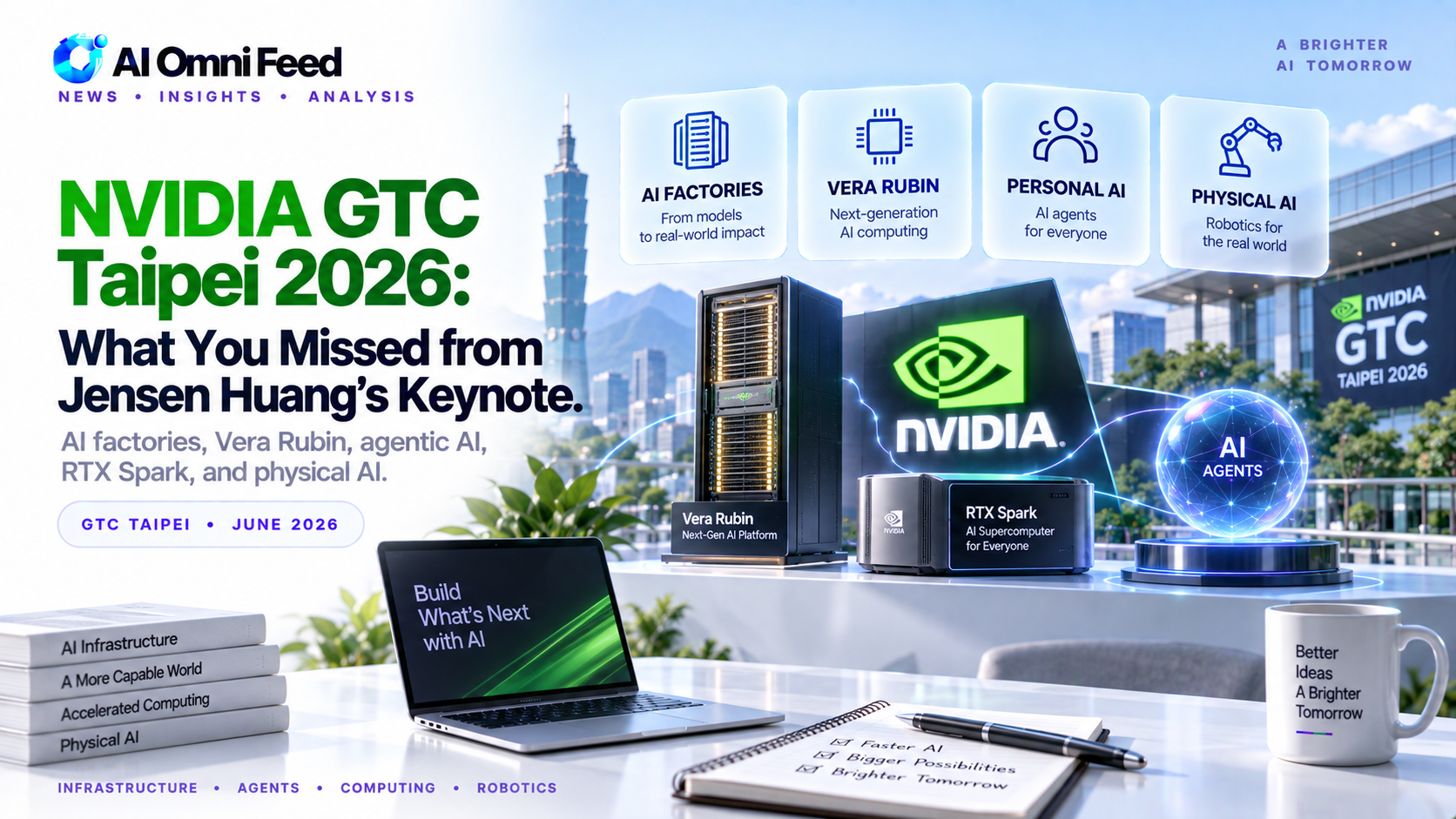
Quick Answer: NVIDIA GTC Taipei 2026
Jensen Huang keynote at GTC Taipei 2026 announced the Vera Rubin platform entering full production, RTX Spark for edge AI, Cosmos 3 open physical AI foundation model, and Isaac GR00T humanoid robot research platform. These announcements signal NVIDIA strategy to dominate AI hardware from data center to edge to robotics.
Key Takeaways
- NVIDIA Vera Rubin platform enters full production, delivering 10x agentic AI throughput at 1/10th the cost per token of Grace Blackwell.
- RTX Spark superchip brings 1 petaflop of AI performance to Windows PCs for on-device personal AI agents.
- NVIDIA released Cosmos 3, the first fully open omnimodel for physical AI, and the Isaac GR00T open humanoid robot reference design.
What Did NVIDIA Announce at GTC Taipei 2026?
NVIDIA CEO Jensen Huang delivered the keynote at GTC Taipei on May 31, 2026, announcing a sweeping set of new hardware and software products. The announcements centered on a single theme: AI is moving from training in data centers to running as autonomous agents everywhere — in robots, cars, PCs, and factories.
The major launches included the Vera Rubin platform, the RTX Spark superchip for Windows PCs, the Cosmos 3 open world model, and the Isaac GR00T reference humanoid robot.
NVIDIA Vera Rubin Platform: Entering Full Production
The Vera Rubin platform is NVIDIA’s next-generation AI infrastructure designed specifically for agentic AI workloads. The platform pairs the new Rubin GPU with the Vera CPU, which features 88 custom Olympus cores and an LPDDR5X memory subsystem delivering 1.2 TB/s of bandwidth.
Key specifications:
- 10x agentic AI throughput compared to Grace Blackwell
- 1/10th the cost per token for inference
- Vera CPU outperforms x86 processors by 1.8x on agentic tasks
- NVL72 configuration pairs 36 Vera CPUs with 72 Rubin GPUs
- NVLink 6 interconnects for high-speed communication
- BlueField-4 STX storage processor for persistent agent context
Early adopters include Anthropic, OpenAI, xAI, CoreWeave, ByteDance, and Oracle Cloud Infrastructure. Systems ship fall 2026.
What Is NVIDIA RTX Spark?
RTX Spark is a new superchip that brings 1 petaflop of AI performance to Windows laptops and compact desktops. It features up to 128GB of unified memory and is purpose-built for running AI agents locally with full privacy and security.
NVIDIA partnered with Microsoft to deliver new Windows security primitives and the NVIDIA OpenShell runtime, enabling agents to run in isolated sandbox environments on-device. Adobe is rearchitecting Photoshop and Premiere for RTX Spark, delivering up to 2x faster AI performance.
RTX Spark laptops and desktops will be available fall 2026 from ASUS, Dell, HP, Lenovo, Microsoft Surface, MSI, Acer, and GIGABYTE.
NVIDIA Cosmos 3: Open Physical AI Foundation Model
Cosmos 3 is NVIDIA’s most advanced open world foundation model for physical AI. It uses a mixture-of-transformers architecture and is the first fully open omnimodel capable of native vision reasoning and multimodal generation across text, images, video, ambient sound, and action.
Among open models, Cosmos 3 ranks first on Artificial Analysis, Physics-IQ, PAI-Bench, and R-Bench for world generation accuracy, and leads on RoboLab and RoboArena for action policy.
NVIDIA also launched the Cosmos Coalition — a collaboration with Agile Robots, Black Forest Labs, Runway, Skild AI, and others. Cosmos 3 Super and Nano are available now on Hugging Face.
Isaac GR00T: Open Humanoid Robot for Research
NVIDIA announced the Isaac GR00T Reference Humanoid Robot, the first open humanoid robot reference design. It combines a Unitree H2 Plus humanoid chassis, Sharpa five-fingered dexterous hands, an NVIDIA Jetson Thor onboard computer, and the Isaac GR00T open software stack.
Leading research institutions including Ai2, ETH Zurich, Stanford Robotics Center, and UC San Diego will use the platform. The robot will be available from Unitree in late 2026.
What This Means for the AI Industry
NVIDIA’s GTC Taipei announcements signal a clear strategic shift: the company is building the full hardware-software stack for agentic AI, from data-center-scale training (Vera Rubin) to on-device inference (RTX Spark) to physical world interaction (Cosmos 3, Isaac GR00T). The throughline is that AI is no longer just about generating text and images — it is about autonomous systems that perceive, reason, and act in the real world.
NVIDIA’s Strategic Position in the AI Hardware Market
NVIDIA’s dominance in AI hardware continues with these announcements. The company controls roughly 80-90% of the AI accelerator market, and products like Vera Rubin and RTX Spark extend that lead. What is notable about the GTC Taipei announcements is the emphasis on agentic AI specifically rather than general AI training. NVIDIA is betting that the next phase of AI growth comes from autonomous agents running inference at scale, not just training larger models. This strategic bet shapes their entire product roadmap from data center to edge devices.
The Vera Rubin platform’s 10x improvement in agentic AI throughput and 90% reduction in cost per token directly addresses the economics that have limited agent deployment. By making inference dramatically cheaper, NVIDIA is attempting to unlock the mass adoption of AI agents in enterprise and consumer applications. The RTX Spark superchip extends this vision to the PC, enabling local AI agents that operate with full privacy and no ongoing API costs.
Competitive Landscape and Industry Response
NVIDIA’s announcements put pressure on competitors AMD and Intel, who are developing their own AI accelerator roadmaps but remain years behind in software ecosystem maturity. AMD’s MI400 series targets AI training workloads but lacks the agentic optimization focus of Vera Rubin. Intel’s Gaudi 3 has found niche adoption but cannot compete at scale. The industry response has been mixed: while customers welcome the performance improvements, there is growing concern about dependency on a single vendor for AI infrastructure. Several major tech companies are investing in custom AI chips (Google TPU, Amazon Trainium, Microsoft Maia) to reduce NVIDIA dependency.
NVIDIA GTC Taipei 2026 Announcements
| Announcement | Category | Impact | Availability |
|---|---|---|---|
| Vera Rubin Platform | Hardware | Next-gen AI training | Full production |
| RTX Spark | Edge AI | On-device inference | Upcoming |
| Cosmos 3 | Foundation Model | Physical AI research | Open source |
| Isaac GR00T | Robotics | Humanoid robot platform | Research |
NVIDIA Hardware Roadmap Beyond GTC Taipei
Beyond the headline announcements at GTC Taipei 2026, NVIDIA shared its broader hardware roadmap. The Vera Rubin platform represents a complete architecture redesign with significant improvements in memory bandwidth, interconnect speed, and power efficiency compared to the Blackwell generation. Early benchmark results shared at GTC suggest Vera Rubin delivers 3-4x training performance improvement for large language models while reducing total cost of ownership by approximately 40%.
RTX Spark targets the growing edge AI market, bringing server-grade inference capabilities to local devices. This enables applications where low latency and data privacy are critical, such as manufacturing quality control, autonomous vehicle subsystems, and medical device AI. The platform supports NVIDIA full software stack including TensorRT and Triton Inference Server, making it easy for developers to deploy models trained in the cloud to edge devices. Cosmos 3 open-source release gives researchers access to state-of-the-art physical world understanding, accelerating progress in robotics and autonomous systems.
Frequently Asked Questions
What did NVIDIA announce at GTC Taipei 2026?
Vera Rubin platform entering production, RTX Spark for edge AI, Cosmos 3 open-source physical AI model, and Isaac GR00T humanoid robotics platform.
What is NVIDIA Vera Rubin?
Vera Rubin is NVIDIA next-generation AI training platform, succeeding Hopper and Blackwell architectures, designed for large-scale AI model training.
What is NVIDIA Cosmos 3?
Cosmos 3 is an open physical AI foundation model that helps robots and autonomous systems understand and navigate the physical world.
