Quick Answer: What Is the EU AI Act and Why Does August 2026 Matter?
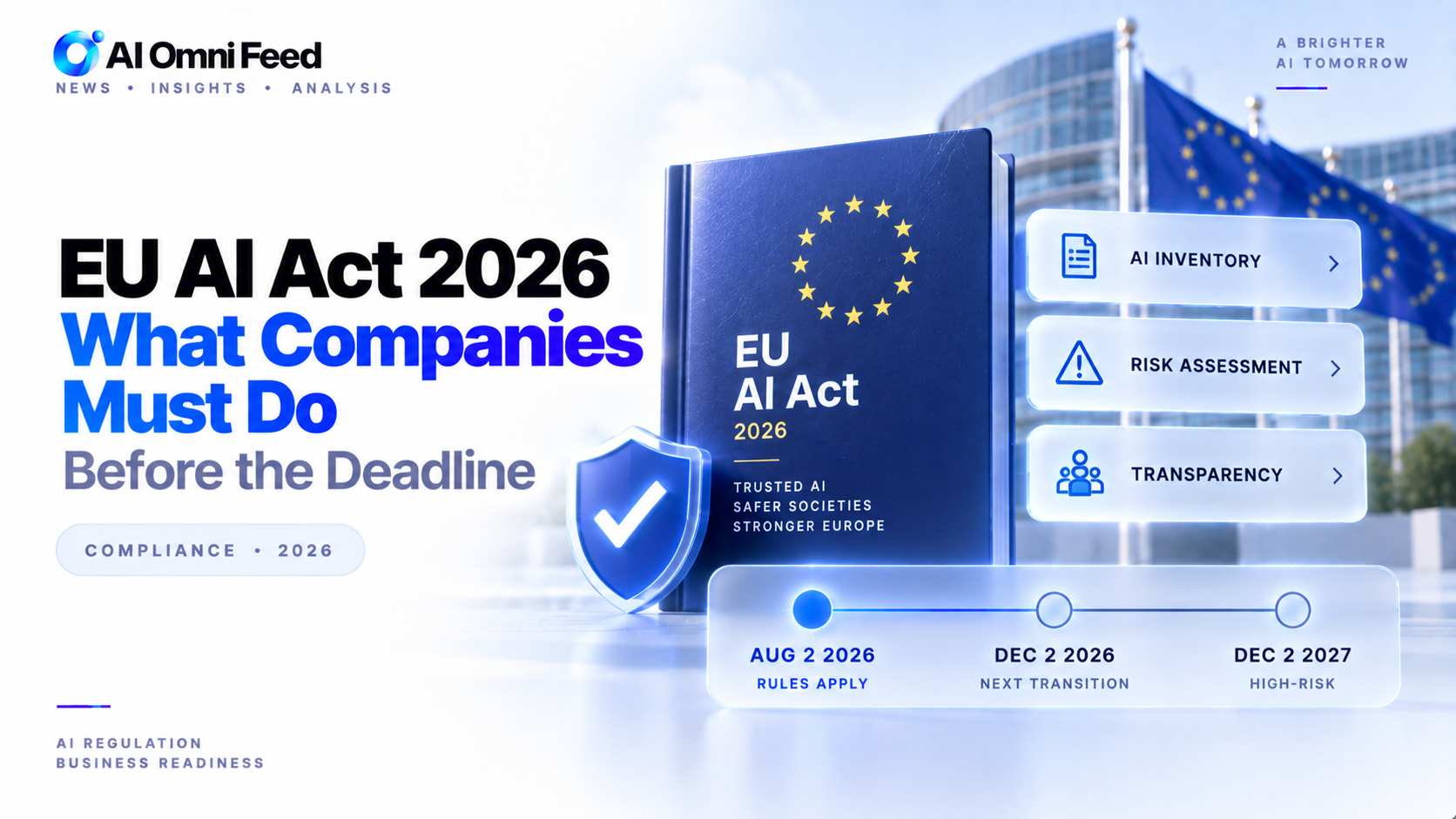
The EU AI Act is the world first comprehensive artificial intelligence regulation. It classifies AI systems by risk level and imposes requirements ranging from transparency disclosures to full conformity assessments. August 2, 2026 is the critical deadline when most obligations take effect for high-risk AI systems, transparency requirements, and general-purpose AI provider rules. Many companies mistakenly believe they have until August 2027, but the earlier deadline applies to most organizations. Non-compliance penalties can reach up to 7% of global annual turnover or 35 million euros, whichever is higher. Understanding the deadline and your obligations is urgent.
Does the EU AI Act Apply to Your Company?
The EU AI Act has broad extraterritorial reach. It applies to any organization that places AI systems on the EU market or whose AI system outputs are used in the EU, regardless of where the company is headquartered. A US-based SaaS company whose AI features are used by EU customers is subject to the Act. A Japanese manufacturer whose AI quality control system affects products sold in Europe is subject to the Act. A Canadian AI startup whose API is called by an EU application is subject to the Act. The reach is intentionally broad and covers the entire AI value chain.
However, most B2B software companies fall into the minimal or limited risk categories if their AI systems do not appear in Annex III of the regulation. Annex III lists high-risk categories including biometric identification, critical infrastructure management, education and vocational training, employment and worker management, credit scoring, law enforcement, migration and border control, and administration of justice. If your AI system does not fall into these categories, your obligations are limited to transparency disclosures rather than full conformity assessments.
The Four Risk Categories
| Risk Level | Examples | Requirements | Timeline |
|---|---|---|---|
| Prohibited | Social scoring, real-time biometric surveillance in public | Banned entirely | Already in effect |
| High-risk | Employment AI, credit scoring, biometric ID, education AI | Conformity assessment, risk management, human oversight | August 2, 2026 |
| Limited risk | Chatbots, AI content generation | Transparency disclosures only | August 2, 2026 |
| Minimal risk | AI video games, spam filters | No obligations | N/A |
What You Must Do by August 2, 2026
If your AI system is high-risk (classified under Annex III), you must complete several requirements. Implement a risk management system that identifies, evaluates, and mitigates risks throughout the AI system lifecycle. Establish data governance practices ensuring training data is relevant, representative, and free from biases. Prepare technical documentation demonstrating compliance, including the intended purpose, design specifications, and development methodology. Design for transparency so users know they are interacting with an AI system. Implement human oversight measures including the ability for humans to override or stop the AI system. Ensure accuracy and robustness through appropriate testing and validation.
Even if your AI system is limited risk rather than high-risk, you still have obligations. You must disclose when content is AI-generated. Chatbots must inform users they are interacting with AI. Deepfakes and AI-generated synthetic content must be labeled. These transparency requirements apply broadly and affect most companies deploying AI in customer-facing applications. The cost of non-compliance is significant. For high-risk systems, penalties can reach 7% of global annual turnover or 35 million euros. For transparency violations, penalties reach 3% of global annual turnover or 15 million euros.
AI Literacy: The Requirement You May Have Missed
One requirement already in effect since February 2, 2025 is often overlooked. Article 4 of the EU AI Act requires organizations to ensure AI literacy among staff who deploy or use AI systems. This means organizations must provide training so that employees understand how AI systems work, their capabilities and limitations, and the risks associated with their use. The requirement applies regardless of risk classification, meaning every organization subject to the Act must have an AI literacy program in place.
Practical steps include conducting an AI skills assessment across your organization, developing training materials tailored to different roles, implementing a documented training program with completion tracking, updating training as AI technology and regulations evolve, and maintaining records of training completion for potential audit. The AI literacy requirement is one of the easiest to implement but one of the most frequently missed. For broader context on AI regulation, see our analysis of the Florida OpenAI lawsuit.
EU AI Act and GDPR: How They Interact
The EU AI Act does not replace GDPR. If you process personal data through AI systems, both regulations apply simultaneously. A financial institution using AI for credit scoring must comply with both the AI Act high-risk requirements and GDPR data protection principles. The good news is that many GDPR compliance measures overlap with AI Act requirements. A Data Protection Impact Assessment covers much of the AI Act documentation requirements for high-risk systems. Organizations with mature GDPR compliance programs are typically ahead on AI Act readiness. However, the AI Act introduces additional requirements around transparency, human oversight, and risk management that go beyond GDPR.
Cost of Compliance
For organizations with high-risk AI systems, compliance costs are significant but manageable. Estimates from Flint Brief suggest compliance costs of 30,000 to 120,000 euros for SMEs, covering risk management implementation, technical documentation preparation, conformity assessment engagement, and ongoing monitoring and auditing. For limited risk systems, costs are substantially lower, primarily involving transparency disclosures and AI literacy training. The cost of non-compliance is much higher: up to 7% of global annual turnover creates existential risk for non-compliant organizations. For more on AI economics and costs, see our economics of AI analysis.
What Changed in June 2026
The European Parliament voted in June 2026 to amend certain AI Act provisions. The amendments delayed some deadlines for specific provisions while clarifying ambiguity around foundation model regulation. The general-purpose AI code of practice timeline was extended, giving foundation model providers more time to develop compliance frameworks. However, the core August 2, 2026 deadline for high-risk system obligations remains unchanged. Organizations should not interpret the amendments as reason to delay compliance efforts.
How to Build Your EU AI Act Compliance Program
Building an EU AI Act compliance program requires a structured approach that integrates with existing governance frameworks. Start with an AI system inventory that catalogs every AI system your organization deploys, including third-party systems embedded in commercial software. Classify each system by risk category based on the Act Annex III criteria. Document the intended purpose, data sources, and decision-making scope of each system. Prioritize high-risk systems for immediate compliance work while ensuring transparency requirements are met across all systems.
Engage legal counsel with AI regulation expertise early in the process. The AI Act interacts with GDPR, sector-specific regulations like financial services compliance or medical device regulation, and emerging AI laws in other jurisdictions. A coordinated compliance strategy across all applicable regulations is more efficient than addressing each regulation separately. Most organizations find that their existing GDPR compliance infrastructure, particularly data protection impact assessments and documentation practices, provides a strong foundation for AI Act compliance. The key is extending these practices to cover AI-specific requirements around transparency, human oversight, and risk management that GDPR does not address.
Frequently Asked Questions
Does the EU AI Act apply to US companies?
Yes. The Act applies to any organization whose AI system outputs are used in the EU, regardless of where the company is headquartered. US companies with EU customers are subject to the Act.
What happens if we miss the August 2026 deadline?
Non-compliance penalties reach up to 7% of global annual turnover or 35 million euros for high-risk violations. Regulatory authorities can also order system suspension and mandatory remediation.
How do I know if my AI system is high-risk?
Check Annex III of the AI Act. Systems in categories like biometric identification, employment, credit scoring, education, and critical infrastructure are high-risk. If your system is not listed, obligations are limited to transparency.
What is the first thing I should do to prepare?
Conduct an AI system inventory to classify each system by risk level. Implement AI literacy training for staff. These two steps address the most immediate requirements and provide a foundation for further compliance work.
