Quick Answer: The Biggest AI News So Far This Week
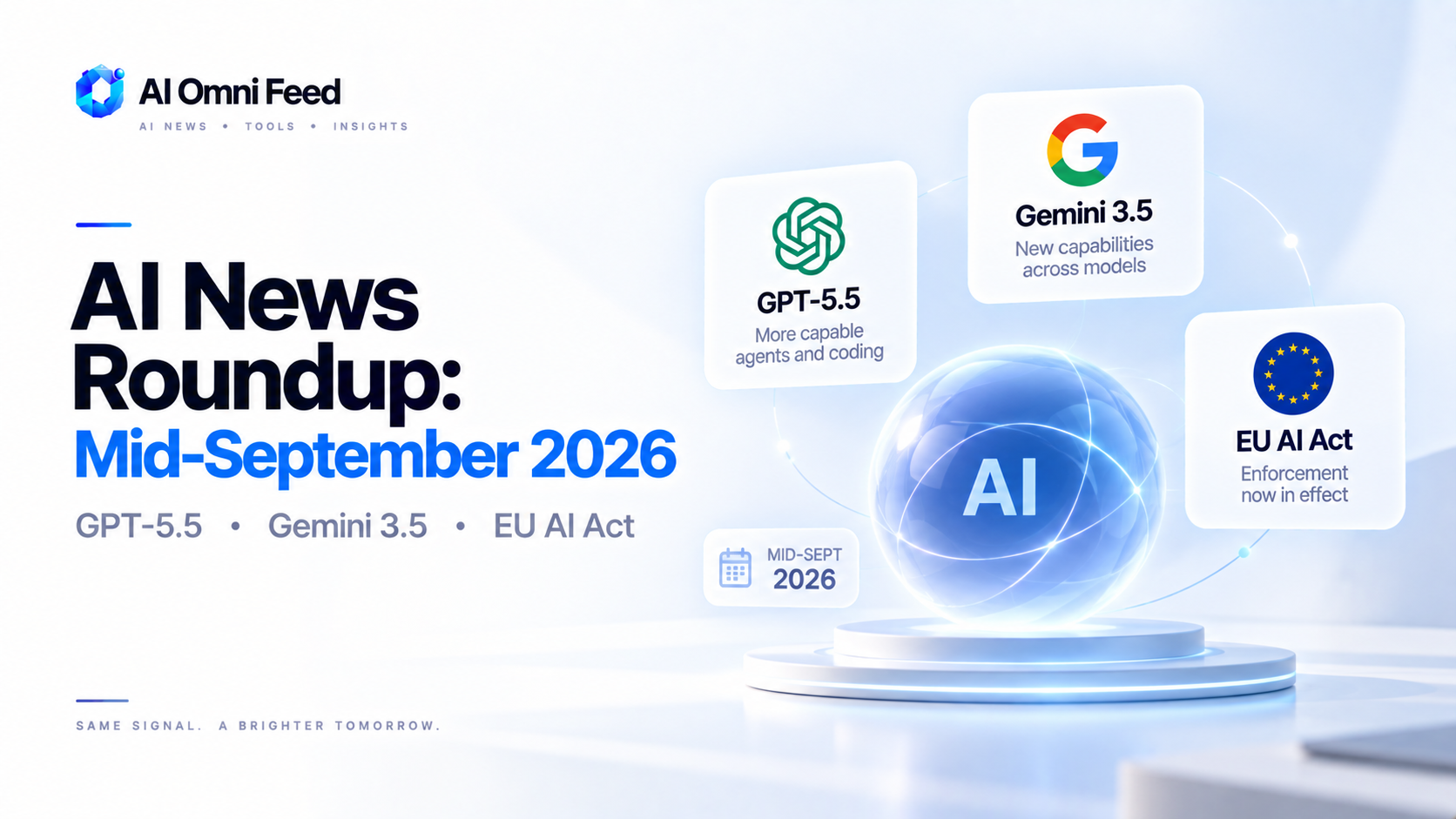
The big stories this week in AI: OpenAI began quietly rolling out the first GPT-5.5 research previews to select enterprise partners, Google shipped the Gemini 3.5 Ultra release candidate to a small set of API testers, Anthropic expanded Claude’s enterprise approval workflows, and the EU AI Act entered its compliance enforcement phase for high-risk systems. OpenAI’s IPO filing also moved forward, with the first public S-1 documents revealing projected revenue run-rate targets. This roundup covers each story with context on what it actually means for developers and businesses, not just the headlines.
OpenAI Rolls Out GPT-5.5 Research Previews to Enterprise Partners
The first GPT-5.5 research previews started landing with select enterprise partners this week. OpenAI is positioning the model as a compute-efficiency upgrade rather than a generational leap – public roadmap materials describe roughly 1.4x better performance on coding and agentic benchmarks versus GPT-5.6 Sol, with a similar token price point. A public release is not yet dated, and OpenAI says it expects several months of partner testing before GA. For businesses already deep in the OpenAI stack, the practical takeaway is simpler: stay on GPT-5.6 Sol for now, because the near-term gains come from efficiency rather than new capability. If you need the full current model lineup compared, our big model comparison is kept up to date.
Gemini 3.5 Ultra Release Candidate Reaches API Testers
Google quietly pushed the Gemini 3.5 Ultra release candidate to a small set of API testers this week. Early feedback from testers (leaked mainly via niche developer communities) points to strong gains on long-context and multimodal reasoning, with tougher competition at the very top of the frontier on agentic coding – where OpenAI and Anthropic still lead. Google is expected to announce broader availability in the coming weeks. The competitive picture across the four main model families – OpenAI, Google, Anthropic, and xAI – continues to narrow at the flagship tier, with each vendor now leapfrogging the others by inches rather than by a full generation.
Anthropic Expands Claude Enterprise Approval Workflows
Anthropic announced an expansion of Claude’s enterprise approval workflow capabilities this week. The new release lets businesses require human sign-off for specific categories of agentic actions – sending external emails, making purchases above a set dollar threshold, or deploying code to production – while allowing autonomous execution for everything else. This addresses a critical concern for regulated industries (finance, healthcare, legal) that were previously reluctant to let Claude agents act on their own. It builds directly on the approval-workflow direction we flagged in our September roundup.
EU AI Act Compliance Enforcement Begins for High-Risk Systems
This week marked the start of EU AI Act enforcement for systems classified as high-risk. The practical effect for European businesses: providers and deployers must now demonstrate compliance documentation, risk assessments, and human-oversight measures for high-risk use cases, or face fines that scale with company turnover. Many US-based vendors are responding by rolling out EU-specific compliance packages. Notably, xAI’s Grok remains unavailable in the EU, which continues to matter for European teams evaluating model options – the xAI pricing dispute with the EU was covered in our July roundup.
OpenAI IPO Filing Moves Forward
OpenAI’s IPO moved a step forward with the first public portions of its S-1 filing surfacing this week. The documents reportedly outline a revenue run-rate target, continued heavy compute investment, and the previously announced 5% government stakeholder structure. No date or price range has been set. For buyers of ChatGPT and API access, the near-term implication is minimal – the filing points to continued heavy focus on enterprise revenue, which suggests API pricing stability in 2026. See our full IPO analysis for the strategic details.
Numbers That Matter This Week
A few figures give the week some shape. OpenAI’s S-1 materials reportedly target a near-term revenue run-rate that would put it among the fastest scaling enterprise software companies on record, though exact figures remain confidential ahead of the formal filing. Gemini 3.5 Ultra testers describe roughly 15-20% gains on multimodal benchmarks over the current production model, consistent with Google’s pattern of incremental Ultra releases. EU enforcement fines for high-risk violations start at a scale tied to global turnover – for the largest deployers that means meaningful financial exposure, which is precisely why enterprise vendors are rushing out compliance tooling. And on the open-source side, Llama 5 previews continue to show credible progress on on-device agentic tasks, keeping pressure on proprietary vendors at the small-model tier even as the flagship race stays dominated by OpenAI, Anthropic, and Google.
Also This Week: Five Quick Stories Worth Knowing
- Llama 5 previews continued through their third-party partner program, with Meta emphasizing agentic tool use and on-device performance.
- Legal AI deals accelerated: another mid-size firm signed a deal to deploy Claude-based document review after the trend we covered in late July.
- AI phone answering tooling got cheaper: one major provider cut entry pricing, relevant if you’re evaluating AI phone answering for your small business.
- Copilot Marketplace traction: GitHub reported strong growth in third-party tools published for Copilot, an ecosystem play we’d watch for agentic workflows.
- No-code AI app builders matured: Bolt.new shipped improved database handling in its platform, one of several updates we track in our no-code builder guide.
What to Watch Next
Three things to watch over the next two weeks: first, whether OpenAI discusses GPT-5.5 timing publicly at any of its upcoming events; second, Google’s Gemini 3.5 Ultra announcement, which could land around a late-September developer day; and third, how the EU enforcement phase plays out for real high-risk deployments in the first weeks of compliance. For businesses, the actionable advice remains the same as it has been all year: don’t chase previews, standardize on a stable model, and wait for GA before relying on new capability in production.
FAQs About This Week in AI
Is GPT-5.5 out yet?
No. Only research previews are rolling out to select enterprise partners. OpenAI has not announced a GA date, and GPT-5.6 Sol remains the production model businesses should standardize on.
When will Gemini 3.5 Ultra be publicly available?
It’s in a release-candidate phase with API testers. Google hasn’t announced an exact date but broader availability is expected within weeks.
Does the EU AI Act affect US companies?
Yes, if you offer high-risk AI systems or deploy them where EU users are affected. Compliance requirements and fines now apply, with enforcement starting this week for high-risk systems.
What changed for Claude enterprise approvals?
Anthropic now allows businesses to require human sign-off on specific agentic actions (external emails, purchases over a threshold, production deploys) while allowing autonomous execution for everything else – important for regulated industries.
Should I switch models based on these news items?
No. None of this week’s announcements change the production recommendation: stick with the stable flagship model you already use (GPT-5.6, Claude, Gemini) and wait for any new model to reach GA before evaluating.
