Quick Answer: Open Source vs Closed Source AI
Closed source AI models like GPT-5 and Claude Opus currently lead in raw capability, reliability, and safety features. Open source models like Llama 4 and Mistral Large have narrowed the gap significantly and offer advantages in customization, privacy, and cost. The best choice depends on your use case: closed source for production applications requiring reliability, open source for custom deployments and privacy-sensitive applications. Many organizations now use a hybrid approach, combining both based on specific needs.
Key Takeaways
- Open-source models like DeepSeek R2, Gemma 4, and Kimi K2.5 now rival closed models on many benchmarks.
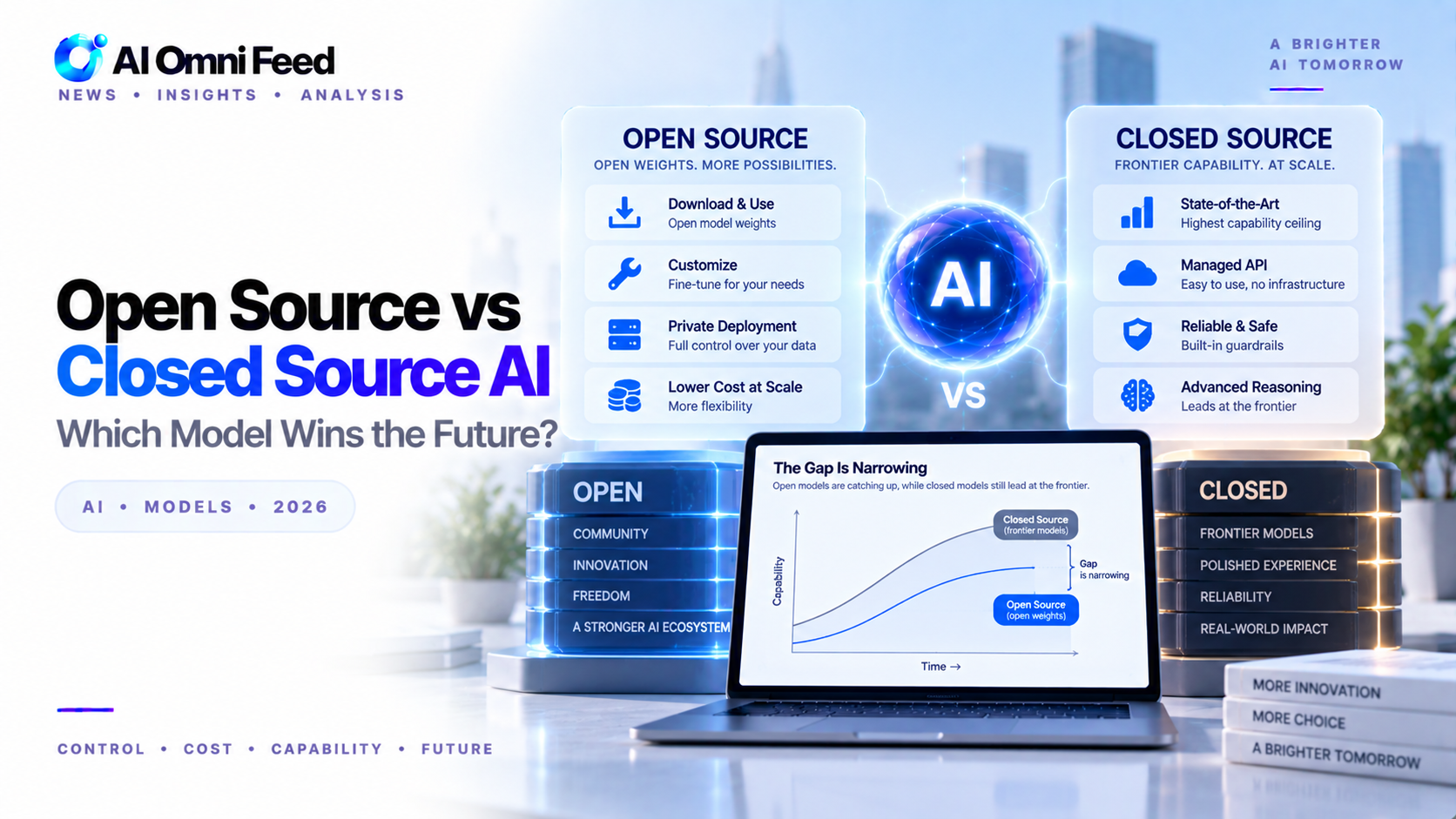
- Closed models still lead at the absolute frontier but the gap has narrowed to single-digit percentages.
- The choice often comes down to control and cost versus convenience and capability.
Open Source vs Closed Source AI: Which Model Wins the Future?
The debate between open and closed AI models is one of the most consequential in technology. Both approaches have advantages, and the gap between them is narrowing faster than most expected.
The Case for Closed Source
Closed models like GPT-5.5, Claude Opus 4.8, and Gemini 3.5 Pro offer the highest capability at the frontier. They are backed by massive infrastructure investments, rigorous safety testing, and enterprise-grade support. You pay per token and get the best possible performance. Best for: high-stakes applications where quality cannot be compromised.
The Case for Open Source
Open models like DeepSeek R2, Gemma 4 31B, Kimi K2.5, and Stable Diffusion 4 offer compelling advantages: zero per-token cost, full data privacy (runs locally), complete control over customization, and no vendor lock-in. The quality gap with frontier closed models has shrunk to approximately 5-10% on most benchmarks. Best for: privacy-sensitive applications, high-volume usage, and customization.
The Middle Ground
Most organizations use both. Use closed frontier models for complex reasoning, analysis, and generation tasks where quality matters most. Use open models for routine inference, internal tools, and high-volume workloads where cost and privacy take priority.
The Verdict
Neither wins outright. The market is settling into a hybrid model where closed frontier models define the ceiling and open models define the floor. The smart strategy is to build systems that can work with both and switch based on the task.
Key Players in the Open Source AI Ecosystem
The open-source AI landscape is diverse. Meta‘s Llama 4 family offers models from 8B to 405B parameters, covering edge deployment to data center use. Mistral’s models emphasize efficiency and are popular in Europe for data sovereignty reasons. DeepSeek R2 from China has gained attention for competitive benchmark scores at a fraction of the training cost of US models. Gemma 4 from Google bridges the gap between open weights and Google’s infrastructure. Kimi K2.5 from Moonshot AI excels at long-context reasoning. Each of these models has a community of developers building specialized fine-tuned versions for medical, legal, coding, and creative applications.
Total Cost of Ownership Comparison
Cost analysis reveals a clear but nuanced picture. For low-volume usage (under 1M tokens per month), closed API models are cheaper because there are no infrastructure costs. For medium volume (1M-100M tokens per month), open-source self-hosted models begin to win on cost. For high volume (over 100M tokens per month), open-source models are dramatically cheaper, often 10-100x less expensive than API-based alternatives. The break-even point depends on your hardware costs, electricity, and engineering time for maintenance, but the long-term trend clearly favors open-source for high-volume use cases.
Security and Compliance Considerations
Data security is often the deciding factor for organizations in regulated industries. Closed API models require sending data to third-party servers, which may violate GDPR, HIPAA, or internal data governance policies. Open-source models running on your own infrastructure keep data completely private. For healthcare, legal, financial services, and government applications, this privacy advantage often outweighs any capability gap. The ability to audit the model weights, training data, and inference process also matters for compliance with emerging AI regulations.
The Innovation Dynamic
The relationship between open and closed source AI is symbiotic, not purely competitive. Open-source models benefit from community contributions that improve training techniques, optimization, and safety. Closed-source models push the frontier, demonstrating what is possible and setting benchmarks that the open-source community works to match. Both approaches drive the field forward. The question is not which approach wins, but which mix of open and closed best serves the specific needs of each organization and application.
Ecosystem and Community Support
Open-source models benefit from vibrant communities that create tools, documentation, and fine-tuned variants. Hugging Face hosts thousands of community models, datasets, and demo applications. Developer communities on GitHub and Discord share optimization techniques, troubleshooting advice, and creative use cases. This ecosystem accelerates development and reduces the learning curve for new users. Closed-source models offer professional support, SLAs, and managed infrastructure, which organizations without in-house ML expertise may prefer. The choice between ecosystems depends on your team’s technical capabilities and support needs.
Real-World Migration Patterns
Enterprise adoption patterns in 2026 show a clear trend: organizations start with closed API models for quick experimentation, then migrate high-volume workloads to open-source models for cost efficiency and privacy. Companies like Bloomberg, Goldman Sachs, and Siemens have publicly discussed migrating from GPT-API for internal tools to self-hosted Llama or Mistral deployments. The pattern suggests that closed models serve as an excellent on-ramp, while open models become the long-term infrastructure for production workloads. This hybrid approach captures the benefits of both worlds.
Real-World Migration Patterns: When Organizations Switch
Understanding when organizations switch between open and closed source AI provides practical insights. In 2025-2026, several patterns emerged. Startups typically start with closed source APIs for speed of development, then migrate to open source self-hosted models as usage scales and costs grow. Enterprises with strict data privacy requirements often start with open source and add closed source for specific high-value use cases. Educational institutions increasingly favor open source for teaching and research due to cost and the ability to examine model internals. Healthcare and finance organizations remain split, with closed source preferred for regulated patient-facing applications and open source for internal research and data analysis.
Making the Right Choice for Your Organization
Choosing between open and closed source AI requires evaluating several factors: your data privacy requirements, available technical expertise, usage volume, need for customization, compliance requirements, and budget. For organizations without dedicated ML teams, closed source APIs offer the fastest path to production. For organizations with strong technical capabilities and specific privacy needs, open source provides more control. Many organizations benefit from a phased approach: start with closed source to prove value, then evaluate open source alternatives for production deployment at scale.
Frequently Asked Questions
Which is better: open source or closed source AI?
Neither is universally better. Closed source leads in capability and reliability; open source wins on customization, privacy, and cost. Choose based on your specific use case requirements.
Are open source AI models as good as GPT-5?
Open source models like Llama 4 and Mistral Large now approach GPT-5 performance on many tasks, with the gap narrowing from 30% in 2024 to roughly 5-10% in 2026.
Is open source AI cheaper than closed source?
Yes, for high-volume usage. Open source self-hosted models have no per-token costs, only infrastructure costs. For low-volume usage, closed source APIs may be more economical.
Which is more secure: open source or closed source AI?
Open source offers better data privacy since data stays on your infrastructure. Closed source offers better built-in safety features and regular security updates from the provider.
Can I use both open and closed source AI together?
Yes. Many organizations use hybrid approaches, leveraging closed source for customer-facing applications and open source for internal tools and sensitive data processing.
What is the future of open source vs closed source AI?
The gap continues to narrow, suggesting both will coexist. Open source democratizes AI access while closed source drives frontier capability improvements and safety research.
