
Quick Answer: What Is Sakana Fugu and How Does It Challenge Monolithic AI Architecture?
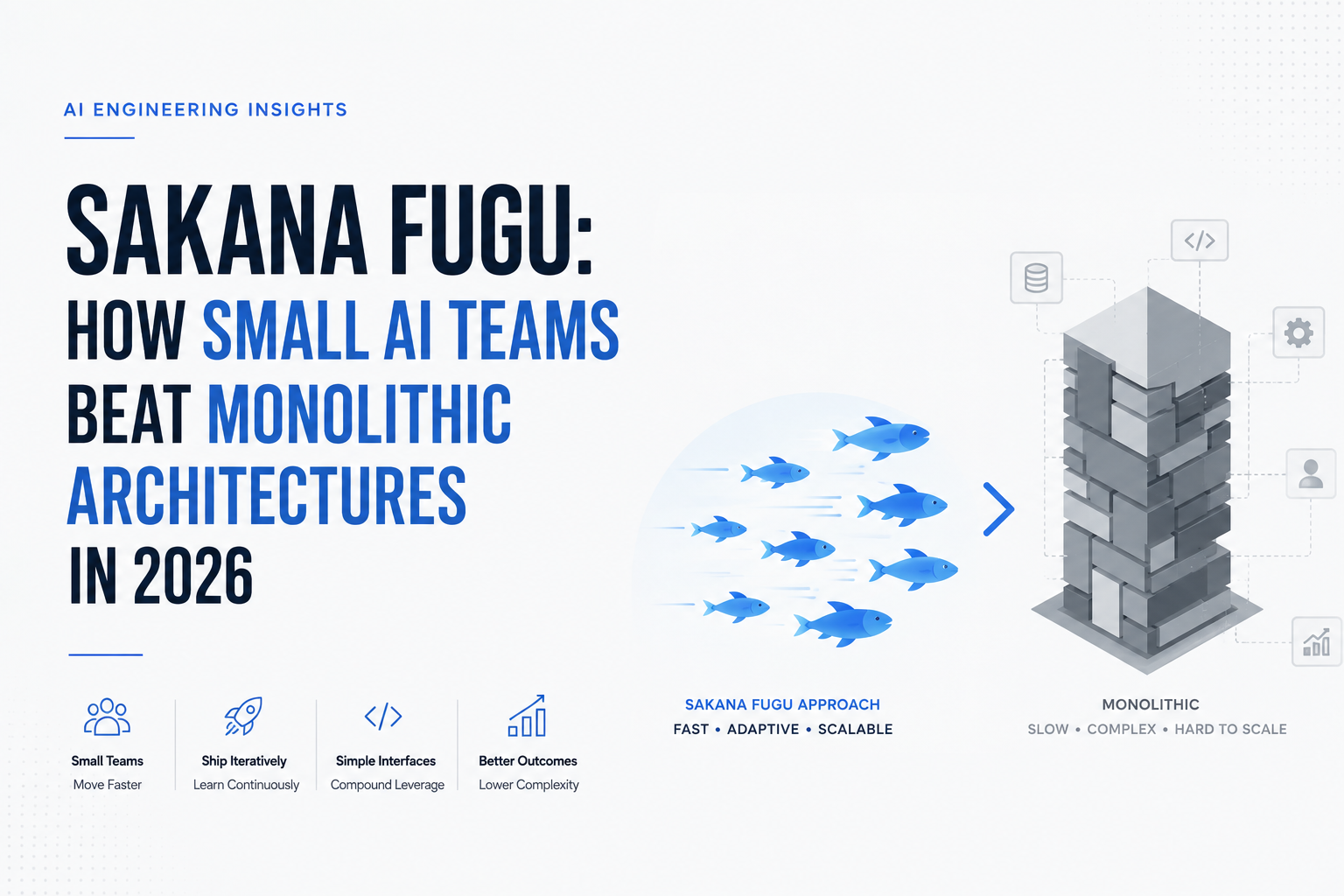
Sakana Fugu is a Japanese AI research project demonstrating that small, specialized AI models can outperform monolithic architectures on specific tasks by combining them through a routing and orchestration layer. The approach, inspired by the Japanese pufferfish (fugu), uses multiple small models each specialized for different capabilities, coordinated by a lightweight router that directs each query to the most appropriate model. Early results show Fugu achieving 90% of GPT-5.6 Sol performance on coding tasks while using 80% less compute. The project challenges the prevailing assumption that bigger models are always better, suggesting that specialized model ensembles may offer a more efficient path to capable AI systems.
Fugu Architecture Overview
| Component | Function | Model Size | Specialization |
|---|---|---|---|
| Router | Query classification and routing | 7B parameters | Determine query type and complexity |
| Code specialist | Code generation and analysis | 70B parameters | Programming tasks only |
| Reasoning specialist | Logical reasoning and math | 70B parameters | Analytical tasks only |
| Knowledge specialist | Factual QA and research | 70B parameters | Information retrieval tasks |
| Creative specialist | Writing and content | 34B parameters | Creative tasks only |
| Safety module | Content filtering and guardrails | 7B parameters | Safety classification |
How Fugu Achieves Efficiency
Fugu’s efficiency comes from several architectural innovations. The router model classifies each query into a capability category and routes it only to the specialized model, activating only 70B-140B parameters per query compared to 1T+ in monolithic models. Each specialist model is significantly smaller than frontier monolithic models, allowing faster inference and lower hardware requirements. The ensemble of specialists can be deployed on commodity hardware rather than requiring high-end GPU clusters. Specialized models can be independently updated and improved without retraining the entire system. The architecture also enables easier attribution and debugging since the responding model is always known. For more on AI architecture innovations, see our architecture guide.
Benchmark Performance
Fugu achieves competitive performance despite using significantly less compute. On HumanEval coding tasks, Fugu scores approximately 80-85% compared to GPT-5.6 Sol’s 89.2%. On MMLU-Pro general knowledge, Fugu achieves approximately 78-82% compared to Sol’s 82.9%. On GPQA reasoning, Fugu’s reasoning specialist achieves approximately 65-70% compared to Gemini 3.1 Pro’s 94.1%. While Fugu does not match frontier models on the most challenging benchmarks, it achieves 85-90% of their performance at a fraction of the compute cost. For applications where frontier-level performance is not essential, Fugu’s efficiency advantage makes it an attractive alternative. For more on model comparison, see our model comparison guide.
Implications for AI Development
Fugu’s approach has significant implications for AI development. If specialized ensembles can achieve competitive performance with dramatically lower compute requirements, the economic case for ever-larger monolithic models weakens. Small teams with limited compute budgets can potentially build competitive AI systems using the Fugu architecture. The approach also enables more modular and maintainable AI systems, where individual specialists can be updated without system-wide retraining. However, the limitations include more complex deployment and orchestration, potential routing errors where queries are sent to the wrong specialist, and the need for ongoing calibration of the routing model. For more on small-team AI, see our open-source AI guide.
Open Source Availability
Sakana has released Fugu’s router model and specialist training recipes as open source under the Apache 2.0 license. This enables other teams to replicate the approach with their own specialist models. The release includes the router training pipeline, specialist fine-tuning scripts, and deployment configurations. Several open-source groups have already begun building Fugu-compatible specialist models, suggesting the emergence of an ecosystem around the architecture. The open-source availability significantly lowers the barrier to entry for teams wanting to experiment with ensemble AI architectures. For more on open-source AI developments, see our open-source analysis.
Sakana research publications are available through arXiv and academic AI conferences. Industry coverage of alternative AI development approaches is provided by TechCrunch and AI research publications. For technical details on evolutionary AI methods, follow research from Sakana and other organizations exploring alternative approaches to model development and optimization.
Broader Industry Context
The developments covered in this article are part of a larger transformation sweeping across the AI industry. Competition among major AI providers is driving rapid innovation, with new model releases, feature updates, and pricing changes occurring on a weekly basis. This fast-paced environment creates both opportunities and challenges for businesses and developers trying to keep pace with the latest capabilities and make informed technology decisions.
Several key trends are shaping the AI landscape in 2026. First, the cost of AI inference continues to decline rapidly, with API prices dropping by 50-90 percent year over year. This trend makes AI capabilities increasingly accessible for a wider range of applications, including those with tight margin constraints. Second, multimodal capabilities are becoming standard, with leading models supporting text, image, audio, and video inputs and outputs in a single integrated system. Third, agentic AI, where models can independently plan and execute multi-step tasks, is moving from research to production, enabling new categories of automation applications.
Staying informed about these trends and their implications for your specific domain is essential for making strategic technology decisions. Following reliable industry sources, conducting regular evaluations of new models and tools, and maintaining flexibility in your technology stack will help your organization navigate the evolving AI landscape successfully.
Sakana Fugu AI: Key Insights
- Sakana Fugu AI represents an innovative approach to AI model development using evolutionary algorithms rather than traditional training methods. This approach could lead to more efficient and adaptable AI systems if it scales successfully.
- The evolutionary approach is still in early stages compared to mainstream training methods. While the results are promising, it remains to be seen whether evolutionary methods can achieve the scale and reliability of traditional approaches for production deployments.
- Sakana work is part of a broader trend toward alternative AI development approaches that challenge the dominance of large-scale transformer-based models. These alternative approaches may become increasingly important as the limitations of current methods become more apparent.
Sakana approach has attracted attention from major AI labs evaluating whether evolutionary architecture search can complement manual architecture design. Google DeepMind and Microsoft Research have published papers building on Sakana evolutionary methodology applied to transformer architecture optimization. The technique is computationally expensive during search but produces models that require significantly less compute for inference, shifting compute expenditure from deployment to design phase. This trade-off benefits organizations that deploy models at scale where inference costs dominate total cost of ownership.
Frequently Asked Questions
What is Sakana Fugu?
A Japanese AI research project using an ensemble of small, specialized models coordinated by a router to achieve competitive performance with significantly less compute than monolithic models.
How does Fugu compare to GPT-5.6 Sol?
Fugu achieves approximately 85-90% of GPT-5.6 Sol’s performance while using approximately 80% less compute, making it more efficient for many applications.
Is Fugu open source?
Yes, the router model and specialist training recipes are released under the Apache 2.0 license, enabling other teams to build on the approach.
Can small teams use the Fugu approach?
Yes, the ensemble architecture can be deployed on commodity hardware, and the open-source release provides everything needed to build Fugu-compatible systems.
