Quick Answer: What Is the Best AI for Essay Writing in 2026?
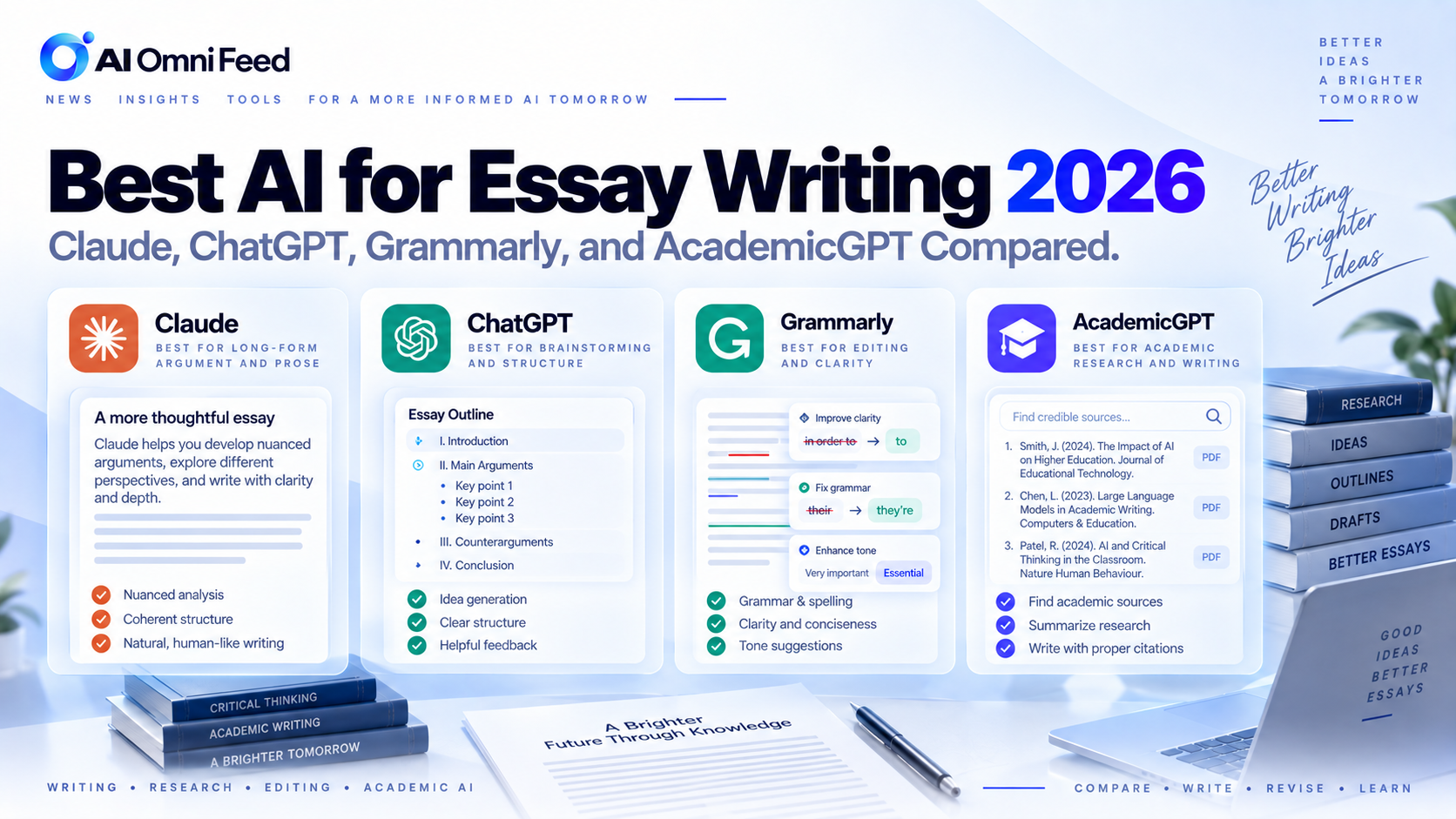
The best AI for essay writing in 2026 is Claude Mythos 5 for structure and depth, ChatGPT for versatility and editing, Grammarly Pro for polishing, and AcademicGPT for research-backed writing. Claude produces the most naturally structured essays with sophisticated arguments and smooth transitions. ChatGPT offers the best all-around writing assistance with strong editing capabilities. Grammarly Pro excels at the final polish phase with tone analysis and style consistency. AcademicGPT specializes in research essays with proper citations and academic formatting. This guide evaluates each tool across essay types, writing quality, research integration, and academic integrity considerations.
AI Essay Writing Tool Comparison
| Tool | Best For | Output Quality | Research Integration | Citation Support | Price |
|---|---|---|---|---|---|
| Claude Mythos 5 | Structure and argumentation | Excellent | Good | Manual | $20/mo |
| ChatGPT (GPT-5.6) | Drafting and editing | Very good | Good | Basic | $20/mo |
| Grammarly Pro | Editing and polishing | N/A (editing only) | N/A | APA/MLA/Chicago | $30/mo |
| AcademicGPT | Research essays | Good | Excellent | Full Zotero integration | $15/mo |
| Gemini 3.1 Pro | Analysis and research | Very good | Excellent | Good | $20/mo |
Claude Mythos 5: Best for Essay Structure
Claude Mythos 5 produces the most naturally structured essays of any AI writing tool. Its output features well-developed thesis statements, logical paragraph progression, smooth transitions between ideas, and conclusions that synthesize rather than repeat. For argumentative and analytical essays, Claude’s ability to present multiple perspectives and anticipate counterarguments produces more sophisticated writing than competitors. The model also excels at adapting to different essay formats, from persuasive to expository to compare-and-contrast. For students and professionals who need well-structured essays with minimal editing, Claude is the best choice. For more on AI writing capabilities, see our AI writing tools guide.
ChatGPT: Best for Drafting and Revision
ChatGPT with GPT-5.6 Sol offers the best combination of drafting and editing capabilities for essay writing. The model can generate complete essay drafts from outlines, rewrite specific sections while maintaining consistent style, adjust tone and complexity for different audiences, and provide targeted feedback on existing writing. ChatGPT’s versatility makes it the best choice for writers who want an interactive writing partner rather than a one-shot generation tool. The conversational interface enables back-and-forth refinement that produces better results than single-pass generation. For writers who prefer an iterative approach to essay writing, ChatGPT is the most effective tool.
AcademicGPT: Research-Focused Writing
AcademicGPT specializes in research-backed essay writing with proper citation integration. The tool searches academic databases for relevant sources, extracts key findings, and integrates them into the essay with proper APA, MLA, or Chicago formatting. AcademicGPT’s most valuable feature is its Zotero integration, allowing users to manage references within the AI writing workflow. The tool also generates properly formatted bibliographies and in-text citations. AcademicGPT is the best choice for college and graduate students writing research papers, though its output quality for non-research essays does not match Claude or ChatGPT. For more on AI for academic work, see our AI research guide.
Grammarly Pro: The Polish Layer
Grammarly Pro serves as the essential final layer in any AI essay writing workflow. Its tone analysis ensures the writing matches the intended audience and purpose. The style guidance flags inconsistencies and suggests improvements for clarity and impact. The citation formatting tool ensures proper formatting throughout. The plagiarism checker provides confidence that AI-generated content is properly attributed. Grammarly Pro is not a generation tool but an enhancement tool that transforms good AI-generated drafts into polished final essays. For serious academic or professional writing, Grammarly Pro is an essential complement to any AI writing tool.
Ethical Considerations and Best Practices
The use of AI for essay writing raises important ethical considerations. Most educational institutions now have specific policies about AI use in academic work, ranging from complete prohibition to encouraged use with disclosure. Best practices include using AI for brainstorming and outlining rather than complete generation, always fact-checking AI-generated claims against primary sources, properly citing any AI tools used in the writing process, and editing AI-generated content substantially to ensure authentic voice. The most effective and ethical use of AI for essay writing treats AI as a writing assistant rather than a replacement for original thinking.
For independent reviews follow TechCrunch and educational technology publications. Official documentation from writing tool providers offers current feature information. Academic integrity guidelines from institutions provide context for appropriate AI writing tool use.
Anthropic publishes research and updates through the Anthropic blog. The company research on AI safety and alignment is available through arXiv preprints. Industry analysis from TechCrunch and Reuters provide ongoing coverage of Anthropic competitive positioning and product developments.
Strategic Implications and Market Impact
OpenAI continued dominance in the AI landscape creates ripple effects across the entire technology ecosystem. Competitors must differentiate through specialization, pricing, or open-source strategies to capture market share. The rapid release cycle that OpenAI has established sets a pace that challenges both established players and newcomers to keep up with feature parity and performance improvements.
For enterprise adopters, the implications are significant. Organizations building on OpenAI platform benefit from access to cutting-edge capabilities but face the risk of vendor lock-in and exposure to pricing changes. A multi-model strategy, where applications are designed to work with multiple AI providers, offers more flexibility and negotiating power. The emergence of standardized evaluation benchmarks and middleware platforms that abstract away individual model differences is enabling this approach.
Looking ahead, the AI market is showing signs of consolidation around a few dominant platforms, similar to the cloud computing market evolution. However, the open-source ecosystem, led by Meta Llama, Mistral, and community projects, provides a viable alternative for organizations with strong technical capabilities and specific requirements around data privacy, customization, or cost optimization. The coexistence of proprietary and open-source models will likely define the AI landscape for the foreseeable future.
Competitive Positioning and Market Dynamics
Anthropic differentiation strategy centers on safety, alignment, and reasoning quality rather than raw speed or scale. This positioning appeals to enterprise customers in regulated industries where reliability and explainability are paramount. Claude strengths in long-context understanding, nuanced reasoning, and safety-conscious behavior make it particularly suitable for legal document analysis, compliance review, and complex analytical tasks.
The competitive pressure from OpenAI GPT-5.6 series, Google Gemini 2.5, and xAI Grok is forcing Anthropic to accelerate its release cycle while maintaining its safety-first approach. The company investment in constitutional AI and interpretability research provides a unique value proposition that competitors have not matched. However, the premium pricing of Claude models compared to GPT-5.6 alternatives may limit adoption in price-sensitive segments.
For developers and enterprises evaluating AI providers, the choice between Claude and alternatives depends on the specific use case requirements. Organizations dealing with sensitive data, complex reasoning tasks, or regulatory compliance needs may find Claudes safety features and reliability worth the premium. Meanwhile, applications prioritizing speed and cost efficiency may be better served by GPT-5.6 Sol or Gemini 2.5 Flash models.
Frequently Asked Questions
Which AI is best for essay writing?
Claude Mythos 5 for structure and argumentation, ChatGPT for drafting and revision, AcademicGPT for research papers with citations.
Can AI write a complete essay?
Yes, but ethical and quality considerations mean AI is best used as a writing assistant for outlining, drafting, editing, and research rather than generating complete essays.
Is it cheating to use AI for essays?
It depends on your institution’s policies. Many allow AI use with disclosure for specific tasks like research and editing but prohibit complete AI generation of submitted work.
How can I make AI-generated essays sound more human?
Provide detailed outlines and examples of your writing style, edit AI output substantially, add personal examples and insights, and use AI for specific sections rather than complete generation.
