
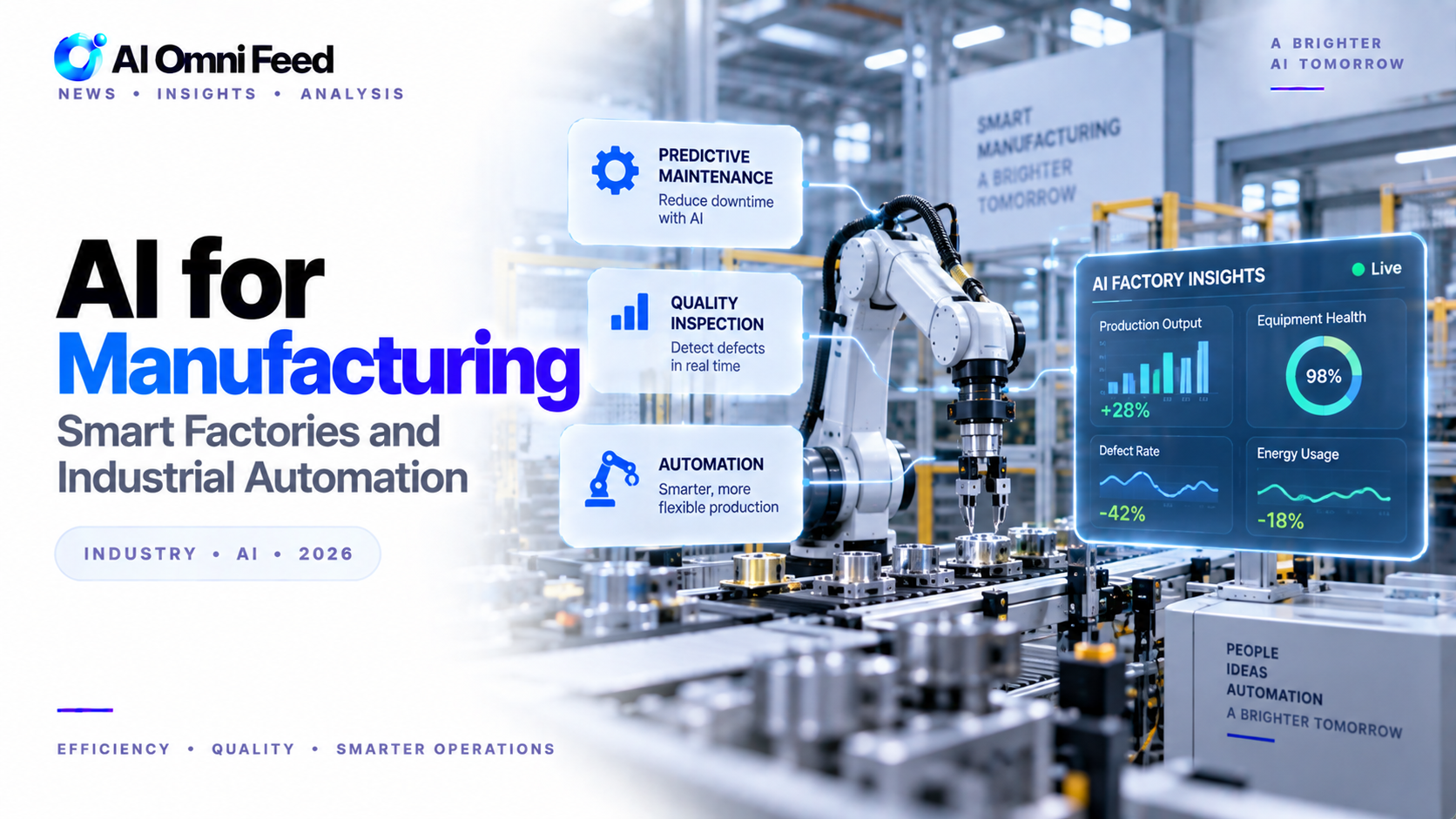
Quick Answer: AI for Manufacturing in 2026
AI in manufacturing reduces unplanned downtime by 30-50% through predictive maintenance. Computer vision AI achieves 99%+ defect detection accuracy on production lines. Digital twins enable manufacturers to simulate and optimize entire factory operations before making physical changes. Collaborative robots with AI work alongside humans without safety cages. The average payback period for AI manufacturing implementations is 6-12 months.
Key Takeaways
- AI in manufacturing reduces unplanned downtime by 30-50% through predictive maintenance.
- Computer vision AI achieves 99%+ defect detection accuracy on production lines.
- Digital twins powered by AI enable manufacturers to simulate and optimize entire factory operations before making physical changes.
- Average payback period for AI manufacturing investments is 6-12 months.
How AI Is Transforming Manufacturing in 2026
Manufacturing has become one of the most active adoption areas for artificial intelligence. Smart factories use AI across every stage of production from design and supply chain optimization to quality control and predictive maintenance. The results are tangible: reduced downtime, higher quality, lower costs, and faster time to market. For an overview of how AI is transforming other industries, see our guide to AI for small business.
The Business Case for AI in Manufacturing
Manufacturing executives are investing in AI because the returns are clear and measurable. A 2025-2026 industry survey found that manufacturers who implemented AI across at least three use cases saw average cost reductions of 15-25%, quality improvements of 20-30%, and production throughput increases of 10-20%. The technology has matured enough that implementation risks are low for well-scoped projects. Most manufacturers start with a single high-impact use case, prove ROI, then expand systematically across their operations.
Predictive Maintenance — Biggest ROI Use Case
Predictive maintenance is the highest-ROI AI application in manufacturing. AI models analyze sensor data from equipment including vibration, temperature, pressure, and acoustic signatures to predict failures hours or days before they occur. Siemens, GE, and IBM lead with platforms that integrate with existing PLC and SCADA systems. Implementation typically reduces unplanned downtime by 30-50% and maintenance costs by 10-20%. Average payback period is 6-12 months for most installations. The most sophisticated systems can predict not just when a failure will occur but what component will fail and what replacement part is needed.
Computer Vision for Quality Control
AI-powered computer vision systems inspect products at every stage of production. Modern systems detect defects smaller than 0.1mm at line speeds exceeding 1000 units per minute. Unlike traditional machine vision, AI systems learn from examples and improve over time. They detect surface defects, dimensional variations, assembly errors, and packaging issues. Companies like Landing AI, Covariant, and Veo Robotics provide specialized manufacturing vision platforms. Accuracy routinely exceeds 99% with minimal false positives, significantly reducing waste and rework costs.
Digital Twins and Simulation
Digital twins are virtual replicas of physical production systems that use AI to simulate and optimize operations. Manufacturers test production line changes, layout modifications, and process adjustments in the digital twin before implementing them physically. Siemens Xcelerator and NVIDIA Omniverse provide platforms for creating and running manufacturing digital twins. AI agents within digital twins can autonomously optimize production schedules, material flows, and energy consumption, running thousands of simulations to find the optimal configuration.
Supply Chain Optimization
AI models optimize every aspect of manufacturing supply chains: demand forecasting, inventory management, supplier selection, and logistics routing. In 2026, generative AI enables what-if analysis where manufacturers ask natural language questions about production timeline impacts and receive instant scenario analysis with recommended actions. Leading platforms include Blue Yonder, Kinaxis, and SAP IBP with embedded AI. These systems have become essential for managing the complexity of global supply chains with multiple tiers of suppliers and logistics providers.
Collaborative Robots and AI Co-Pilots
AI-powered collaborative robots work alongside human operators without safety cages. They use computer vision and natural language processing to understand verbal instructions and adapt to changing conditions. AI co-pilots assist factory workers by providing real-time guidance, safety alerts, and process documentation. Companies like Universal Robots, FANUC, and ABB lead in AI-integrated robotics. Average cobot cost has fallen to 25,000-45,000 with payback periods under 12 months, making them accessible to mid-size manufacturers.
AI Manufacturing Applications Comparison Table
| Application | ROI Impact | Implementation Complexity | Payback Period | Key Providers |
|---|---|---|---|---|
| Predictive Maintenance | 30-50% downtime reduction | Medium | 6-12 months | Siemens, GE, IBM |
| Quality Control (Vision) | 99%+ defect detection | Medium | 6-12 months | Landing AI, Covariant |
| Digital Twins | 10-20% throughput increase | High | 12-18 months | Siemens, NVIDIA |
| Supply Chain AI | 15-25% cost reduction | Medium-High | 6-12 months | Blue Yonder, Kinaxis |
| Collaborative Robots | 20-30% productivity gain | Low-Medium | Under 12 months | Universal Robots, FANUC |
Getting Started with AI in Manufacturing
Manufacturers should start with a pilot project focused on a single high-impact use case typically predictive maintenance on critical equipment or quality control on a key production line. Key success factors include clean sensor data, clear ROI metrics, and buy-in from both plant managers and IT. Most manufacturers work with systems integrators for initial implementation. Cloud AI platforms like AWS IoT, Azure AI, and Google Cloud Vertex AI offer manufacturing-specific tools that reduce implementation complexity. For more on AI across industries, see our state of AI trends analysis.
AI in Manufacturing Case Studies
Real-world implementations demonstrate the impact of AI in manufacturing. A major automotive manufacturer implemented predictive maintenance across 500 critical machines and reduced unplanned downtime by 45% in the first year, saving 12 million annually. A food processing plant deployed computer vision quality control and reduced defect rates from 3% to 0.2%, saving 2 million per year in waste and rework. A electronics manufacturer created a digital twin of their assembly line and optimized throughput by 18% without any physical changes to the factory floor.
A mid-size industrial parts manufacturer deployed collaborative robots on three assembly lines and increased productivity by 35% while reducing ergonomic injuries by 80%. These case studies share common success factors: strong executive sponsorship, clean data infrastructure, focused scope, and partnership with experienced AI implementation partners.
Data Requirements for Manufacturing AI
Successful manufacturing AI implementations depend on data quality. For predictive maintenance, you need historical sensor data from equipment including normal operation data and data from past failures. Ideally 6-12 months of data at minimum. For computer vision quality control, you need labeled images of both good and defective products, typically 1000-5000 images per product type. For supply chain optimization, you need historical order data, supplier performance metrics, and logistics data. Most AI platforms can work with existing data infrastructure and do not require new sensors for initial deployments, though additional sensors can improve accuracy over time.
Challenges in Manufacturing AI Adoption
Manufacturers face several challenges when adopting AI. Data silos between different systems and departments make it difficult to get a complete picture. Legacy equipment may not have the sensors needed for AI analysis. Workforce concerns about job displacement require change management and retraining programs. Integration with existing ERP, MES, and SCADA systems can be complex. Cybersecurity concerns arise when connecting factory floor systems to cloud AI platforms. Starting with a well-scoped pilot project addresses most of these challenges by limiting scope and proving value before expansion.
Frequently Asked Questions
How is AI used in manufacturing?
AI is used in manufacturing for predictive maintenance, quality control via computer vision, digital twin simulation, supply chain optimization, and collaborative robots. These applications reduce costs and improve quality.
What is the ROI of AI in manufacturing?
Manufacturers typically see 15-25% cost reduction, 20-30% quality improvement, and 10-20% throughput increase. Average payback period is 6-12 months for well-scoped projects.
How do I start with AI in my factory?
Start with a pilot project on a single use case like predictive maintenance on critical equipment. Ensure clean sensor data, define clear ROI metrics, and work with a systems integrator for initial implementation.
What is predictive maintenance in manufacturing?
Predictive maintenance uses AI to analyze equipment sensor data and predict failures before they occur, reducing unplanned downtime by 30-50% and maintenance costs by 10-20%.
Do I need a data science team for manufacturing AI?
Not necessarily. Many AI manufacturing platforms offer pre-built models that can be customized with your data. Most manufacturers work with systems integrators or cloud AI platform providers for initial setup.
What is a digital twin in manufacturing?
A digital twin is a virtual replica of a physical production system that uses AI to simulate and optimize operations. Manufacturers test changes virtually before implementing them physically, reducing risk and cost.
