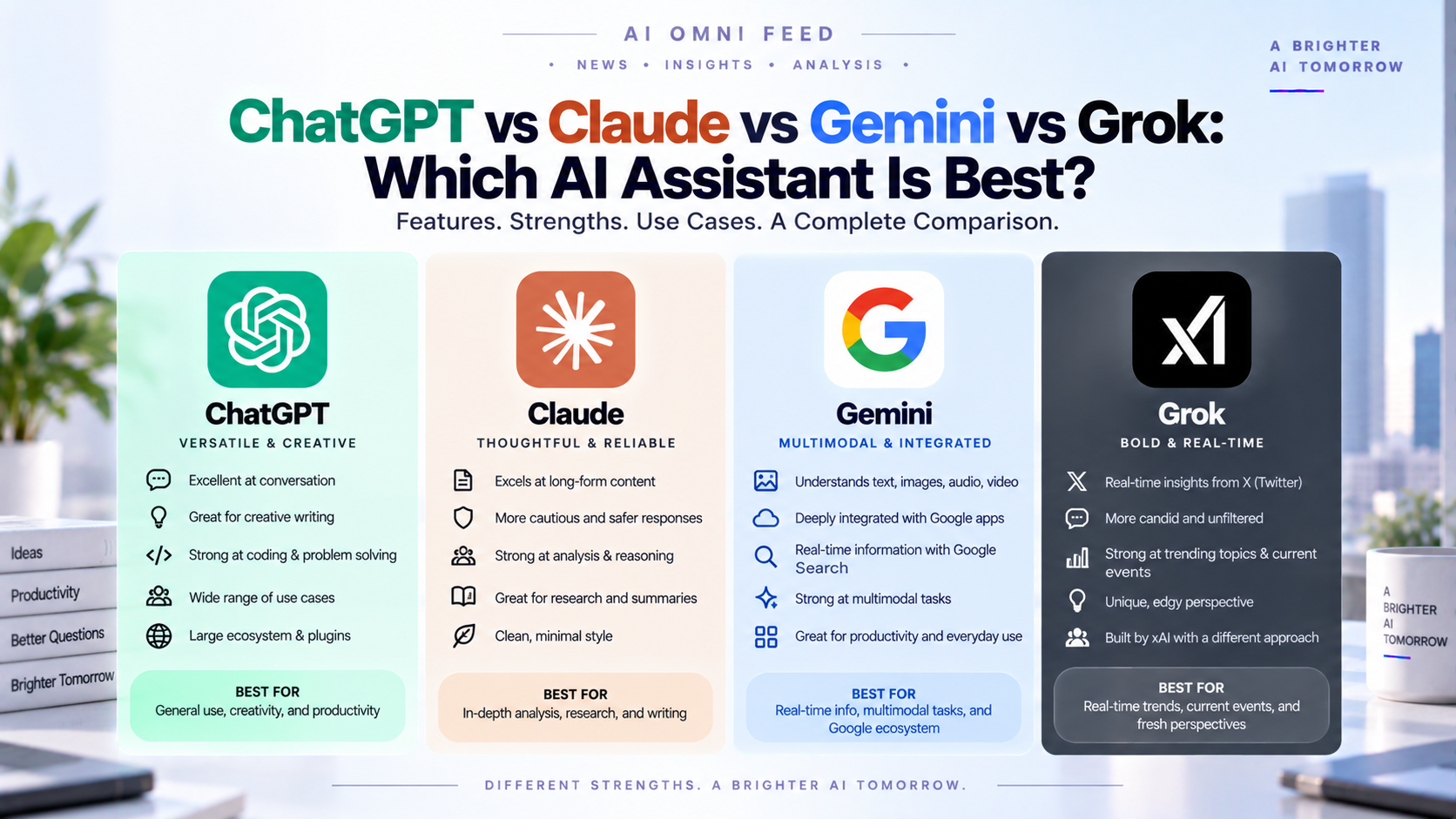
The AI assistant landscape has never been more competitive. With OpenAI’s ChatGPT, Anthropic’s Claude, Google’s Gemini, and xAI’s Grok all battling for users, choosing the right one for your workflow can feel overwhelming. We’ve spent months testing each assistant across real-world tasks — writing, coding, reasoning, research, and creative work — to give you an honest, practical comparison.
The Contenders at a Glance
| Assistant | Company | Best For | Pricing |
|---|---|---|---|
| ChatGPT | OpenAI | General-purpose, coding, creative writing | Free / $20/mo Plus / $200/mo Pro |
| Claude | Anthropic | Long-form writing, analysis, coding | Free / $20/mo Pro / $100/mo Max |
| Gemini | Research, Google ecosystem integration | Free / $20/mo Advanced / included with Google One | |
| Grok | xAI | Real-time data, X integration, uncensored responses | Free / $10/mo Premium+ on X |
ChatGPT (OpenAI)
ChatGPT remains the default for most people — and for good reason. OpenAI’s GPT-4o model delivers strong performance across nearly every category. The interface is polished, with support for voice conversations, image generation (via DALL-E 3), file uploads, and custom GPTs you can build for specific tasks.
Where it shines: Coding is where ChatGPT truly stands out. Its ability to debug, refactor, and explain code in multiple languages is best-in-class. The Advanced Data Analysis feature (formerly Code Interpreter) lets you upload CSV files, run Python analysis, and generate charts — all without leaving the chat.
Where it falls short: Context management. Once conversations get long, ChatGPT starts forgetting earlier instructions. Output quality can also feel generic without careful prompting. And the knowledge cutoff means it misses very recent events unless you use browsing mode.
Claude (Anthropic)
Claude has carved out a loyal following among writers, researchers, and developers who need depth. Anthropic’s Claude 4 Opus model excels at nuanced analysis, long-form reasoning, and following complex instructions.
Where it shines: Long documents. Claude’s 200K token context window lets you feed it entire books, codebases, or research papers in one go. Its summaries are more thoughtful and structured than what ChatGPT produces. For writing — essays, reports, editing — Claude consistently produces more natural, less robotic output.
Where it falls short: Fewer integrations. Claude doesn’t have the plugin ecosystem or API reach that ChatGPT does. Real-time web search is less polished. And while Pro at $20/mo is fair, the more generous rate limits require the $100/mo Max plan.
Gemini (Google)
Google’s bet with Gemini is distribution. It’s baked into Google Workspace (Gmail, Docs, Sheets), Android, and Search. The Gemini 2.5 Pro model is competitive on benchmarks, and Google’s DeepMind research pipeline means it keeps improving.
Where it shines: Ecosystem integration. If you live in Gmail, Google Docs, and Google Drive, Gemini can summarize your emails, draft documents from your existing files, and pull data across your workspace. Its Google Search grounding also means answers come with fresh, cited sources more naturally than competitors.
Where it falls short: Creative writing and coding both trail ChatGPT and Claude. The user interface, while improving, can feel cluttered with Google’s typical design overhead. Responses sometimes lack the depth that power users expect.
Grok (xAI)
Elon Musk’s xAI has positioned Grok as the edgy, real-time alternative. Tightly integrated with X (formerly Twitter), Grok has access to the firehose of public conversations on the platform — giving it a genuinely unique data advantage.
Where it shines: Real-time awareness. Grok can reference and summarize trending discussions on X within minutes. It’s also the most willing to tackle controversial topics without the safety guardrails that frustrate some users. Its image generation and understanding have improved dramatically in recent versions.
Where it falls short: Smaller context window, fewer third-party integrations, and a user base that’s still heavily tied to X. For professional workflows outside of social media analysis, it’s hard to recommend Grok over the more established competitors.
Head-to-Head Comparison
Best for Coding
Winner: ChatGPT — GPT-4o with Advanced Data Analysis and custom GPTs gives it the edge. Claude is a close second, especially for code review and architecture discussions. Gemini lags but is catching up.
Best for Writing & Editing
Winner: Claude — Anthropic’s models produce the most natural prose, follow style guides more reliably, and handle long documents without losing coherence.
Best for Research & Analysis
Winner: Gemini — When you need grounded, cited answers with Google Search integration, Gemini is hard to beat. Claude is better for deep-dive analysis of a single source; Gemini is better for synthesis across many sources.
Best for Real-Time Information
Winner: Grok — No other assistant has access to the real-time X firehose. If you need to track emerging conversations or trending topics, Grok has a genuine data moat.
Best Value
Winner: ChatGPT (Free tier) — OpenAI’s free tier is the most generous, with access to GPT-4o with rate limits. Claude’s free tier is limited to the weaker Haiku model. Gemini’s free tier is competitive but capped.
Which One Should You Pick?
The honest answer: most people should use more than one. Power users typically keep subscriptions to at least two assistants and switch based on the task. Here’s our pragmatic advice:
- If you can only pick one and you’re a developer → ChatGPT
- If you can only pick one and you’re a writer or researcher → Claude
- If you live in Google’s ecosystem → Gemini (it’s already bundled)
- If you’re actively following X conversations → Add Grok as a secondary
- If you’re budget-conscious → Use free tiers of ChatGPT + Gemini
The gap between these assistants narrows every quarter. What matters most isn’t which model is theoretically best — it’s which one you’ll actually use consistently.
Deep Dive: Pricing Tiers and What You Actually Get
Understanding what you pay for beyond the headline price is critical. ChatGPT Plus at $20/month includes GPT-4o with 80 messages every 3 hours, DALL-E 3 image generation, Advanced Data Analysis, and custom GPTs. ChatGPT Pro at $200/month adds unlimited GPT-4o access, o1 pro mode for advanced reasoning, and priority access during peak times. This tier is aimed at power users who rely on ChatGPT for their daily workflow.
Claude Pro at $20/month includes Claude 4 Opus with significantly more generous rate limits than the free tier. Claude Max at $100/month offers 5x the usage limits, priority access, and early access to new features. For heavy users doing deep analysis on long documents, Claude Max is the better value despite the higher price point.
Gemini Advanced at $20/month is bundled with Google One Premium, including 2TB of cloud storage, Google Workspace integration, and access to Gemini in Gmail, Docs, and Sheets. This makes it the best value if you already pay for cloud storage or use Google Workspace professionally. Grok is available through X Premium+ at $10/month, making it the cheapest premium AI assistant, though its capabilities are more specialized.
Enterprise and Team Considerations
For organizations deploying AI across teams, the calculus changes. ChatGPT Team at $25/user/month includes unlimited GPT-4o, workspace isolation, and admin controls. Claude for Work at $30/user/month offers centralized billing, SSO, and usage analytics. Google Workspace customers get Gemini Enterprise at $30/user/month with full Workspace integration and data governance. xAI is developing enterprise offerings but currently lacks the administrative features that organizations require.
The enterprise decision often comes down to data privacy and integration. Google’s offering is compelling for organizations already on Google Workspace. Microsoft’s Copilot for Microsoft 365 integration makes ChatGPT attractive for Microsoft-centric organizations. Anthropic emphasizes its responsible AI practices and is winning enterprise deals in regulated industries like healthcare and finance.
Emerging Specialized Assistants
Beyond the big four, specialized AI assistants are gaining traction. Perplexity excels at research with cited sources. Copy.ai and Jasper focus on marketing content. Replit’s AI assistant is built specifically for software development. These specialized tools sometimes outperform general assistants in their domains. Power users often combine a general assistant (ChatGPT or Claude) with one or two specialized tools for specific workflows.
How We Tested: Methodology
Our testing methodology involved standardized prompts across five categories: coding (build a React component with API integration), writing (draft a 2000-word analytical article), reasoning (solve multi-step logic puzzles and math problems), research (summarize recent developments in quantum computing with citations), and creative work (generate marketing copy, story outlines, and business plans). Each assistant was scored on output quality, consistency, speed, and adherence to instructions. Tests were conducted in May 2026 using the latest available models.
The Bottom Line for 2026
No single AI assistant is best for everyone. The right choice depends on your primary use case, budget, ecosystem, and personal preference for response style. The good news is that all four major assistants are capable enough to deliver significant productivity gains for most knowledge workers. The best approach is to try the free tiers, identify which assistant handles your most frequent tasks best, and invest in a paid subscription for that one while keeping free tiers of the others as supplements.
Frequently Asked Questions
Which AI assistant is best?
ChatGPT leads for versatility and breadth. Claude excels at long-form, nuanced content. Gemini integrates best with Google services. Grok offers real-time web access. The best choice depends on your specific needs.
Is ChatGPT better than Claude?
ChatGPT offers broader capabilities while Claude provides better long-form writing and larger context windows. Both are excellent. Many users subscribe to both for different use cases.
Which AI assistant is best for coding?
Claude generally leads for complex coding tasks with its large context window. ChatGPT is excellent for quick code generation. Both handle most programming languages well.
