Quick Answer: What Is the State of AI Regulation in July 2026?
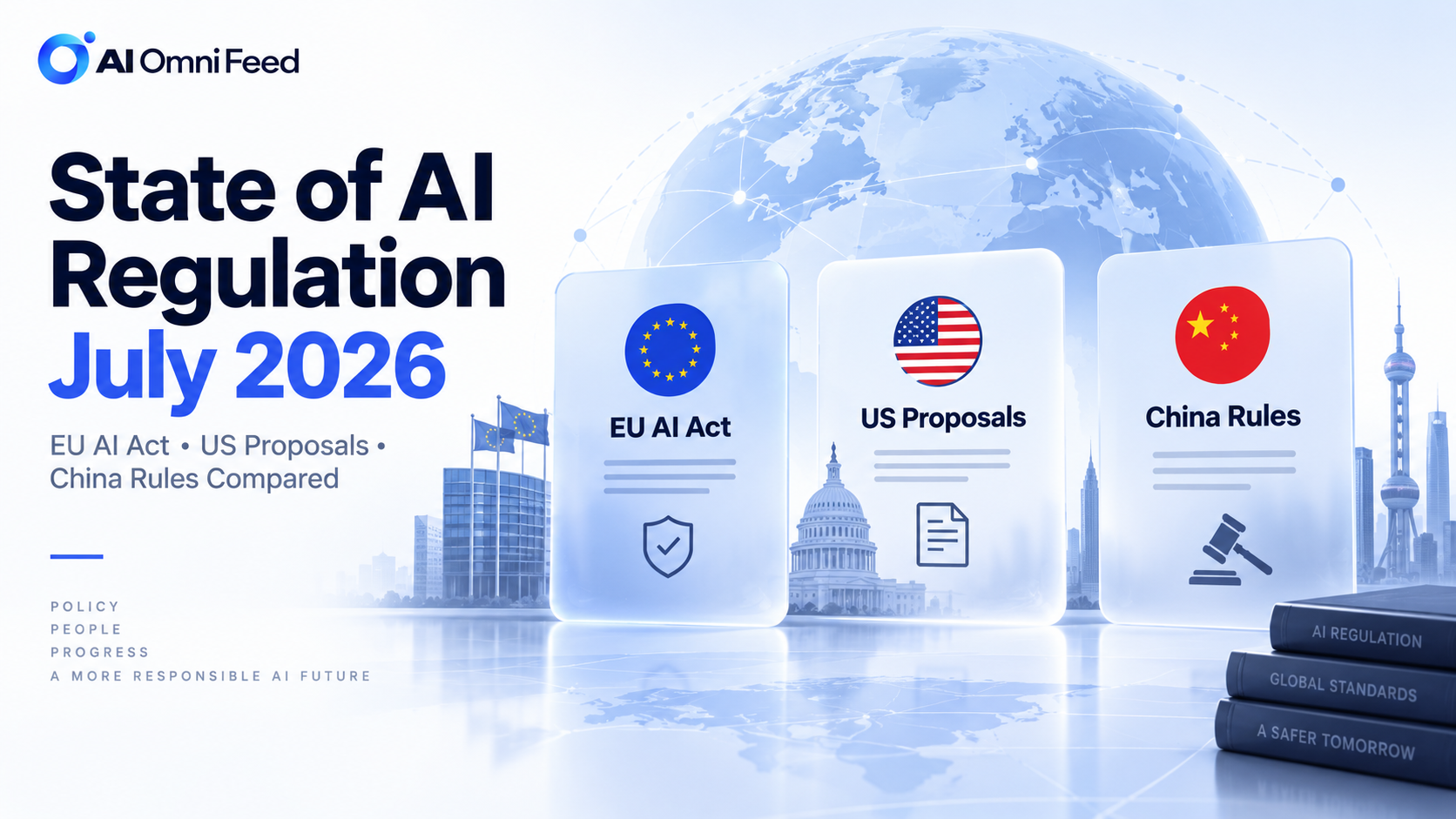
The global AI regulatory landscape in July 2026 features three major developments: the EU AI Act’s graduated enforcement framework is now operational with sector-specific guidance for financial services and healthcare, the US government has proposed the AI Accountability Act creating federal oversight for high-risk AI systems, and China has updated its AI regulations to address generative AI and foundation models. The EU leads in comprehensive AI regulation with the most detailed requirements. The US follows a sectoral approach without comprehensive federal AI legislation. China has the strictest content controls but the fastest regulatory approval process for compliant AI systems. Organizations operating across multiple jurisdictions face the complex challenge of navigating divergent regulatory requirements.
Global AI Regulation Comparison
| Dimension | EU AI Act | US (Proposed) | China Regulations |
|---|---|---|---|
| Scope | Comprehensive, risk-based | Sectoral, high-risk focus | Content and security focused |
| High-risk definition | Annex III categories | Individual rights impact | Social stability impact |
| Penalty maximum | 7% of global turnover | Civil penalties proposed | Business license revocation |
| Transparency requirements | Extensive | Moderate | Limited to content labeling |
| AI literacy requirement | Yes (Article 4) | Not proposed | Training is mandatory |
| Model evaluation | Third-party for high-risk | Self-certification proposed | Government review required |
EU AI Act: Operational Enforcement
The EU AI Act’s enforcement framework is now operational with key components in place. The AI Office has published compliance templates for technical documentation, risk assessments, and conformity declarations. Sector-specific guidance for financial services and healthcare provides clarity for regulated industries. The graduated enforcement approach prioritizes prohibited AI practices while giving organizations time to achieve full compliance. First-year enforcement focuses on education and remediation rather than penalties, with formal investigations reserved for the most serious violations. The AI Office has also established a voluntary compliance certification program that offers regulatory fast-track benefits for certified organizations. For a complete compliance guide, see our EU AI Act analysis.
US: AI Accountability Act Proposed
The bipartisan AI Accountability Act proposes federal oversight for high-risk AI systems that impact individual rights. The legislation would require impact assessments for AI systems used in employment, housing, credit, and healthcare decisions. Unlike the EU’s comprehensive approach, the proposed US framework focuses on transparency and accountability rather than pre-market approval. The legislation establishes a new AI Safety Board within NIST to develop standards and conduct evaluations. The bill faces uncertain prospects in the current Congress, with supporters hoping for passage before the 2028 election cycle. In the absence of federal legislation, states continue to enact their own AI regulations, creating a patchwork of requirements that complicates compliance for national businesses. For more on US AI regulation, see our AI security guide.
China: Updated Generative AI Rules
China updated its AI regulations in July 2026 to address generative AI and foundation models. The updated rules require registration and government review for foundation models above a capability threshold, content filtering requirements that include political alignment with state-approved narratives, and data localization requirements that mandate training data be stored on Chinese servers. China’s approach is characterized by strict content controls combined with rapid approval for compliant systems. While the regulatory burden is highest in China in terms of content restrictions, the approval process for compliant systems is faster than both EU and proposed US frameworks. For organizations operating in China, compliance requires dedicated local teams and infrastructure.
Cross-Border Compliance Challenges
Organizations operating across multiple jurisdictions face significant compliance challenges. The EU’s comprehensive requirements conflict with China’s data localization requirements. The US sectoral approach creates gaps that organizations must fill through voluntary compliance. International standards bodies including ISO/IEC are working on harmonized AI management standards, but adoption is voluntary and years away from widespread implementation. The practical approach for most organizations is to comply with the most stringent applicable regulation as a baseline, supplementing with jurisdiction-specific requirements where necessary. The complexity of cross-border AI compliance is driving demand for AI governance platforms and compliance automation tools.
Official regulatory texts and guidance are available from the European Commission and corresponding authorities in other jurisdictions. Industry analysis of global AI regulation is provided by TechCrunch and Reuters. Law firms and consultancy practices specializing in AI regulation publish practical compliance guides for multinational organizations.
Global AI Regulation: State of Play July 2026
Global AI regulation in July 2026 presents a complex patchwork of frameworks that organizations must navigate. The EU AI Act implementation is the most advanced, with detailed technical guidance now available for compliance. The United Kingdom has published its pro-innovation regulatory framework, taking a sector-by-sector approach that contrasts with the comprehensive EU model. Japan and Canada are developing frameworks that blend elements of both approaches, seeking to balance innovation promotion with risk management.
China AI regulation has evolved significantly, with new requirements for generative AI services including content moderation obligations, training data transparency, and user notification requirements for AI-generated content. The Chinese approach emphasizes state oversight and content control, creating significant compliance obligations for companies operating AI services in the Chinese market or serving Chinese users.
For multinational organizations, the diversity of regulatory approaches creates significant compliance complexity. The most practical strategy is to build AI governance frameworks that meet the highest standard across applicable jurisdictions, typically the EU AI Act requirements, and then verify compliance with specific additional requirements in each market. This approach minimizes the risk of non-compliance while avoiding the cost of building separate systems for each jurisdiction.
Global AI Regulatory Strategy
- Build AI governance frameworks to the highest common standard, typically EU AI Act requirements, and verify compliance with specific additional requirements in each market. This approach minimizes non-compliance risk efficiently.
- Monitor regulatory developments in each market where you operate or serve users. AI regulation is evolving rapidly, and compliance requirements may change significantly between planning and deployment.
- Engage with industry associations and regulatory bodies during rule-making processes. Proactive engagement allows organizations to influence regulatory development and gain early insight into evolving requirements.
UK approach to AI regulation has attracted attention for its pro-innovation stance, relying on existing regulators to develop sector-specific guidance rather than creating a central AI authority. Japan has adopted a similar approach focused on economic competitiveness while establishing safety guidelines. Brazil and India are developing AI frameworks that balance innovation promotion with consumer protection. The diversity of regulatory approaches creates compliance complexity but also opportunities for regulatory arbitrage in AI development and deployment decisions.
Frequently Asked Questions
Which country has the strictest AI regulation?
The EU has the most comprehensive requirements with 7% turnover penalties. China has the strictest content controls. The US has the least comprehensive federal framework.
What is the US AI Accountability Act?
Proposed bipartisan legislation requiring impact assessments for high-risk AI systems in employment, housing, credit, and healthcare with oversight through a new NIST board.
How do I comply with multiple AI regulations?
Comply with the most stringent applicable regulation as a baseline, supplement with jurisdiction-specific requirements, and invest in AI governance platforms.
Will international AI standards emerge?
ISO/IEC is developing harmonized AI management standards, but adoption is voluntary and years away from widespread implementation.
