Quick Answer: What Happened in AI This Week (July 12)?
This week in AI brought several major developments: GPT-5.6 Sol access expanded to all ChatGPT Plus users, Google Gemini 3.1 Pro general availability with benchmark dominance on GPQA, Anthropic’s Claude Mythos 5 tool-use reliability update, and the emergence of OpenAI Codex Mobile for on-device app development. The EU AI Act enforcement continued to develop with the first formal compliance guidance from the AI Office. LongCat-2.0’s open-source release triggered debates about AI safety and export control effectiveness. Microsoft Copilot’s Summer 2026 Update brought significant AI improvements to Excel and Teams. Grok 4.5 private beta testers began sharing initial impressions.
| Development | Category | Impact |
|---|---|---|
| GPT-5.6 Sol Opens to ChatGPT Plus | Model Access | All Plus subscribers now have Sol as default model |
| Gemini 3.1 Pro General Availability | Platform Release | Available to all Google Cloud customers with Context Caching |
| OpenAI Codex Mobile Launches | Product Launch | Full app development from iOS devices with real-time preview |
| EU AI Office Publishes Compliance Guidance | Regulation | First formal AI Act enforcement priorities published |
| LongCat-2.0 Safety Debates | Open Source | 100K+ downloads triggered debates on AI safety and export controls |
| Grok 4.5 Beta Impressions | Model Beta | Private beta testers share positive reasoning improvement reviews |
GPT-5.6 Sol Opens to All ChatGPT Plus Users
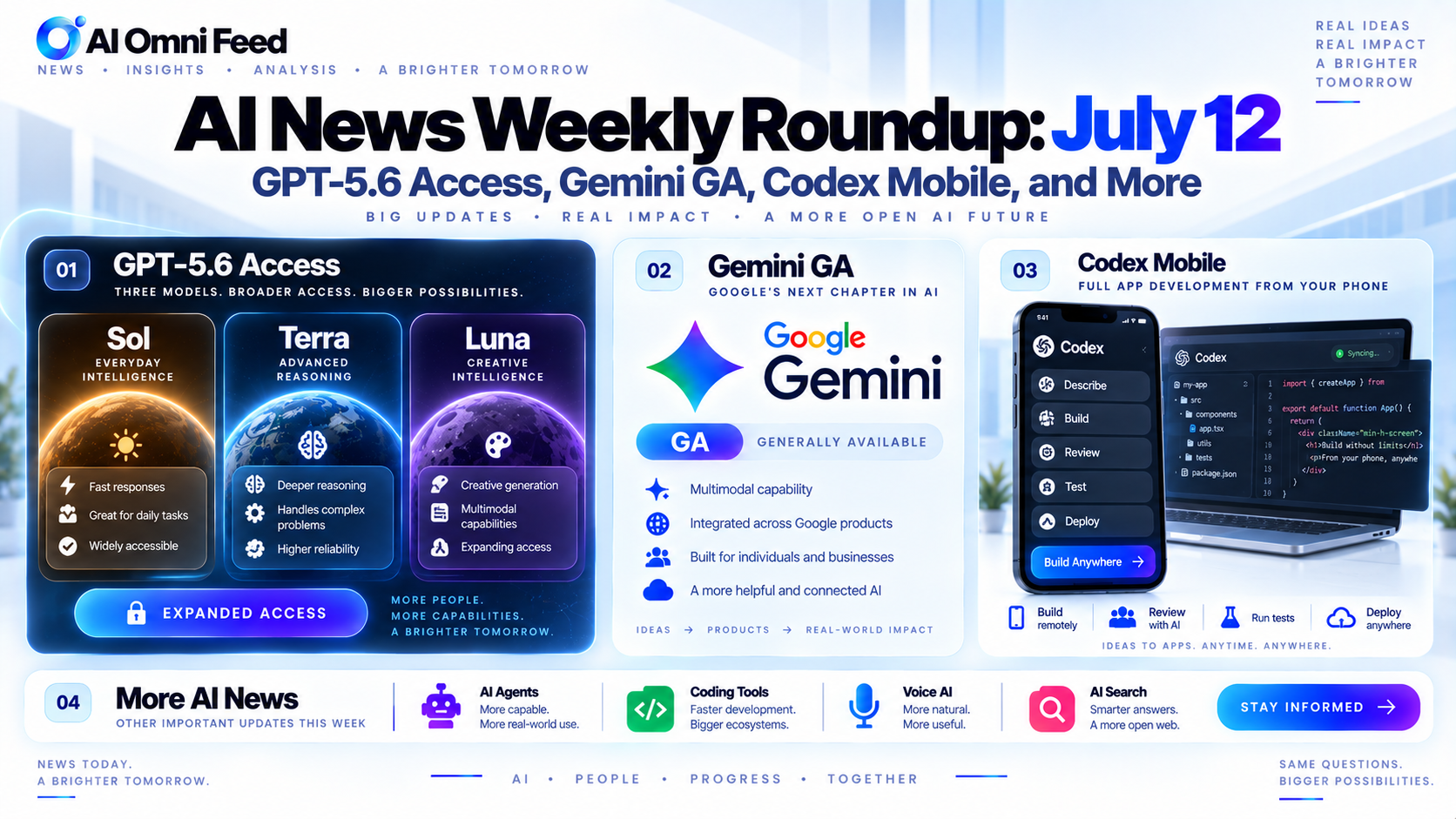
OpenAI expanded GPT-5.6 Sol access to all ChatGPT Plus subscribers this week, moving beyond the initial API-only rollout. Plus users now get Sol as their default model with the option to switch to GPT-5 or GPT-5.6 Terra for more complex queries. Early user feedback highlights significant improvements in coding assistance quality and response speed. The tiered access model used by OpenAI here is instructive: Sol handles most queries, Terra is available for complex reasoning, and the user can manually select which model to use for each task. This mirrors the multi-model strategy we recommend for enterprise deployments. For our complete Sol review, see our GPT-5.6 Sol first-week analysis.
Gemini 3.1 Pro Goes GA
Google’s Gemini 3.1 Pro achieved general availability this week, bringing its 94.1% GPQA score and 2 million token context window to all Google Cloud customers. Early enterprise adopters report particular success with document analysis workflows previously requiring complex chunking strategies. One financial services firm reported processing 1,500-page regulatory documents in a single API call with 96% accuracy on compliance-relevant extraction. Google also announced Context Caching pricing that reduces costs by up to 75% for repeated analysis of the same documents. For more analysis, see our Gemini 3.1 Pro review.
OpenAI Codex Mobile Launches
OpenAI launched Codex Mobile, enabling full app development from an iPhone or iPad. The app combines GPT-5.6 Sol’s coding capabilities with a mobile-optimized IDE that supports real-time preview, debugging, and deployment. Early reviews highlight impressive capability for simple to moderately complex apps, though performance degrades for apps requiring extensive native API integration. The app supports React Native, Flutter, and native SwiftUI development. For a detailed review, see our Codex Mobile analysis.
EU AI Office Publishes First Compliance Guidance
The EU AI Office published its first formal compliance guidance this week, providing clarity on documentation requirements, risk assessment methodologies, and acceptable conformity assessment procedures. The guidance confirms the narrowed high-risk classification approach and provides a standardized template for technical documentation. Organizations that have not yet started compliance work now have a clear roadmap to follow. The guidance also establishes a voluntary compliance certification program that offers regulatory fast-track benefits for participating organizations. For a full overview of requirements, see our EU AI Act guide.
LongCat-2.0 Safety Debates
LongCat-2.0’s open-source release this week sparked renewed debates about AI safety and the effectiveness of semiconductor export controls. The model’s competitive benchmark performance demonstrates that China can train frontier-class models despite US chip export restrictions. Some AI safety researchers expressed concern about potential misuse, while others argued that open-source model availability is net positive for AI safety research. The debate reflects fundamental disagreements about AI governance approaches. For our perspective on open versus closed source AI, see our comparison guide.
Grok 4.5 Beta Impressions
Initial impressions from Grok 4.5 private beta testers began emerging this week. Testers consistently praise the model’s improved reasoning depth and real-time data integration. The expanded multimodal support for video and audio was highlighted as a differentiator. Concerns include higher latency than expected for complex queries and inconsistent output quality on creative tasks. Several testers noted that Grok 4.5’s self-correction capability during multi-step reasoning is genuinely impressive and represents a meaningful advance. For more details, see our Grok 4.5 preview.
Follow TechCrunch and Reuters for weekly AI industry news coverage. Official announcements from OpenAI, Google AI, and other major providers offer the most current information on product launches, feature updates, and platform changes as the AI landscape continues its rapid evolution.
Google publishes detailed technical information through the Google AI Blog and Google Technology Blog. Third-party evaluations from TechCrunch provide independent perspective on benchmark claims and real-world performance. The broader implications for the AI competitive landscape are covered by major technology publications.
For ongoing AI news coverage, follow TechCrunch AI and Reuters AI coverage for breaking developments. Company announcements from OpenAI, Anthropic, and Google AI provide official information on new model releases and product updates as they happen.
What This Means for the AI Industry
The developments covered in this weeks AI news roundup highlight several key trends shaping the industry. First, the pricing war between major AI providers is accelerating, with OpenAI, Anthropic, and Google all reducing API costs while improving model capabilities. Second, the regulatory landscape is becoming more defined, with the EU AI Act implementation timeline and emerging frameworks in the US and UK creating compliance requirements that will affect AI adoption globally. Third, open-source models continue to narrow the gap with proprietary systems, challenging the competitive advantage of closed-source providers.
For businesses and developers, this rapidly evolving landscape presents both opportunities and challenges. The decreasing cost of AI inference makes it more accessible for startups and small businesses to integrate AI capabilities into their products. However, keeping pace with the latest model releases, understanding their relative strengths and weaknesses, and navigating the regulatory requirements demands ongoing attention and expertise. Organizations that invest in AI evaluation frameworks and compliance infrastructure now will be better positioned to leverage new capabilities as they emerge.
The competition among AI providers ultimately benefits end users through better performance, lower costs, and more choices. As we move through the second half of 2026, we expect to see continued rapid iteration in model capabilities, further price reductions, and increasing specialization as providers target specific use cases and industries. The AI landscape is evolving faster than ever, and staying informed through reliable sources is essential for making strategic decisions.
Key Developments from This Weeks AI News
The July 12 week brought several significant developments that collectively signal an acceleration in AI industry dynamics. GPT-5.6 Sol broad access expansion means more developers and businesses can now experiment with and deploy the model, potentially accelerating the feedback loop that drives further improvements. Google Gemini general availability announcement marks a shift from beta testing to production readiness, giving enterprise customers the confidence to build on the platform.
OpenAI Codex Mobile launch represents a strategic expansion into the mobile AI assistant market, bringing powerful code generation and analysis capabilities to smartphones. This move positions OpenAI to compete directly with mobile-first AI assistants while expanding the addressable market for its models beyond desktop and server environments. The mobile AI market is expected to grow rapidly as smartphone hardware becomes capable of running increasingly sophisticated on-device AI models.
The cumulative effect of these developments is a market that is becoming more accessible, more competitive, and more integrated into daily technology use. For businesses, the expanding availability of AI capabilities across platforms and devices creates new opportunities for embedding AI into customer-facing applications and internal workflows. The key challenge is keeping pace with the rapid rate of change while making strategic decisions that will remain relevant as the market continues to evolve.
Gemini GA: What General Availability Means
Google decision to declare Gemini generally available signals confidence in the platforms reliability, security, and scalability for enterprise workloads. General availability status is a prerequisite for many enterprise procurement processes, and this milestone will unlock adoption in regulated industries and large organizations that require production-ready SLAs and support commitments before deploying AI platforms.
The GA announcement includes expanded enterprise features including dedicated infrastructure options, enhanced data isolation, and compliance certifications including SOC 2, ISO 27001, and HIPAA eligibility. These enterprise features address the main barriers that have prevented broader enterprise AI adoption and position Gemini as a serious contender for organizations with stringent security and compliance requirements.
For the competitive landscape, Gemini GA increases pressure on OpenAI and Anthropic to match these enterprise features while maintaining their own performance advantages. The enterprise AI platform market is evolving from capability competition to comprehensive platform competition encompassing performance, security, compliance, support, and ecosystem integration as differentiators.
Frequently Asked Questions
What was the biggest AI story this week?
GPT-5.6 Sol expanding to all ChatGPT Plus users and Gemini 3.1 Pro reaching general availability were the week’s biggest stories.
Can I develop apps from my phone with AI?
Yes, OpenAI Codex Mobile enables full app development from iPhone/iPad with support for React Native, Flutter, and SwiftUI.
What did the EU AI Office guidance cover?
Standardized documentation templates, risk assessment methodologies, and a voluntary compliance certification program with regulatory benefits.
Is Grok 4.5 better than GPT-5.6 Sol?
Early beta impressions suggest Grok 4.5 is competitive with improved reasoning, but production comparisons await public release.
