
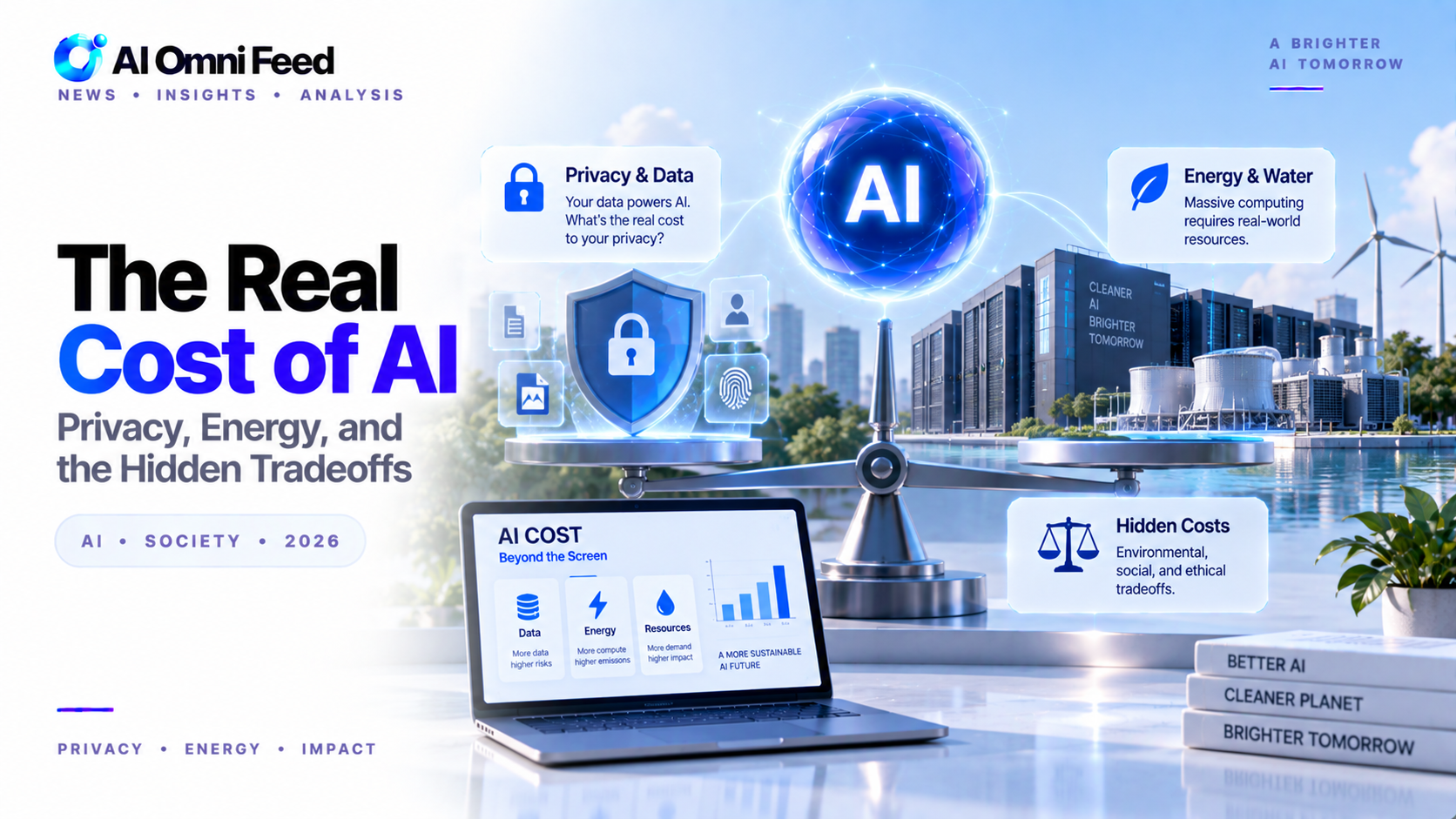
Quick Answer: The Real Cost of AI
Beyond subscription fees, AI has significant hidden costs: environmental impact from energy consumption, privacy risks from data collection, economic displacement of workers, bias amplification in decision-making, and the societal cost of disinformation. A single GPT-5 training run consumes approximately 50 GWh of energy. Data collection for AI training raises privacy concerns across every industry. Understanding these tradeoffs is essential for responsible AI adoption.
Key Takeaways
- AI data centers are projected to consume 8% of US electricity by 2027, up from 4% in 2025.
- Only 1 in 5 organizations has a mature governance model for autonomous AI agents.
- Deepfakes and AI-generated disinformation are rising faster than detection technologies.
The Real Cost of AI: Privacy, Energy, and the Hidden Tradeoffs
For every breakthrough AI product, there is a hidden cost. The conversation about AI is dominated by benefits. The tradeoffs deserve equal attention.
Energy Consumption
AI data centers already consume 4% of US electricity, projected to reach 8% by 2027. A single ChatGPT query uses roughly 10x the energy of a Google search. NVIDIA’s $2.1 billion deal with IREN to unlock 5 gigawatts of infrastructure shows that AI availability is now a power-grid issue, not just a software problem.
Privacy and Data Rights
Every AI interaction generates training data. Questions about consent, data ownership, and privacy remain unresolved. The EU AI Act‘s transparency rules (effective December 2026) require clear labeling of AI-generated content, but enforcement mechanisms are still being defined.
Governance and Accountability
Deloitte’s 2026 AI report found that only 1 in 5 organizations has a mature governance model for AI agents. Grant Thornton found 78% lack confidence they could pass an AI governance audit. Most organizations are scaling AI they cannot explain, measure, or defend.
Disinformation and Deepfakes
AI-generated content is increasingly indistinguishable from real media. Documented AI incidents rose to 362 in 2025, up from 233 in 2024. Detection technology is improving but cannot keep pace with generation quality.
Balancing Innovation and Responsibility
These costs do not mean AI should not be built. They mean it should be built thoughtfully. Energy efficiency, privacy-by-design, governance frameworks, and transparency are not optional — they are the foundation of sustainable AI adoption.
Environmental Impact Beyond Energy
Energy consumption is only part of the environmental story. AI data centers require enormous amounts of water for cooling: a mid-sized data center can use 1-5 million gallons per day. The hardware manufacturing footprint of GPUs and AI accelerators involves rare earth minerals, complex supply chains, and significant carbon emissions. E-waste from rapidly deprecated AI hardware is a growing concern as GPU generations turn over every 2-3 years. Companies are investing in liquid cooling, renewable energy, and hardware recycling programs, but the environmental footprint of AI is substantial and growing.
Economic Displacement and Inequality
AI’s economic benefits are not distributed evenly. The majority of AI investment and value accrues to a small number of companies and regions. Workers in occupations with high automation potential face displacement risk without clear retraining pathways. The Stanford HAI AI Index 2026 notes that while AI is creating new jobs overall, the transition is painful for displaced workers. Policymakers are grappling with how to distribute AI’s economic benefits broadly through education, social safety nets, and antitrust enforcement.
Bias and Fairness in AI Systems
AI systems inherit and can amplify biases present in their training data. Studies consistently show that AI models perform worse for minority groups on tasks ranging from facial recognition to medical diagnosis to language understanding. Mitigation techniques like debiasing, diverse training data, and fairness constraints are improving but remain imperfect. The EU AI Act and emerging US regulations require bias testing for high-risk AI systems, but the technical challenge of ensuring fairness across all demographic groups is not fully solved.
What Consumers and Businesses Can Do
For consumers, awareness is the first step. Be deliberate about which AI services you use and understand their privacy policies. Use privacy-focused AI tools when handling sensitive information. Support companies that are transparent about their AI practices. For businesses, conduct AI ethics reviews before deployment, invest in governance frameworks, measure for bias regularly, and be transparent with customers about when and how AI is used. Responsible AI is not just an ethical choice but a competitive advantage as customers and regulators demand accountability.
The Path Forward: Sustainable AI
Sustainable AI balances innovation with responsibility. It means investing in energy-efficient hardware, training models on clean energy, designing privacy into products from the start, building governance frameworks alongside technology, and ensuring AI benefits are broadly distributed. The companies that take these considerations seriously will be better positioned for the regulatory environment of 2027 and beyond. The real cost of AI is manageable if we acknowledge it and invest in solutions, but ignoring the tradeoffs creates risks that compound over time.
Mental Health and Social Costs
The psychological impact of AI is an underappreciated cost. Job displacement anxiety affects workers across industries. The erosion of creative professions as AI generates art, writing, and music raises questions about the value of human creative work. AI-generated content flooding social media makes it harder to distinguish authentic human connection from algorithmic output. Social isolation may increase as AI companions replace human interaction. These costs are harder to quantify than energy consumption or privacy violations, but they affect millions of people and deserve consideration in the AI deployment calculus.
Regulatory Responses Worldwide
Governments are responding to AI risks with varying approaches. The EU AI Act takes a risk-based approach, classifying AI applications by potential harm and imposing corresponding requirements. The US is pursuing sector-specific regulation rather than comprehensive legislation, with the White House executive order on AI model review as a key initiative. China requires algorithmic transparency and content moderation. The UK and Japan are taking lighter-touch approaches designed to encourage innovation. This regulatory patchwork creates compliance challenges for global AI deployment but reflects genuine differences in societal values and risk tolerance.
Environmental Impact Beyond Energy
AI environmental costs extend beyond energy consumption. Training large AI models requires significant water for cooling data centers, with estimates suggesting GPT-5 training consumed 5-10 million liters of fresh water. The hardware manufacturing process involves rare earth minerals and produces e-waste as GPUs and TPUs have short useful lifespans due to rapid advancement cycles. Data center expansion is driving land use changes and straining local water resources in drought-prone regions. Some companies are addressing these impacts through renewable energy commitments, water-efficient cooling, and hardware recycling programs, but the industry overall has significant room for improvement.
The Economics of AI: Who Benefits and Who Pays
The economic benefits of AI are distributed unevenly. AI companies and their investors capture most of the value. Large enterprises with data and computing resources benefit more than small businesses. Knowledge workers in AI-adjacent fields see productivity gains while workers in automatable roles face displacement pressure. Developing countries risk falling further behind as AI advantages concentrate in already-advanced economies. This distributional challenge requires policy responses: investment in education and retraining, social safety nets for displaced workers, and mechanisms to share AI benefits more broadly across society.
Frequently Asked Questions
What are the hidden costs of AI?
The hidden costs include environmental impact from energy consumption, privacy risks from data collection, economic displacement of workers, amplification of bias, and societal costs of disinformation.
How much energy does AI consume?
A single GPT-5 training run consumes approximately 50 GWh. Inference (using AI) is more efficient but adds up at scale. Data centers for AI already consume 1-2% of global electricity.
Does AI threaten jobs?
AI will automate some jobs and transform many others. Historical precedent suggests net job creation in new categories, but the transition period will be disruptive for affected workers.
How does AI affect privacy?
AI systems require vast amounts of training data, often collected without explicit consent. This data can reveal sensitive information and be used for surveillance or profiling.
Can AI be biased?
Yes. AI systems reflect biases in their training data and can amplify existing societal inequalities in hiring, lending, criminal justice, and healthcare decisions.
What can I do about AI costs?
Choose transparent AI tools, verify AI outputs, advocate for regulation, and develop skills that complement rather than compete with AI capabilities.
