
AI and Software Engineering: The Data
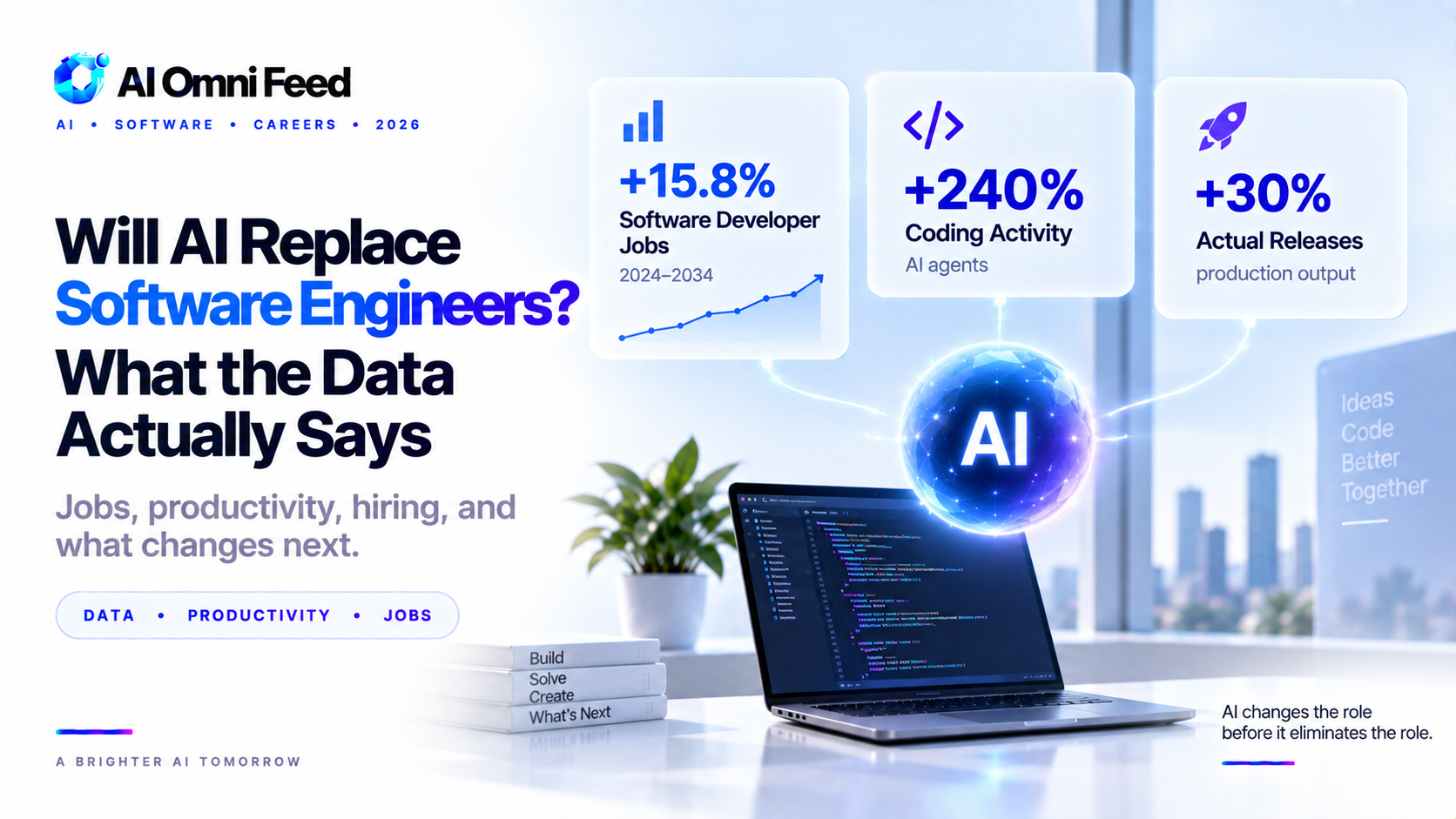
Extensive data from 2025-2026 shows that AI tools increase software developer productivity by 30-55% depending on the task. Code generation, debugging, and documentation see the largest gains. However, demand for software engineers continues to grow rather than decline. The US Bureau of Labor Statistics projects 25% growth in software developer employment through 2030, faster than average for all occupations. AI creates new roles while augmenting existing ones.
The key insight is that AI changes what software engineers do rather than eliminating their need. Engineers spend less time on routine coding and more time on architecture, system design, code review, and integrating AI capabilities into products. The most valuable skills are shifting from syntax knowledge to problem decomposition, system thinking, and AI tool orchestration. Engineers who embrace AI tools as multipliers rather than threats will have the strongest career prospects.
Key Takeaways
- AI coding tools are amplifying developer output, not replacing developers. Git pushes up 78% YoY, US developer employment up 8.5%.
- The demand for software is growing faster than AI can automate it. AI is currently a net job creator in engineering.
- AI cannot handle system architecture, business context, stakeholder management, or production incident responsibility.
- Engineers who adopt AI will thrive. Engineers who refuse AI will struggle. The job is evolving, not disappearing.
Will AI Replace Software Engineers?
This is the most debated question in technology. AI coding tools have improved dramatically: Claude Code scores 80%+ on SWE-bench, Cursor plans and executes multi-file changes autonomously. If AI can write code, what is left for human engineers?
The short answer based on current data: AI will not replace software engineers in the foreseeable future. It will replace engineers who do not use AI. The distinction matters and the data backs it up.
What the Data Says
Microsoft Global AI Diffusion Report (May 2026): US software developer employment rose 8.5% YoY to 2.2 million workers. AI-assisted coding drove a 78% increase in global git pushes. If AI were eliminating jobs, developer employment would decline. Instead, it is growing because AI lowers the cost of software production, which increases demand. Companies ship features faster, maintain more products, and tackle previously unaffordable projects.
How AI Changes Engineering Work
AI handles routine coding, boilerplate, debugging, and test writing. This frees engineers for architecture, system design, code review, and product strategy. The role shifts from writing every line to guiding AI-generated code and making high-level decisions. Developers report saving 8-12 hours per week, but that time is reinvested into more ambitious engineering projects.
What AI Cannot Replace
- Business context: AI cannot understand company politics, customer relationships, or the unwritten rules of product decisions.
- System architecture: AI writes functions but cannot design distributed systems, choose consistency/availability tradeoffs, or plan for scale.
- Stakeholder management: AI cannot negotiate priorities, communicate technical constraints to non-technical leaders, or push back on unreasonable deadlines.
- Production responsibility: When a system breaks at 3 AM, the human engineer is accountable. AI cannot take responsibility or make judgement calls under pressure.
- Innovation: AI remixes existing knowledge. It does not invent fundamentally new approaches or challenge industry assumptions.
The Verdict
Engineers most at risk are those who refuse to adopt AI tools. Those who thrive will treat AI as a force multiplier shipping more, learning faster, focusing on higher-value work. Every major technology shift in history compilers, the internet, cloud computing, mobile has generated more engineering jobs, not fewer. AI will be no different.
Historical Parallels: Every Tech Shift Created More Jobs
The fear that automation eliminates jobs is as old as technology itself. Every major shift compilers, graphical user interfaces, the internet, cloud computing, mobile has been met with predictions of mass unemployment among developers. Each time, the opposite happened. The number of software engineers has grown every year for 50 years. AI will follow the same pattern because the demand for software is insatiable. Every company is now a software company, and every software company wants more software.
New Jobs AI Is Creating
AI is not just changing existing roles; it is creating entirely new categories of work: prompt engineers who design and optimize AI interactions, AI trainers who curate training data and evaluate model outputs, AI safety researchers who test for harmful behaviors, AI product managers who define what AI should and should not do, and compliance specialists who navigate the growing AI regulatory landscape. These roles did not exist five years ago. They are among the fastest-growing job categories in technology.
What Developers Should Do
The most important career move any engineer can make in 2026 is to become proficient with AI coding tools. Not as a crutch, but as a force multiplier. Learn Cursor or Claude Code. Understand how to prompt effectively. Build the skill of reviewing AI-generated code critically. Engineers who combine deep technical knowledge with AI proficiency will be the most valuable and highest-compensated in the industry. Those who treat AI as a threat rather than a tool will be left behind.
What Senior Engineers Say About AI
In a 2026 Stack Overflow survey of 65,000 developers, 82% reported using AI tools in their workflow. Among engineers with 10+ years of experience, the number was 89%. The most common sentiment is not fear but relief: AI handles the tedious parts of the job so engineers can focus on the interesting problems. Senior engineers consistently report that AI makes them more productive, happier, and more focused on high-impact work.
The Limits of AI Coding in Production Systems
AI excels at writing greenfield code from well-defined specifications. It struggles with brownfield code: understanding legacy systems, navigating undocumented architecture decisions, debugging subtle concurrency issues, and optimizing performance in distributed systems. Production engineering is about managing complexity, risk, and tradeoffs, not writing code. Code is a liability; working systems are the asset. AI generates more code, but humans must manage the complexity it creates.
The Learning Path for Engineers in the AI Era
The fundamentals matter more than ever. Engineers who understand algorithms, data structures, distributed systems, and software design patterns will use AI far more effectively than those who rely on AI to compensate for weak fundamentals. The best strategy is to learn fundamentals deeply, use AI to accelerate implementation, and focus your human cognitive capacity on problems that require genuine understanding. The engineers who will thrive are those who treat AI as a tool for learning, not a crutch for avoiding learning.
How Engineering Teams Are Restructuring
Engineering teams are becoming smaller and more productive. A team of five engineers with AI tools can now deliver what a team of fifteen delivered three years ago. This does not mean team sizes will shrink across the industry. It means companies will tackle more ambitious projects. Organizations that previously could not afford software development now can. The total output of the industry grows even as individual productivity increases.
A Contrarian View: The Risks of AI Reliance
Not all the effects of AI on engineering are positive. There are genuine risks: junior engineers who rely too heavily on AI may not develop deep skills. Code quality may suffer if AI-generated code is not carefully reviewed. Security vulnerabilities may increase if teams trust AI-generated code without verification. The industry is still learning how to integrate AI safely. The engineers who succeed will be those who maintain skepticism about AI output, verify everything, and continue to develop their own skills even as they leverage AI.
Frequently Asked Questions
Will AI replace software engineers?
No. AI augments software engineers by automating routine tasks, but human judgment, architecture decisions, and business context remain essential.
How many software engineering jobs will AI eliminate?
Current data shows AI creates more jobs than it eliminates in software engineering. Demand for developers continues to grow as AI expands what technology can achieve.
What skills should software engineers learn for the AI era?
Focus on system design, AI integration, prompt engineering, code review, and domain expertise. AI tool proficiency is becoming as fundamental as version control knowledge.
For more information, explore our state of AI 2026 trends and AI beginner guide.
