Quick Answer: How to Build AI Agents in 2026
Building AI agents in 2026 is more accessible than ever thanks to mature SDKs from OpenAI, Anthropic, Google, and open-source frameworks. The key components are a language model backbone, tool-calling capabilities, memory systems, and safety guardrails. MCP (Model Context Protocol) and A2A (Agent-to-Agent) protocols enable agents to interact with tools and each other. Beginners can build a functional research agent in under an hour using available SDKs.
Key Takeaways
- Three major agent SDKs launched in 2026: OpenAI Agents SDK (March), Google ADK (April), and Anthropic Agent SDK (May).
- MCP (Model Context Protocol) is the standard for connecting agents to tools; A2A handles agent-to-agent communication.
- Beginners should start with OpenAI Agents SDK for the easiest onboarding curve.
What Is an AI Agent?
An AI agent is a system that uses a large language model to reason, make decisions, and execute actions autonomously. Unlike a standard chatbot, an agent can plan multi-step tasks, call external tools, browse the web, run code, and iterate until it completes a goal.
What Agent SDKs Are Available in 2026?
Three major vendors released dedicated agent SDKs in 2026:
- OpenAI Agents SDK (March): Best for beginners. Tight GPT-5 integration, built-in tool use.
- Google ADK (April): Best for multimodal agents. Native Gemini 3.5, 2M token context.
- Anthropic Agent SDK (May): Best for enterprise workflows. Multi-agent orchestration, MCP-native.
How Do MCP and A2A Work?
MCP (Model Context Protocol) is the standard for connecting agents to external tools, databases, and APIs. A2A (Agent-to-Agent) handles communication between multiple agents in the same workflow, enabling a research agent to delegate to a coding agent automatically.
Step-by-Step: Building a Simple Research Agent
- Choose your SDK. OpenAI Agents SDK has the gentlest learning curve.
- Define your agent’s goal: “Research a topic and return a structured summary.”
- Configure tools: web search API, content fetcher, and output formatter.
- Set boundaries: token limits, max iterations, approved domains.
- Test with a real query and refine the instructions.
Which SDK Should You Pick?
Start with OpenAI Agents SDK if you are new to agents. Switch to Anthropic SDK for complex enterprise workflows. Choose Google ADK if your agent needs to process video, images, or very large documents natively.
Core Concepts Every Agent Developer Should Know
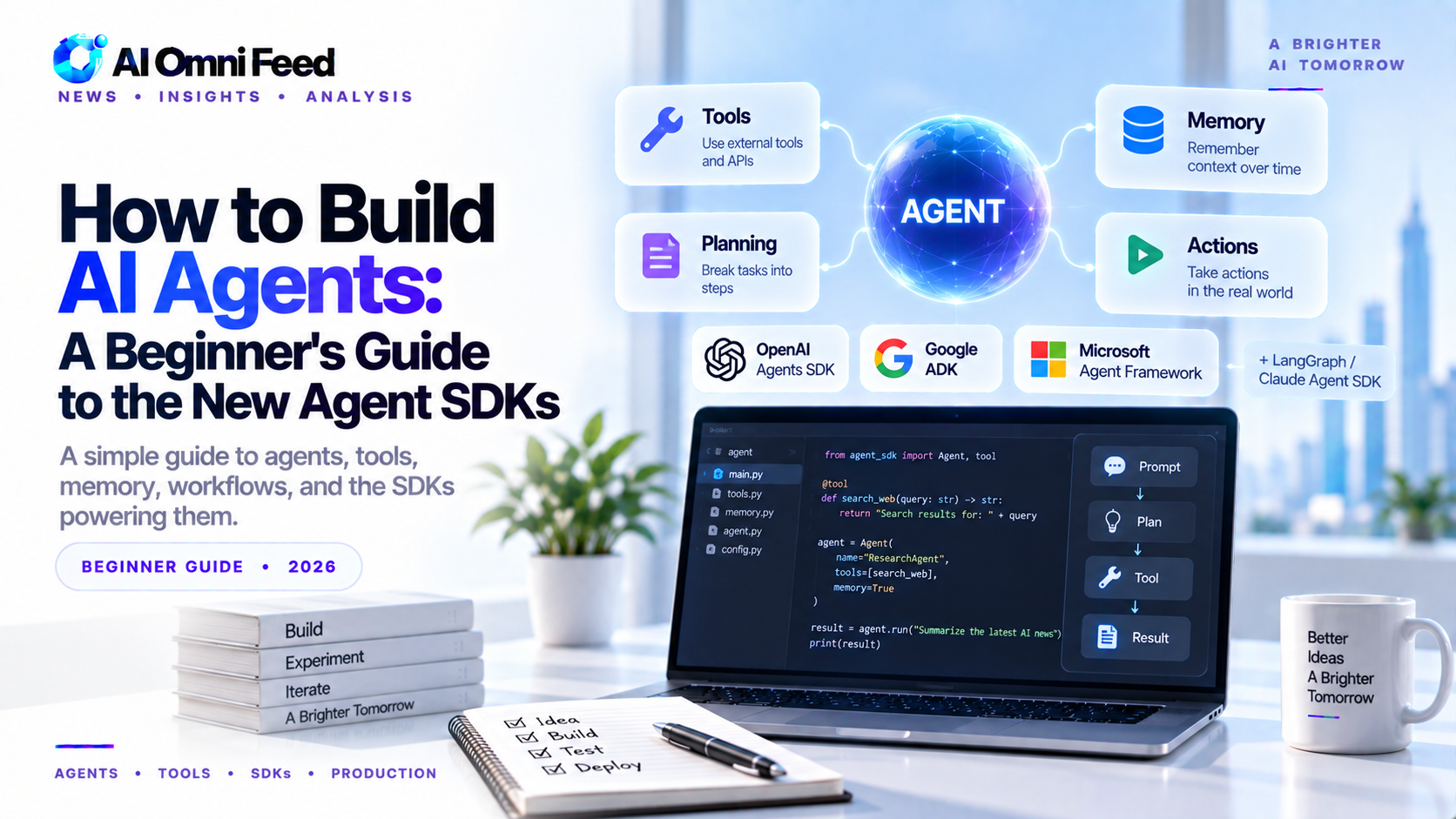
Before diving into SDK specifics, understanding a few core concepts helps. An agent follows a loop: receive a task, reason about it, decide on an action, execute the action, observe the result, and reason again. Tools are external functions the agent can call, like web search or database queries. Guardrails define constraints budget limits, approved actions, safety checks. Memory lets the agent retain context across interactions. Orchestration coordinates multiple agents working on different parts of a complex task. These concepts are consistent across all major SDKs, even though implementation details vary.
Detailed SDK Comparison
The OpenAI Agents SDK is built around a simple concept: define an agent with instructions and tools, then run it. It handles tool execution, error recovery, and context management automatically. The Google ADK is more complex but more powerful, supporting multimodal inputs, 2M token context windows, and native Google Search grounding. The Anthropic Agent SDK is optimized for enterprise workflows with built-in MCP support, multi-agent orchestration, and comprehensive logging. For most beginners, the OpenAI Agents SDK provides the fastest path from zero to a working agent. Start there, then graduate to Anthropic’s SDK for production workloads or Google’s ADK for multimodal applications.
Common Pitfalls and How to Avoid Them
New agent developers commonly make several mistakes. Overly broad instructions lead to agents going off-task. Always constrain the agent’s scope with clear, specific objectives. Insufficient error handling means agents fail silently. Implement proper error logging and retry logic. No budget limits allow runaway costs. Always set maximum iterations, token limits, and API call budgets. Lack of testing with real inputs leads to production failures. Test your agent with diverse inputs that reflect actual usage patterns. Poor tool design results in agents misusing tools. Design each tool with clear descriptions, required parameters, and expected output formats.
From Prototype to Production
Moving an agent from prototype to production requires several additional considerations. Add monitoring and logging to track agent behavior and performance. Implement authentication and authorization for tool access. Set up alerting for agent failures or anomalous behavior. Design a human-in-the-loop approval process for high-stakes actions. Plan for scaling: your agent may need to handle multiple concurrent requests. Consider whether your agent needs to maintain state across sessions and how that state is persisted and secured. The transition from prototype to production is where most agent projects fail, so invest in infrastructure early.
Building Agents Responsibly
As you build agents, consider the ethical and safety implications from the start. Set clear boundaries on what your agent can and cannot do. Implement human approval for any action that costs money, modifies data, or communicates externally. Monitor agent behavior for unexpected patterns. Design your agent to explain its reasoning and refuse requests that fall outside its intended scope. Responsible agent development is not just about avoiding harm it builds user trust and makes your agents more reliable and useful in the long run.
AI Agent SDKs Comparison Table
| SDK | Provider | Best For | Language | Key Feature |
|---|---|---|---|---|
| Agents SDK | OpenAI | GPT-powered agents | Python | Deep GPT integration |
| Claude Agent | Anthropic | Safe, reliable agents | Python, TypeScript | Constitutional AI |
| ADK | Gemini agents | Python | Multimodal agents | |
| CrewAI | Open source | Multi-agent systems | Python | Role-based agents |
| LangGraph | Open source | Custom agent workflows | Python | Graph-based control |
Core Concepts Every Agent Developer Should Know
Before building AI agents, understand these core concepts. Tool calling is how agents interact with external systems each tool has a name, description, and parameters that the agent learns to invoke. Memory systems let agents maintain context across conversations, with short-term memory (conversation history) and long-term memory (persistent knowledge storage). Safety guardrails prevent agents from taking harmful actions, including input validation, output filtering, and human-in-the-loop approval for high-risk actions. Planning and reasoning capabilities let agents break complex tasks into steps and adapt their approach based on intermediate results. Understanding these concepts is essential before choosing an SDK or framework.
Common Pitfalls and How to Avoid Them
Agent development has common pitfalls. Overly permissive tool access can lead to unsafe agent behavior always scope tool permissions to minimum necessary. Insufficient error handling causes agents to fail silently implement robust retry and fallback logic. Lack of human oversight for critical decisions creates risk use human-in-the-loop for high-stakes actions. Poor prompt engineering leads to unreliable agent behavior invest time in crafting clear, specific agent instructions. Neglecting monitoring means you cannot improve agent performance implement logging and analytics from day one. Following best practices from the start produces more reliable agents and faster development cycles. For more development resources, see our AI coding assistants guide.
Frequently Asked Questions
What is an AI agent?
An AI agent is a system that uses a language model to autonomously perform tasks, make decisions, and interact with tools and APIs based on goals and instructions.
What SDKs are available for building AI agents?
OpenAI Agents SDK, Anthropic Claude Agent, Google ADK, CrewAI, and LangGraph. Each offers different strengths for different use cases.
What are MCP and A2A protocols?
MCP (Model Context Protocol) lets agents connect to external tools and data sources. A2A (Agent-to-Agent) enables agents to communicate and delegate tasks to each other.
Do I need to be a programmer to build AI agents?
Basic programming knowledge helps, but no-code agent builders are emerging. Most SDKs require Python or TypeScript proficiency.
For more AI development resources, see our AI coding assistants guide and task automation guide.
